
Staff augmentation is the practice of contracting external specialists who work under the direct management and governance of the client’s internal team — not a managed service provider’s delivery lead. The augmented worker executes against the client’s architecture decisions, sprint plans, and quality gates. The client retains IP ownership, system access controls, and delivery accountability. This distinction is codified in Master Services Agreements across Australian enterprise procurement because it determines who bears regulatory liability, who owns the code, and who controls the data.
Australia’s domestic ICT talent pipeline has not kept pace with the scale of digital transformation programmes now running simultaneously across financial services, retail, government, and healthcare. Federal and state governments have published explicit ICT workforce strategies acknowledging this structural shortfall — not as a cyclical dip, but as a multi-year supply constraint tied to graduate pipeline lag and vocational pathway gaps.
Technology roles remain among the most persistently unfilled categories, with vacancy rates elevated well above pre-2020 baselines. Technology occupations are among the fastest-growing demand categories — while supply pipelines lag by multiple years.
Simultaneously, the Australian Government’s Digital Economy Strategy and the APS Digital Profession framework are pulling skilled technologists into public-sector roles, compressing the private-sector talent pool further. State-level programmes — the NSW Digital Government Strategy and the Victorian Government Digital Strategy — add additional demand pressure that competes directly with enterprise hiring.
The result: Australian IT leaders running 18–36-month transformation programmes cannot staff them domestically at the pace the business requires. Staff augmentation is not a preference. For most programmes, it is the only executable path.
The Compliance Architecture Australian IT Leaders Must Build
This is where most augmentation arrangements either succeed or collapse. Australian enterprises operating in regulated sectors face a compliance stack that is non-trivial to navigate — and that the augmentation vendor must be able to support, not just acknowledge.
Privacy Act 1988 and Australian Privacy Principles (APP 8)
When augmented staff are located offshore, the Australian Privacy Principles — specifically APP 8 — require the Australian enterprise to take reasonable steps to ensure the overseas recipient does not breach the APPs in relation to personal information. This is not a disclosure obligation; it is an accountability obligation. The enterprise remains liable.
Practically, this means:
- Data Processing Agreements (DPAs) with the augmentation vendor that mirror APP obligations
- Contractual audit rights allowing the Australian enterprise to verify compliance
- Data residency controls specifying where personal information can be stored and processed
- Incident response protocols that integrate with the enterprise’s own breach response procedures
Notifiable Data Breaches (NDB) Scheme
Under the NDB scheme, Australian enterprises bear notification liability for breaches caused by offshore augmented staff. A breach originating from an augmented engineer’s compromised credentials or misconfigured access is the Australian enterprise’s notification obligation — not the vendor’s. This creates a direct incentive to mandate rigorous data handling SOPs, role-based access controls, and audit logging as contractual deliverables, not informal expectations.
Essential Eight Maturity Model
The ASD/ACSC Essential Eight is the baseline cybersecurity framework for Australian organisations. Augmented offshore staff who handle Australian enterprise data must demonstrably align with Essential Eight controls — particularly application control, patching cadence, multi-factor authentication, and privileged access management. Vendors who can provide pre-mapped compliance documentation against the Essential Eight maturity levels reduce the enterprise’s vendor onboarding burden materially.
APRA CPS 234 and CPS 230 (For Regulated Entities)
Australian enterprises operating under APRA regulation — banks, insurers, superannuation funds — face two additional prudential standards directly relevant to augmentation.
CPS 234 requires APRA-regulated entities to maintain information security capability commensurate with threats, including those arising from third-party arrangements. Augmented staff are third-party arrangements. The regulated entity must assess and document the information security capability of the augmentation vendor, not just the individual contractors.
CPS 230, effective 1 July 2025, extends this to operational resilience — requiring regulated entities to manage operational risks from service providers with explicit risk tolerance statements, material service provider registers, and exit planning. An augmentation arrangement covering a critical transformation workstream will likely qualify as a material service provider relationship under CPS 230, triggering the full third-party risk management framework.
APRA-regulated enterprises that have not mapped their augmentation arrangements against CPS 230 before July 2025 are running a compliance gap that their prudential supervisor will identify.
Security Clearance Constraints: The Public Sector Boundary
Australian Government security clearance requirements — baseline, NV1, NV2 — restrict offshore augmented staff from certain public-sector workstreams. This is not a vendor quality issue; it is a structural constraint of the Australian Government’s personnel security framework.
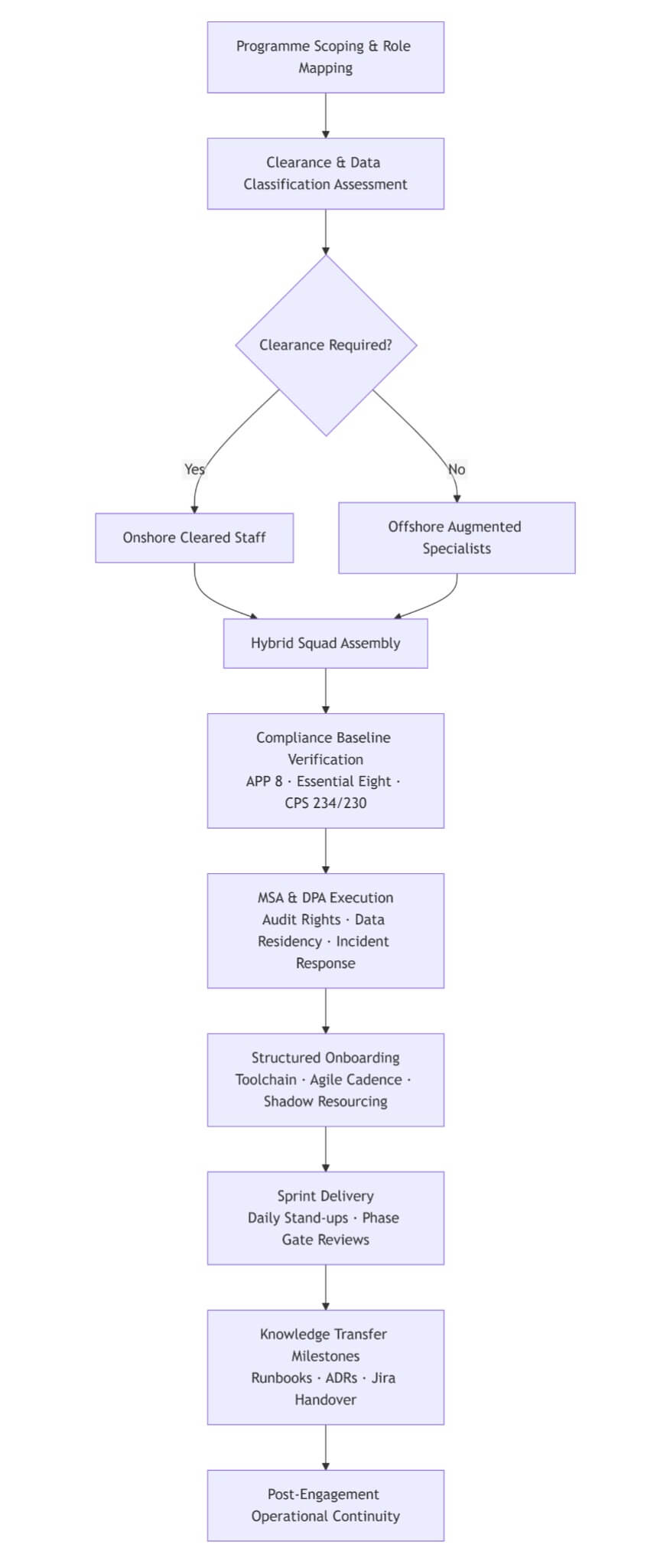
The practical implication for vendors serving both public and private Australian clients: role scoping and clearance mapping must be completed as a pre-engagement step, not discovered mid-programme. Workstreams involving classified data, critical infrastructure systems, or ASD-designated sensitive environments are categorically unavailable to offshore augmented staff without the relevant clearance — which offshore staff cannot hold.
This creates a hybrid delivery model in practice: onshore cleared staff handle the clearance-required workstreams; offshore augmented staff handle the adjacent technical workstreams that do not require clearance. The architecture of this split must be designed at programme inception, not retrofitted when a clearance issue surfaces.

How It Works
The six workstreams where augmented offshore specialists are most frequently deployed — and where the productivity case is strongest — cluster around the following areas:
| Workstream | Typical Augmented Roles | Primary Delivery Risk Without Augmentation |
| Cloud migration (AWS, Azure, GCP) | Cloud architects, DevOps engineers, FinOps analysts | Programme timeline slippage due to internal skill gaps |
| ERP modernisation (SAP S/4HANA, Oracle Fusion) | Functional consultants, integration developers, data migration leads | Cost overrun from extended vendor-led delivery |
| Data engineering & analytics platforms | Data engineers, BI developers, ML pipeline specialists | Delayed insight delivery; analytics debt accumulation |
| DevSecOps pipeline implementation | Security engineers, CI/CD specialists, SREs | Security posture gaps; failed Essential Eight alignment |
| Legacy application re-platforming | .NET/Java modernisation engineers, API developers | Technical debt compounding; system fragility |
| Cybersecurity uplift programmes | SOC analysts, penetration testers, GRC specialists | Regulatory non-compliance; breach exposure |
Each workstream requires specialists with narrow, deep expertise that Australian enterprises cannot hire fast enough domestically, and cannot afford to leave vacant while transformation timelines run.
Staff Augmentation Delivery Flow for Australian Enterprise Digital Transformation
The Knowledge Transfer Imperative
Knowledge transfer is the most undercontracted element of augmentation arrangements and the most consequential for long-term programme outcomes. Augmented specialists who deliver excellent technical output during the engagement but leave no transferable documentation create a structural dependency that the enterprise cannot resolve without re-engaging the same vendor.
Australian IT leaders are addressing this through contractual architecture:
- Runbook requirements as phase-gate deliverables, not end-of-engagement obligations
- Architecture Decision Records (ADRs) maintained in the enterprise’s Confluence instance throughout delivery, not compiled retrospectively
- Jira handover standards that ensure sprint history, backlog rationale, and technical debt registers are legible to internal staff post-engagement
- Shadow resourcing requirements mandating that internal staff are paired with augmented specialists during critical workstreams, not just at handover
Enterprises that treat knowledge transfer as a contractual deliverable — with milestone-linked payment terms tying each phase-gate payment to the submission of documented runbooks and handover artefacts — tend to achieve better post-engagement operational continuity than those that treat it as a professional courtesy.

Key Benefits
Compressed Time-to-Productivity
Pre-vetted specialists with demonstrated certifications — AWS Certified Solutions Architect, Azure certifications, CISSP, ITIL 4 — can contribute to sprint delivery within days of onboarding, not weeks. This is the primary KPI Australian IT leaders cite for distinguishing vendor tiers.
Headcount Elasticity Without Redundancy Exposure
The headline appeal of staff augmentation for Australian IT leaders is headcount flexibility without the redundancy exposure that applies to direct employees under the Fair Work Act 2009. Augmented staff on time-and-materials contracts can be ramped up during build sprints and scaled back during stabilisation phases without triggering the redundancy provisions that apply to permanent employees. A transformation programme that needs 8 cloud engineers during migration and 3 during hypercare can flex without the fixed cost of 8 permanent headcount.
Compliance Pre-Loading
Vendors who arrive with Essential Eight documentation, DPA templates, and CPS 234 assessment frameworks reduce the enterprise’s compliance setup time materially. This is not an administrative convenience — it is a programme risk control.
Agile Integration Without Structural Disruption
Augmented staff with demonstrated SAFe or Scrum fluency integrate into existing delivery cadences without requiring the enterprise to restructure its operating model. Structured daily stand-ups, shared Jira boards, and defined escalation paths to internal engineering leads create the integration architecture.
Genuine Same-Day Collaboration
Philippine Standard Time overlaps heavily with Australian business hours — narrowing to just 1–3 hours’ difference — enabling real-time stand-ups and incident escalations rather than the asynchronous handoffs typical of European or North American nearshore arrangements. (See Philippines Relevance below for the full time-zone breakdown.)
Costs & Pricing
Time-and-Materials Structure
The standard commercial model for Australian enterprise augmentation is time-and-materials, with rates set per role, seniority band, and certification level. This structure aligns cost directly with delivery output and allows the enterprise to flex headcount across programme phases without fixed-cost exposure.
Headcount Flexibility Across Programme Phases
A transformation programme that requires 8 cloud engineers during active migration and 3 during hypercare stabilisation can scale without carrying the fixed cost of peak headcount across the full programme duration. This elasticity is the primary commercial differentiator from permanent hiring.
Currency Exposure: An Underappreciated Budget Risk
Currency exposure is an underappreciated budget risk in multi-year programmes. Australian enterprises paying offshore augmented staff in USD or PHP must account for AUD/USD and AUD/PHP exchange rate volatility across a 24–36 month programme budget. A programme scoped at a given AUD cost in year one can face meaningful budget pressure if the AUD weakens materially against the USD during delivery. Fixed-rate or hedged commercial structures, with AUD/USD/PHP exposure disclosed upfront, are now standard terms in mature augmentation contracts.
Tenure Instability Costs
Commodity augmentation arrangements — what Australian enterprise RFPs now distinguish as “body shopping” — create compounding onboarding costs. Each replacement requires re-vetting, re-onboarding, and a productivity trough that erodes the speed-to-value proposition. Tenure guarantees and replacement SLAs with defined response windows (illustratively, 10–15 business days for pre-vetted replacements) are now standard commercial terms in mature augmentation contracts.
Replacement SLA Structure
Replacement SLAs should define the trigger condition, response window, and who bears the ramp-up cost — see the FAQ below for the full structure and a key gap to watch for around replacement vetting standards.
Cost Arbitrage in Context
Cost remains a factor, but it isn’t the deciding one for compliance-sensitive programmes — vendors are increasingly selected on compliance readiness and tenure stability over day rate. (See “The Selection Criterion That Matters” in Philippines Relevance for the full picture.)
Global Case Studies
Anonymized composite case studies based on engagement patterns observed across Australian enterprise clients. No real named firms, financials, or incidents are represented.
Composite: Financial Services Core Banking Migration
A mid-market Australian financial services firm — operating in the $50–150M revenue band, sub-APRA threshold — was undertaking a core banking platform migration. Internal estimates placed the programme at 24 months with a fully domestic team. The domestic team did not exist; the firm could not hire the required cloud engineers and data architects within a 6-month window at any realistic salary band.
The firm engaged an offshore augmentation vendor providing 6 cloud engineers and 2 data architects, all Philippines-based. The critical differentiator at vendor selection: the vendor arrived with pre-mapped CPS 234 compliance documentation — not because the firm was APRA-regulated, but because the firm’s banking partners required equivalent information security standards as a condition of API integration.
The programme delivered in 14 months. The enabling factors were not primarily cost arbitrage. They were: pre-vetted technical depth (all engineers held current AWS certifications), time zone alignment enabling daily stand-ups without schedule distortion, and contractual knowledge transfer milestones that produced documented runbooks at each phase gate.
The friction points were real. Two engineers required replacement in month four due to tenure instability at the vendor level — a gap the replacement SLA covered within 3 weeks, but which created a sprint-level productivity dip. Currency exposure on the USD-denominated contract required a budget contingency that the CFO had not initially provisioned.
The net outcome: a programme delivered 10 months ahead of the domestic-only estimate, with full knowledge transfer artefacts and no APP 8 compliance incidents.
Composite: ASX-Listed Retail E-Commerce Re-Platforming
An ASX-listed retail group’s IT leadership team faced a peak-season deadline for an e-commerce re-platforming sprint. Internal DevOps capacity was fully committed to BAU operations. The window to hire permanent DevOps engineers domestically was 3–5 months — longer than the sprint timeline.
Four offshore DevOps engineers were augmented into the internal squad on a time-and-materials basis. Structured daily stand-ups, shared Jira boards, and a defined escalation path to the internal engineering lead created the integration architecture. The sprint delivered on schedule.
The compliance consideration that shaped vendor selection: the retail group’s customer data — including payment card data and loyalty programme records — was subject to APP obligations. The vendor’s DPA was reviewed by the group’s privacy counsel before contract execution. Role-based access controls were scoped to limit augmented staff access to production customer data to the minimum required for the re-platforming workstream.
The floor case: one engineer’s Agile fluency was overstated in the vendor’s pre-engagement assessment. The internal lead absorbed additional coordination overhead in sprint one before the issue was escalated and the engineer was replaced. The replacement SLA — 10 business days — was met, but the sprint-one overhead was real.
Philippines Relevance & Local Examples
The offshore augmentation conversation in Australia frequently defaults to a generic “offshore = cheaper” framing. That framing misses the operational specifics that make the Philippines the dominant delivery geography for Australian enterprise augmentation.
Time Zone Alignment as the Primary Operational Differentiator
Philippine Standard Time (PST) sits 1–3 hours behind Australian Eastern Standard Time (AEST), narrowing further during Australian summer. This creates genuine same-day collaboration windows — not the asynchronous handoff model that characterises European or North American nearshore arrangements. Daily stand-ups, sprint reviews, and incident escalations can run in real time without either party working outside business hours.
English-Language Fluency and Communication Calibration
English-language fluency and communication calibration reduce the documentation overhead that typically inflates offshore coordination costs. Augmented Philippine engineers embedded in Australian Agile squads — running SAFe, Scrum, or Kanban — integrate with materially less friction than teams operating across larger language or cultural gaps.
A Maturing Technology Talent Pool
The Philippines’ IT-BPM sector has been deliberately moving up the value chain from transactional BPO into knowledge services and technology delivery. The talent pool for cloud, data, and DevSecOps roles is materially deeper than it was five years ago, with ICT sector employment tracking this strategic shift. Philippine augmented engineers embedded in Australian squads increasingly hold current certifications — AWS, Azure, CISSP — and demonstrated sprint delivery histories that are reference-checkable.
NPC Compliance Infrastructure
Philippine augmentation vendors operating at the enterprise tier have invested in National Privacy Commission (NPC)-mandated Data Processing Agreement frameworks. This compliance infrastructure — pre-mapped against both Philippine data privacy obligations and Australian APP requirements — reduces the DPA negotiation overhead for Australian enterprise clients and provides a documented accountability chain that satisfies APP 8’s reasonable steps requirement.
The Selection Criterion That Matters
Cost arbitrage remains real but is not the primary selection criterion for Australian enterprise IT leaders running compliance-sensitive programmes. The selection criterion is: can this team pass our security and compliance vetting, integrate into our delivery model, and hold tenure long enough to transfer knowledge? Philippine augmentation vendors who have invested in compliance infrastructure — pre-mapped Essential Eight documentation, NPC-mandated Data Processing Agreements, structured onboarding — win the enterprise mandates. Those who compete purely on day rate do not.
Comparison Table
| Criterion | Body Shopping (Low-Vetting) | Genuine Augmentation (High-Vetting) |
| Technical vetting | CV review; self-reported skills | Structured technical assessments; certification verification |
| Compliance readiness | Acknowledges requirements | Pre-mapped Essential Eight documentation; DPA templates |
| Tenure commitment | No guarantee | Tenure guarantees; replacement SLAs (typically 10–15 business days) |
| Knowledge transfer | Informal | Contractual milestones; Confluence/Jira handover standards |
| Agile fluency | Certification claimed | Demonstrated sprint delivery history; reference-checkable |
| Cultural alignment | Not assessed | Structured onboarding; Australian enterprise communication calibration |
| Currency model | Variable | Fixed-rate or hedged; AUD/USD/PHP exposure disclosed |
| Time-to-productivity | Weeks of ramp-up | Days — pre-vetted specialists contribute from sprint one |
| Clearance mapping | Discovered mid-programme | Completed as pre-engagement step |
| Knowledge transfer artefacts | End-of-engagement, if at all | Phase-gate deliverables with milestone-linked payment terms |
Conclusion & Actionable Takeaway
Australia’s digital transformation programmes are running against a structural talent constraint that domestic hiring cannot resolve within the timelines the business requires. Staff augmentation — specifically, the curated, embedded, long-tenure model that is legally and operationally distinct from managed services or body shopping — is the mechanism that allows IT leaders to execute on schedule without compromising governance, IP ownership, or regulatory compliance.
The enterprises that execute this well share three characteristics: they build the compliance architecture (APP 8, NDB, Essential Eight, CPS 234/230 where applicable) before the first augmented engineer logs in; they contract for knowledge transfer as a deliverable, not an expectation; and they select vendors on time-to-productivity and tenure stability, not day rate.
The enterprises that struggle treat augmentation as a procurement exercise rather than a delivery architecture decision. The vendor selection criteria, the MSA structure, the knowledge transfer protocols, and the compliance mapping are not administrative overhead. They are the programme.
For Australian IT leaders evaluating augmentation for an active transformation programme, the starting point is not a vendor shortlist. It is a role-scoping exercise that maps each workstream against clearance requirements, data classification, and compliance obligations — then identifies which roles can be filled offshore, which require onshore, and what the vendor compliance baseline must be before contract execution.
That scoping exercise, done rigorously, is what separates a 14-month delivery from a 24-month estimate.
FAQs
Can offshore augmented staff access Australian customer personal information under APP 8 without breaching the Privacy Act?
Yes — but only with contractual accountability mechanisms in place before access is granted. APP 8 does not prohibit cross-border data transfers; it requires the Australian enterprise to take reasonable steps to ensure the overseas recipient does not breach the APPs. In practice, this means a Data Processing Agreement that mirrors APP obligations, contractual audit rights, role-based access controls scoped to the minimum data required for the workstream, and incident response protocols integrated with the enterprise’s own NDB procedures. The enterprise retains liability regardless of the vendor’s contractual commitments — which is why privacy counsel review of the DPA before contract execution is non-negotiable, not optional.
How does CPS 230 (effective July 2025) change the risk management obligations for APRA-regulated entities using staff augmentation?
CPS 230 requires APRA-regulated entities to identify material service providers, maintain a register of those arrangements, set explicit risk tolerance statements, and plan for exit scenarios. An augmentation arrangement covering a critical transformation workstream — core banking migration, data platform build, DevSecOps implementation — will likely qualify as a material service provider relationship under CPS 230’s criteria. This triggers formal third-party risk assessment obligations, not just the information security assessment required under CPS 234. Regulated entities that have not mapped their augmentation arrangements against CPS 230’s materiality thresholds before July 2025 are carrying a prudential compliance gap.
What Agile certifications or demonstrated experience should Australian IT leaders require from augmented staff before sprint integration?
Certification alone is an insufficient filter. Australian enterprise IT leaders running SAFe, Scrum, or Kanban programmes should require demonstrated sprint delivery history — reference-checkable engagements where the augmented specialist contributed to a defined sprint cadence, not just participated in a project that used Agile terminology. Specific indicators: familiarity with the enterprise’s toolchain (Jira, Confluence, Azure DevOps), ability to write and refine user stories to the team’s definition of ready, and experience with retrospective-driven process improvement. Vendors who can provide structured Agile fluency assessments as part of pre-engagement vetting — not just CV claims — materially reduce sprint-one integration friction.
How should Australian enterprises structure replacement SLAs in augmentation contracts to protect against tenure instability?
Replacement SLAs should specify three parameters: the trigger condition (resignation, performance-based removal, or role-scope change), the response window (typically 10–15 business days for a pre-vetted replacement, not a new search), and the productivity continuity obligation (the vendor bears the cost of the replacement’s onboarding ramp, not the enterprise). Contracts that define replacement SLAs without specifying the pre-vetting standard for replacements create a gap — the vendor can meet the SLA timeline by placing an unvetted contractor. The SLA should require the replacement to meet the same technical assessment standard as the original placement, with the enterprise retaining the right to reject a replacement that does not meet that standard within the SLA window.
Related Services & Next Steps
Australian IT leaders evaluating staff augmentation for active transformation programmes can explore KineticStaff’s compliance-ready offshore augmentation model — pre-mapped against Essential Eight, APP 8, and CPS 234 requirements — through the following resources:
- compliance and service structures guide — how KineticStaff structures DPAs, audit rights, and Essential Eight alignment for Australian enterprise clients
- offshore team pricing and engagement models — time-and-materials structures, tenure guarantees, and currency exposure management
- Philippines data compliance and onboarding checklist — the pre-engagement scoping process for role mapping, clearance assessment, and compliance baseline verification
- KineticStaff — full-service overview and engagement pathways