
AI-powered staffing platforms for tech hiring combine automated resume parsing, skills-ontology matching, and structured candidate ranking to compress multi-week manual recruitment pipelines into days — delivering total cost reductions of 35–60% in most engagements. When paired with offshore talent markets — particularly the Philippines’ established IT-BPM sector — these platforms allow SMBs to source pre-vetted technical professionals at structurally lower base salaries, with statutory employer-side obligations estimated at 12–15% above base under Philippine labor law. The net result is a cost-per-hire model that materially undercuts domestic contingency recruiting on both the acquisition and ongoing compensation dimensions.
For an SMB operating in the $2M–$20M revenue band, a single senior developer hire through a traditional contingency recruiter carries an agency fee estimated at 15–25% of first-year salary — before the candidate clears their first sprint. Stack that against a fully loaded US compensation package, and the total acquisition cost for one mid-level engineer can approach $40,000–$60,000 (illustrative) before they write a line of production code.
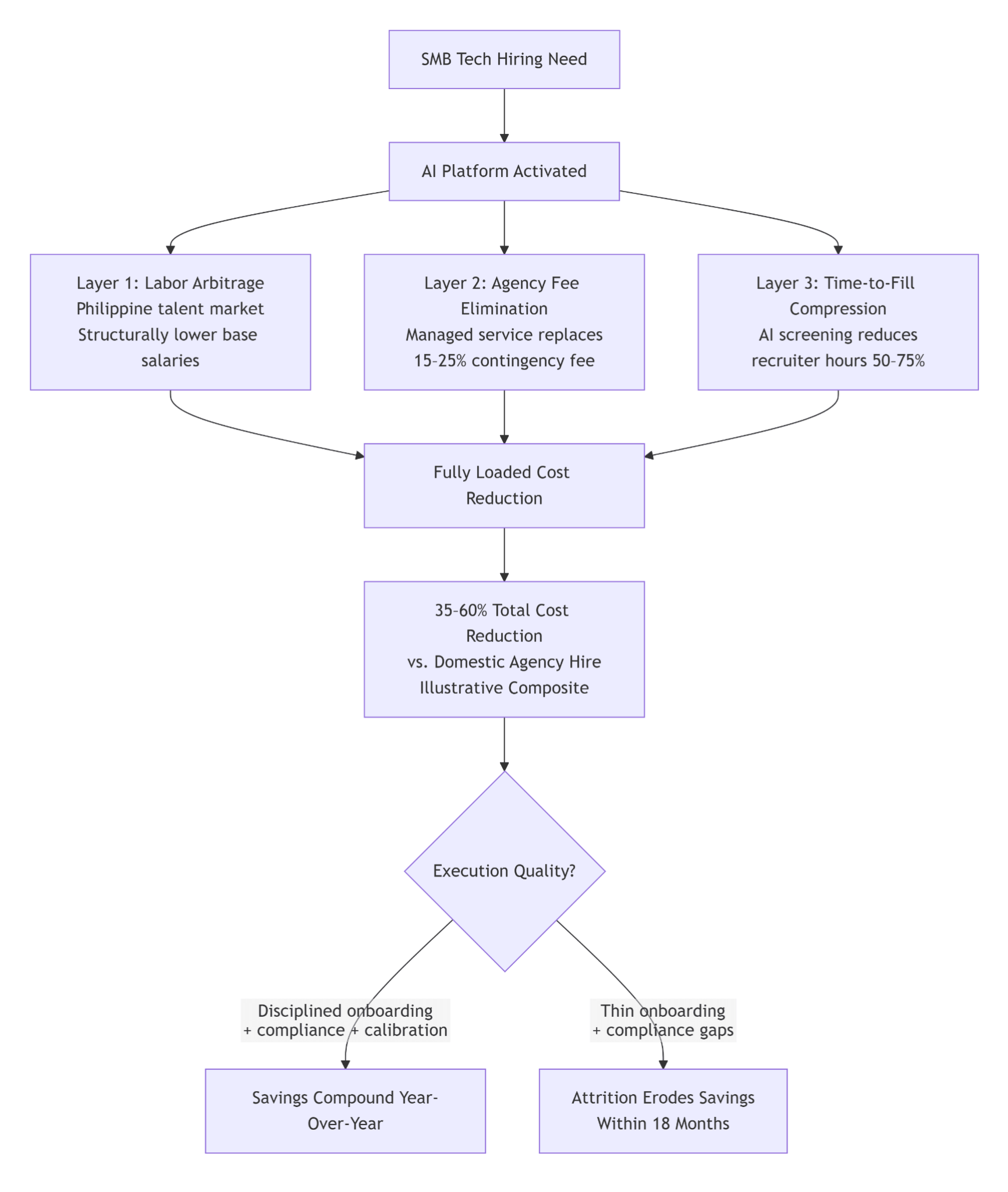
AI-assisted offshore staffing platforms attack that cost structure at three simultaneous pressure points: they eliminate the agency markup layer, compress time-to-fill through automated screening, and substitute purchasing-power-parity labor markets for roles where geographic proximity adds no technical value. The combined effect, in illustrative composite engagements, runs to 35–60% total cost reduction versus domestic agency-placed hires — though the floor of that range requires disciplined execution, and the ceiling is rarely achieved without structured onboarding.
This is not a staffing arbitrage play dressed in software. The AI layer is operationally load-bearing: without it, offshore hiring at SMB scale collapses under recruiter bandwidth constraints and mis-hire risk.

Why SMBs Are Structurally Disadvantaged in Tech Hiring
Enterprise firms absorb hiring costs across dedicated talent acquisition teams, internal ATS infrastructure, and volume-based recruiter relationships that compress per-hire fees. SMBs have none of that infrastructure. Every technical hire is effectively a bespoke transaction — and bespoke transactions in contingency recruiting are priced accordingly.
The math compounds quickly. A $130,000–$150,000 fully loaded mid-level developer hire through a contingency agency generates a placement fee of roughly $20,000–$37,500 (illustrative, at the 15–25% range). That fee is a sunk cost before onboarding begins. If the hire exits within 12 months — and first-year voluntary attrition for offshore tech staff without structured onboarding can run 30–45% in composite operator observations — the replacement cycle restarts at full cost.
For a company with $5M in annual revenue, two mis-hires in a fiscal year is not an HR problem. It is a P&L event.
Three structural gaps drive this exposure:
- No in-house sourcing capacity. Most SMBs in the sub-$20M band rely entirely on external recruiters or job boards, with no proprietary talent pipeline.
- No screening infrastructure. Senior engineers spend hours on first-round interviews that AI pre-screening could eliminate.
- No offshore operational playbook. The coordination overhead of distributed teams — historically real — has been materially reduced by cloud-based version control, async communication tooling, and project management platforms. But SMBs rarely have the institutional knowledge to deploy that infrastructure correctly on day one.
AI-powered staffing platforms address all three gaps simultaneously, which is why adoption among growth-stage SMBs has accelerated.

How It Works
The cost compression operates across three distinct layers, each independently valuable and compounding when combined.
Layer 1 — Labor Arbitrage (The Largest Lever)
Philippine offshore tech talent — developers, QA engineers, data analysts — commands base salaries that are structurally lower than US equivalents due to purchasing-power parity. The gap between US and Philippine prevailing pay rates for comparable technical competency tiers is the arbitrage. Employer-side statutory obligations in the Philippines — SSS, PhilHealth, Pag-IBIG contributions, plus mandatory 13th month pay — add an estimated 12–15% above base salary. Even with that load factored in, the fully loaded cost of a Philippine-based mid-level developer typically runs well below the US equivalent for comparable technical competency tiers.
The Philippines is a structurally differentiated market for English-language technical talent — not a thin-supply arbitrage play. The IT and Business Process Association of the Philippines (IBPAP) tracks sector headcount and revenue growth through its published roadmap, confirming the depth of this talent market.
Layer 2 — Agency Fee Elimination (The Fastest Win)
Traditional contingency recruiting fees of 15–25% of first-year salary represent pure acquisition overhead. AI-assisted offshore staffing platforms replace that fee structure with a managed service or subscription model that spreads cost across multiple hires and ongoing seat management.
For an SMB making three to five technical hires per year, eliminating agency fees alone can represent $60,000–$150,000 in annual savings (illustrative, based on $130K–$150K fully loaded US salaries at the 15–25% fee range). That figure does not require offshore labor arbitrage to be compelling — though the two levers compound when combined.
Layer 3 — Time-to-Fill Compression (The Hidden Cost Reducer)
Every week a technical role sits open carries a productivity cost. AI resume-parsing tools now incorporate skills ontologies and taxonomy matching — mapping “React.js” to broader front-end JavaScript framework competency clusters, for example — improving match quality beyond simple keyword search. AI-driven video interview analysis platforms can flag communication proficiency, technical vocabulary density, and response coherence at scale.
The operational result: recruiter screening hours per hire drop by an estimated 50–75% (illustrative) when AI pre-screening is deployed. Time-to-fill for technical roles compresses by an estimated 30–50% versus fully manual processes (illustrative). For an SMB where the hiring manager is also the engineering lead, that time recapture is not a soft benefit — it is recovered sprint capacity.
AI-Assisted Offshore Staffing — Three-Layer Cost Compression Model
Phase Risk: Where the Model Fails
The 35–60% cost reduction headline is achievable — it is not automatic. Four failure modes account for the majority of underperformance in composite operator observations:
- Failure Mode 1: Algorithm Confidence Without Human Calibration. AI matching tools surface candidates based on skills taxonomy and profile signals. They do not assess organizational fit, communication style under pressure, or the specific technical context of your codebase. SMBs that treat the AI shortlist as a hiring decision — rather than a screening input — see elevated early-tenure exits. Mitigation: Maintain a structured technical interview layer for all AI-shortlisted candidates.
- Failure Mode 2: Onboarding Neglect Post-Hire. The acquisition cost savings are visible immediately. The attrition cost is invisible until month 8. Offshore tech hires without structured 30/60/90-day frameworks, clear role expectations, and active career-pathing conversations exit at rates that can negate the entire cost advantage within 18 months. Mitigation: Treat onboarding as a capital investment, not an administrative task.
- Failure Mode 3: Compliance Gap at System Access. SMBs frequently provision offshore staff with broad system access before executing compliant Data Processing Agreements. This creates retroactive contractual exposure with enterprise clients and regulatory risk under RA 10173. Mitigation: DPA execution precedes system access. No exceptions.
- Failure Mode 4: Role Seniority Mismatch. AI platforms optimize for skills-profile match. They do not automatically flag when a role description is written for a senior engineer but the budget is calibrated for a mid-level hire. The resulting candidate pool is either over-qualified (and exits quickly for better compensation) or under-qualified (and underperforms against sprint expectations). Mitigation: Align job descriptions with realistic salary ranges for the target seniority tier before running AI matching.

Key Benefits
Elimination of Agency Markup
Replacing contingency recruiting fees of 15–25% of first-year salary with a managed service or subscription model removes the single largest acquisition overhead item. For SMBs making three to five technical hires per year, this lever alone can represent $60,000–$150,000 in annual savings (illustrative).
Structural Labor Cost Advantage
Philippine-based mid-level developers carry fully loaded costs well below US equivalents at comparable technical competency tiers, even after factoring in statutory employer obligations (SSS, PhilHealth, Pag-IBIG, 13th month) estimated at 12–15% above base. The arbitrage is not marginal — it is structural, rooted in purchasing-power parity.
Faster Time-to-Productivity
AI pre-screening compresses time-to-fill by an estimated 30–50% (illustrative) versus fully manual pipelines. For SMBs where the hiring manager doubles as the engineering lead, recovered screening hours translate directly into recovered sprint capacity — not a soft benefit.
Improved Screening Quality
Skills-ontology matching surfaces candidates who use non-standard terminology for in-demand skills — candidates keyword-based systems filter out. The result is a higher-quality shortlist delivered faster, with less recruiter effort concentrated at the low-judgment, high-volume triage stage.
Scalable Without Enterprise HR Infrastructure
The managed offshore staffing model handles Philippine statutory compliance, payroll, and HR administration as part of the seat fee. SMBs gain the operational output of a distributed technical team without building the compliance infrastructure to support it.
Attrition Risk Reduction (When Onboarding Is Structured)
AI-assisted pre-screening improves candidate-role fit at the point of hire. When paired with a structured 30/60/90-day onboarding framework, first-year attrition can drop from the 30–45% range (illustrative, unstructured arrangements) to under 15% (illustrative, structured onboarding). That attrition delta is where the cost savings either compound or evaporate.

Costs & Pricing
Three dominant pricing structures exist in the AI-assisted offshore staffing market. The right model depends on the SMB’s existing HR capacity and hiring volume.
| Model | Structure | Best Fit |
| Managed offshore staffing | Monthly seat fee covering sourcing, HR, statutory compliance, and infrastructure | SMBs making 3+ hires; want turnkey operational management |
| AI-platform subscription + direct hire | SaaS fee for matching and screening tools; SMB manages employment directly | SMBs with existing HR capacity; want tool access without full outsourcing |
| Hybrid: platform-sourced, employer-of-record | Platform sources and pre-screens; EOR handles Philippine employment compliance | SMBs without a Philippine legal entity; want compliance coverage without setup cost |
For most SMBs in the $2M–$20M revenue band, the managed offshore staffing model delivers the highest net cost reduction because it eliminates both the agency fee and the internal HR overhead of managing cross-border employment compliance.
What the Statutory Load Actually Costs
Philippine employer-side statutory obligations — SSS, PhilHealth, Pag-IBIG contributions, and mandatory 13th month pay — add an estimated 12–15% above base salary. These are non-negotiable under Philippine labor law and apply uniformly across Metro Manila, Cebu, and all other geographies. The Social Security System, PhilHealth, and Pag-IBIG Fund each publish official contribution schedules that determine the precise statutory load calculation at any given salary level.
The Hidden Cost: Attrition
Acquisition cost savings are visible on day one. Attrition cost is invisible until month 8. A first-year attrition rate of 30–45% (illustrative, unstructured offshore arrangements) restarts the replacement cycle at full acquisition cost. Structured onboarding is not a soft HR investment — it is the mechanism that determines whether the 35–60% cost reduction compounds or erodes within 18 months.
See offshore team pricing and engagement models for current KineticStaff seat pricing and engagement structures.
Global Case Studies
Anonymized composite case studies based on typical engagement parameters. No real named firms are represented.
Composite A: The Three-for-Two Developer Swap
A US-based SaaS company in the $3M–$8M ARR range had budgeted for two US-based mid-level developer hires at $130,000–$150,000 fully loaded each — a $260,000–$300,000 annual commitment before agency fees. Using an AI-matched offshore staffing platform, they sourced three Philippine-based engineers at a blended fully loaded cost of roughly $110,000–$130,000 annually for the cohort.
Sprint velocity held. The team gained a headcount unit. Total labor budget for the function dropped to approximately 40–45% of the original plan.
The friction point: the first 60 days required active management investment from the US engineering lead to calibrate async workflows, establish code review cadence, and close tooling access gaps. Without that investment, the velocity gains would not have materialized.
Composite B: The QA Automation Screening Collapse
A mid-market digital marketing agency needed to fill a QA automation engineer role. Their prior process: a senior recruiter manually screening 200+ applicants over six-plus weeks, consuming an estimated 60+ hours of recruiter time before a shortlist reached the hiring manager.
With AI-powered skills-matching deployed, the same applicant volume was processed in under 8 hours of recruiter time. The role was filled three weeks faster than their prior baseline. The platform’s taxonomy matching correctly surfaced candidates with Selenium and Cypress experience who had listed those skills under non-standard terminology — candidates the keyword-based prior system had filtered out.
The floor: the AI shortlist still required a human calibration pass. Two candidates ranked highly by the algorithm had skill profiles that matched the job description but lacked the domain context the role required. The hiring manager caught this in structured interviews. The AI layer compressed the funnel; it did not replace judgment at the final stage.
Composite C: The Attrition Correction
A professional services firm in the $10M–$20M revenue band had built an offshore developer team without a structured onboarding framework. First-year voluntary attrition ran at roughly 40% — a figure consistent with composite operator observations for unstructured offshore arrangements. The replacement cycle was consuming more recruiter capacity than the original hiring effort.
They implemented a structured 30/60/90-day onboarding framework: role-specific technical assessments at day 30, tool-access and codebase orientation milestones at day 60, and a performance and career-pathing conversation at day 90. First-year attrition dropped to under 15% in the subsequent cohort.
The lesson is not subtle: AI-assisted sourcing reduces acquisition cost, but attrition is the variable that determines whether those savings compound or evaporate.
Philippines Relevance & Local Examples
The Philippines is not a generic offshore destination. It is a structurally differentiated market for English-language technical talent, with specific geographic characteristics that matter operationally.
Metro Manila
Metro Manila (Makati, BGC, Ortigas, Quezon City) carries the deepest talent pool for senior developers, data engineers, and cloud infrastructure professionals. Prevailing pay rates are higher than secondary cities, and attrition risk is elevated due to competitive poaching — particularly in the fintech and SaaS-adjacent segments. For roles requiring deep technical seniority, Metro Manila is typically the correct sourcing geography despite the premium.
Cebu City
Cebu City offers a materially different risk profile: lower prevailing base pay, lower attrition rates in composite operator observations, and a growing IT-BPM infrastructure that has attracted significant investment. For QA automation, data operations, and mid-tier development roles, Cebu frequently delivers better retention economics than Metro Manila at comparable technical quality.
Emerging Hubs
Emerging hubs — Davao, Iloilo, Clark — are relevant for cost-sensitive commodity technical tasks but carry thinner talent pools for specialized roles. SMBs sourcing senior engineers from these markets should expect longer time-to-fill and more active pipeline management.
Statutory Framework
The statutory framework is consistent across all geographies: Philippine labor law applies nationally, and employer-side obligations (SSS, PhilHealth, Pag-IBIG, 13th month) are uniform regardless of city. The Social Security System, PhilHealth, and Pag-IBIG Fund each publish official contribution schedules that determine the statutory load calculation.
Compliance Architecture: The Data Privacy Layer You Cannot Skip
Offshore tech staffing arrangements that involve access to US customer data, source code repositories, or internal systems trigger cross-border data processing obligations under Philippine law.
Republic Act 10173 — the Data Privacy Act of 2012, administered by the National Privacy Commission (NPC) — governs the processing of personal information in the Philippines. For offshore staffing arrangements, the operative compliance instrument is a Data Processing Agreement (DPA) between the Philippine-based processor (the offshore staff or their employer entity) and the foreign data controller (the US SMB).
The NPC has issued advisory guidance on data sharing and processing agreements relevant to cross-border outsourcing arrangements. NPC-mandated Personal Information Processor–Personal Information Controller (PIP-PIC) agreements define the scope of permissible data processing, retention limits, and breach notification obligations.
Practical compliance checklist for SMBs:
- Execute a Data Processing Agreement before any offshore staff access production systems or customer data
- Define data categories in scope (PII, financial records, source code, internal communications)
- Establish breach notification timelines consistent with NPC requirements
- Conduct periodic access reviews — offshore staff access should be role-scoped, not blanket
- Confirm your offshore staffing partner’s own NPC registration status if they operate as a processor entity
Skipping this layer is not a theoretical risk. It is a contractual exposure with US clients who carry their own data processing obligations under GDPR, CCPA, or sector-specific frameworks.
Comparison Table
| Cost Component | Domestic Agency Hire (US) | AI-Assisted Offshore Staffing (Philippines) |
| Base salary (mid-level developer) | $110,000–$130,000 (illustrative) | $28,000–$45,000 (illustrative, USD equivalent) |
| Statutory employer load | ~20–30% of base (US benefits, payroll tax) | ~12–15% of base (SSS, PhilHealth, Pag-IBIG, 13th month) |
| Agency/placement fee | 15–25% of first-year salary | Eliminated or replaced by platform fee |
| Time-to-fill (weeks, typical) | 8–14 weeks (manual pipeline) | 3–6 weeks (AI-assisted) |
| Recruiter screening hours per hire | 40–80 hours (illustrative) | 10–20 hours (AI pre-screened) |
| First-year mis-hire replacement cost | 50–200% of annual salary (illustrative) | Reduced via better pre-screening + structured onboarding |
| Estimated total cost reduction | Baseline | 35–60% (illustrative composite) |
All figures are illustrative estimates based on composite engagement parameters. Actual savings vary by role seniority, platform model, and execution quality.
Role Seniority: Where the Arbitrage Holds and Where It Narrows
| Role Type | Offshore Arbitrage Strength | Notes |
| Mid-level full-stack developer (3–7 yrs) | Strong | Sweet spot for cost reduction and talent availability |
| QA automation engineer | Strong | Cebu and Metro Manila both carry deep supply |
| Data analyst / data operations | Strong | Domain-agnostic; async-compatible |
| DevOps engineer (3–7 yrs) | Moderate–Strong | Supply thinner at senior end; Metro Manila preferred |
| Principal/staff engineer | Moderate | Pay gap narrows at top-tier talent level |
| Healthcare data engineer (HIPAA-specific) | Weak | Domain knowledge overhead can offset cost savings |
Illustrative role-level guidance based on composite operator observations. Actual talent availability varies by timing and geography.
Conclusion & Actionable Takeaway
The 60% cost reduction headline is real — but it is a ceiling, not a floor, and it requires three things to hold: disciplined AI-assisted screening with human calibration at the final stage, structured onboarding that actively manages attrition risk, and compliant data processing architecture before offshore staff touch production systems.
SMBs that treat this as a pure cost play — sourcing cheap, onboarding thin, and ignoring compliance — will see the savings erode through attrition cycles and mis-hire replacement costs within 18 months. SMBs that treat it as an operational model — with the AI layer handling pipeline compression, the offshore geography providing structural cost advantage, and the compliance framework protecting client relationships — will compound the savings year over year.
The Philippines IT-BPM sector has the talent depth to support this model at scale. The AI tooling has matured to the point where SMB-scale deployment is operationally viable without enterprise-level HR infrastructure. The remaining variable is execution discipline.
Start with one role. Build the onboarding framework before the hire arrives. Execute the DPA before system access is provisioned. Measure time-to-productivity at 30, 60, and 90 days.
FAQs
Can an SMB without a Philippine legal entity legally employ offshore tech staff in the Philippines, and what is the fastest compliant path?
Yes — through an Employer of Record (EOR) arrangement, where a licensed Philippine entity employs the staff on your behalf, handling SSS, PhilHealth, Pag-IBIG registration, payroll, and statutory compliance. This eliminates the need to incorporate a Philippine subsidiary (a process that typically takes several months and carries ongoing corporate compliance obligations) and is the standard entry path for SMBs making fewer than 10 offshore hires.
How does the Philippine Data Privacy Act (RA 10173) interact with US client contracts that include data processing restrictions?
RA 10173 requires a Data Processing Agreement between the Philippine processor and the foreign data controller before any personal information is processed. If your US client contracts include GDPR-aligned or CCPA-aligned data processing restrictions, those obligations flow downstream to your offshore staff through the DPA. The NPC-mandated PIP-PIC agreement framework is the operative instrument — it defines permissible processing scope, retention limits, and breach notification timelines. Your offshore staffing partner’s DPA template should be reviewed against your upstream client contract obligations before execution.
What role seniority levels are actually cost-effective to offshore to the Philippines, and where does the arbitrage break down?
The arbitrage is strongest for mid-level and senior-mid technical roles: full-stack developers, QA automation engineers, data analysts, and DevOps engineers with 3–7 years of experience. At the principal engineer or staff engineer level, Philippine prevailing pay for top-tier talent has compressed relative to US equivalents in some specializations — the arbitrage narrows, and the talent pool thins. For roles requiring deep US regulatory domain knowledge (e.g., healthcare data engineering with HIPAA-specific architecture experience), the offshore model adds coordination overhead that can offset cost savings. The sweet spot is technically complex but domain-agnostic engineering work.
If AI pre-screening reduces recruiter hours by 50–75%, what does the remaining recruiter workload actually consist of, and can SMBs eliminate the recruiter function entirely?
No. The remaining recruiter workload — roughly 25–50% of prior effort — concentrates at the highest-judgment stages: final-round technical interview coordination, offer negotiation, reference calibration, and onboarding handoff. These are the stages where mis-hire risk is highest and where recruiter judgment adds irreplaceable value. AI pre-screening eliminates the low-judgment, high-volume work (initial resume triage, scheduling, basic skills verification). SMBs that eliminate the recruiter function entirely after deploying AI tooling typically see offer-acceptance rates decline and early-tenure exits increase, because no one is managing candidate experience at the late funnel stages where drop-off is most costly.
Related Services & Next Steps
Employer of Record (EOR) for Philippine Offshore Hiring
For SMBs without a Philippine legal entity, an EOR arrangement is the fastest compliant path to offshore staffing. The EOR employs Philippine-based staff on your behalf, managing SSS, PhilHealth, Pag-IBIG registration, payroll processing, and statutory compliance — eliminating the need to incorporate a local subsidiary.
Structured Onboarding Framework
The single highest-leverage post-hire investment is a role-specific 30/60/90-day onboarding framework. Composite operator observations consistently show that structured onboarding is the variable separating 40% first-year attrition from sub-15% first-year attrition — a delta that determines whether acquisition cost savings compound or evaporate.
Pricing and Seat Structure
Three engagement models are available — managed offshore staffing, AI-platform subscription with direct hire, and hybrid platform-sourced EOR — each calibrated to different SMB HR capacity levels and hiring volumes. See offshore team pricing and engagement models for current KineticStaff seat pricing and engagement structures.
Compliance Framework and Data Processing Agreements
Cross-border offshore staffing arrangements involving access to US customer data or internal systems require a Data Processing Agreement executed before system access is provisioned. KineticStaff’s standard DPA and NPC compliance documentation is available at compliance and service structures guide.
Start Here
→ KineticStaff | Philippines data compliance and onboarding checklist | compliance and service structures guide | offshore team pricing and engagement models