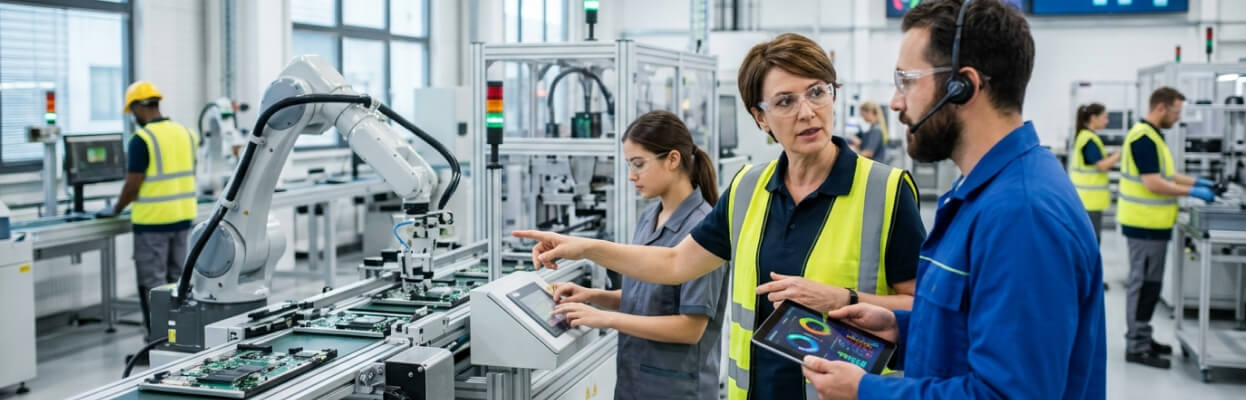
Part 1 — Why Businesses Are Rebuilding Offshore Operations Around AI
For years, offshore staffing lived in a very predictable category inside most boardrooms.
- Not strategic.
- Not transformative.
- Not mission-critical.
Just operational support.
The assumptions were almost always the same:
- Lower labor costs
- Back-office processing
- Customer support overflow
- Administrative work internal teams didn’t want
- Scalable headcount during growth periods
That was the model.
And to be fair, it worked reasonably well for a long time.
But the reality that most companies are facing now is
The old outsourcing playbook is starting to break under modern business pressure.
Not because offshore staffing stopped working.
This is because the market changed faster than traditional operating models could adapt.
The Real Shift Happening Behind the AI Conversation
Many executives still think the issue is mainly an “AI story.”
It isn’t.
It’s an operational pressure story.
AI just happens to be the accelerant.
Businesses today are simultaneously dealing with the following:
| Business Pressure | Operational Impact |
| Rising labor costs | Margin compression |
| Talent shortages | Slower scaling |
| 24/7 customer expectations | Operational strain |
| Digital transformation demands | Workflow complexity |
| Global competition | Faster execution pressure |
| Economic uncertainty | Efficiency mandates |
That combination forces leadership teams to rethink workforce design entirely.
And the companies adapting fastest are not simply adding AI tools to existing workflows.
They’re rebuilding operating systems around AI-enabled execution.
Big difference.
The Question Smart Executives Are Asking Now
Five years ago, the conversation sounded like this:
“How much money can offshore staffing save us?”
Today?
Smarter leadership teams are asking:
“How do we build a workforce that scales intelligently without operational chaos?”
That distinction matters more than most companies realize.
Because once organizations move beyond pure labor arbitrage thinking, offshore staffing becomes something much more valuable:
A scalability engine.
Not just a staffing solution.
Why Traditional Offshore Models Started Breaking Down
Traditional outsourcing followed a fairly linear structure.
Simple system. Familiar system.
But eventually, cracks started appearing.
Especially inside companies scaling aggressively.
| Step | Traditional Offshore Workflow | Operational Reality |
| Step 1 | A company delegated tasks | Work was transferred primarily to reduce workload or lower costs |
| Step 2 | Offshore teams manually executed the work | Most workflows depended heavily on repetitive human processing |
| Step 3 | Managers reviewed the output | Oversight remained highly manual and time-consuming |
| Step 4 | Issues escalated slowly through the communication layers | Delays often increased as organizations scaled |
| Step 5 | Operations remained reactive | Problems were usually addressed after inefficiencies had already spread |
At a smaller scale, this structure worked reasonably well.
But as businesses grew, operational friction became harder to ignore:
- Slower execution
- Reporting bottlenecks
- Workflow duplication
- Communication delays
- Reduced visibility across teams
- Inconsistent quality control
That’s where many traditional offshore models started struggling under modern operational pressure.
What Scaling Problems Actually Look Like Inside Real Businesses
This issue is the part most consultants oversimplify.
Operational inefficiency rarely arrives dramatically.
It leaks slowly into the organization.
At first:
- Reporting becomes slower
- Teams duplicate work
- Communication layers expand
- Approvals take longer
- Accountability gets blurry
Then things compound.
Suddenly, leadership notices the following:
- Productivity flattening
- Customer frustration increasing
- Margins tightening
- Execution becoming inconsistent
- Internal teams are burning out
And here’s the uncomfortable truth:
Adding more people without improving operational systems eventually creates drag, not growth.
I’ve seen companies double headcount and somehow become less efficient six months later.
Why?
Because scaling labor without scaling systems creates friction everywhere.
The Rise of AI-Augmented Offshore Teams
This scenario is where AI changes the equation.
Not by eliminating humans. That narrative is exaggerated.
However, this approach removes operational friction at scale.
Modern offshore teams are starting to look very different from the traditional outsourcing structures most executives grew up with.
This is no longer just about adding remote labour to absorb workload.
The smarter operations are layering AI directly into execution itself.
Not as a gimmick.
Leadership mentions are not just a side experiment; they are discussed during quarterly meetings.
Into the actual operating system of the business.
Technologies Reshaping Modern Offshore Operations
| AI Technology | What It Actually Improves |
| Generative AI | Faster research, documentation, and workflow support |
| Workflow Automation | Reduces repetitive manual tasks |
| AI Copilots | Accelerates execution across departments |
| Predictive Analytics | Improves operational forecasting |
| NLP Systems | Enhances communication workflows |
| Automated Reporting | Creates real-time visibility |
| AI Monitoring Tools | Detects operational issues earlier |
On paper, all of this sounds highly technical.
Operationally, though, the impact is surprisingly practical.
The real value is not “innovation.” Most experienced operators are tired of hearing that word thrown around carelessly anyway.
The value is friction reduction.
What Businesses Actually Gain
- Less waiting between workflows
- Less manual cleanup work
- Faster execution cycles
- Better operational visibility
- Reduced reporting bottlenecks
- Fewer repetitive administrative tasks
- Improved coordination across teams
That’s where companies start seeing meaningful operational improvement.
Not in presentations.
In execution.
Finance operations are changing fast.
For years, the following challenges have overwhelmed finance teams:
- Reconciliation work
- Reporting reviews
- Spreadsheet management
- Manual verification processes
- Data cleanup tasks
And there was a reason for that.
One reporting mistake inside a finance environment can create downstream problems that ripple through an entire organization.
Especially at scale.
AI is starting to reduce that operational pressure significantly.
How AI Supports Offshore Finance Teams
| AI-Assisted Finance Functions | Operational Impact |
| Automated reconciliations | Faster financial processing |
| Anomaly detection | Earlier risk visibility |
| Reporting automation | Reduced manual workloads |
| Forecasting support | Improved financial planning |
| Data processing acceleration | Faster operational reporting |
But here’s what people outside finance often misunderstand:
Nobody serious is handing full financial judgment over to AI.
- Not experienced CFOs.
- Not controllers who manage compliance risk.
- Not organizations that operate in regulated environments.
Because finance is full of nuance, judgment calls, and context, automation still struggles to interpret it properly.
What Human Finance Teams Still Handle
Human oversight still matters for
- Strategic interpretation
- Compliance oversight
- Risk evaluation
- Financial judgment
- Exception handling
- Executive decision-making
And frankly, it should stay that way.
One bad automated assumption inside a financial workflow can create problems that take months to unwind.
Sometimes longer.
Customer Support Is Evolving the Same Way
Customer support operations are also becoming heavily AI-assisted.
And yes, efficiency improves.
But this is only true when companies understand where automation stops being useful.
This is because customers rarely behave logically when they are frustrated.
That’s the reality.
How AI Supports Offshore Customer Support Teams
| AI Support Function | Business Benefit |
| Sentiment analysis | Detects escalation risks earlier |
| Intelligent ticket routing | Faster response prioritization |
| Customer history summaries | Better context visibility |
| Suggested responses | Reduced handling time |
| Workflow assistance | Improved support efficiency |
Sounds efficient. And it is.
Until an irate customer enters the conversation.
That’s usually where operational reality shows up.
Because AI still struggles with:
- Emotional nuance
- Frustration management
- Relationship recovery
- Context-heavy conversations
- High-pressure escalation handling
And those moments matter more than many executives realize.
What Human Customer Support Teams Still Own
Human-Led Responsibilities
- Escalation handling
- Emotional conversations
- Retention recovery
- Complex issue resolution
- Relationship management
- Customer trust rebuilding
That balance matters.
The companies getting this right are not replacing people recklessly.
They’re redesigning how humans and AI operate together under real business pressure.
Big difference.
And honestly, that distinction will separate sustainable AI adoption from expensive operational mistakes over the next few years.
Marketing Operations
AI accelerates
- SEO research
- Reporting
- Campaign analysis
- Content structuring
- Performance insights
But experienced marketers still own the following:
- Brand positioning
- Messaging nuance
- Strategic direction
- Audience psychology
That distinction matters.
Many companies right now are producing massive amounts of AI-generated content that technically looks productive but feels strategically empty.
Volume increased.
Differentiation disappeared.
That’s the hidden risk.
Software Development Operations
AI copilots now help developers:
- Generate code suggestions
- Detect bugs
- Improve testing workflows
- Accelerate documentation
But engineers still control the following:
- Architecture decisions
- Security oversight
- Infrastructure planning
- System integrity
Because speed without technical discipline creates expensive problems later.
- Usually at scale.
- Usually under pressure.
What Most Companies Still Misunderstand About AI
A surprising number of executives still think AI’s biggest value is labor reduction.
That’s shortsighted.
The real value is operational compression.
Meaning:
- Faster execution
- Less friction
- Better coordination
- Improved visibility
- More scalable operations
The strongest organizations are not treating AI as a side experiment anymore.
They’re redesigning workflows around it.
And companies failing to do that are quietly falling behind operationally — even if revenue still looks healthy today.
That lag eventually shows up.
It always does.
Why This Shift Is Happening Faster Than Expected
This transformation accelerated because pressure forced it.
Not because businesses suddenly became visionary.
The market forced adaptation.
Major Forces Accelerating AI Offshore Adoption
Economic Pressure
Businesses are facing the following:
- Inflation
- Margin pressure
- Higher operating costs
- Budget constraints
Workforce Pressure
Organizations continue struggling with:
- Talent shortages
- Hiring delays
- Burnout
- Skills gaps
- Retention challenges
Operational Pressure
Modern companies now operate in environments requiring the following:
- 24/7 responsiveness
- Faster turnaround times
- Real-time visibility
- Continuous execution
- Global coordination
Technology Pressure
Meanwhile, AI became dramatically more accessible.
Five years ago, AI implementation often required:
- Enterprise-level budgets
- Specialized infrastructure
- Dedicated technical teams
- Long deployment cycles
Today?
Mid-sized companies can deploy the following:
- AI workflow systems
- Automation tools
- Generative AI platforms
- Predictive analytics
- AI copilots
Much faster than most executives expected.
That accessibility changed everything.
What the Smartest Leadership Teams Already Understand
The future is not purely human.
But it’s also not purely AI.
That’s the nuance many conversations miss.
The strongest organizations are building the following:
Blended Workforces
Operational environments where:
- AI accelerates execution
- Humans provide judgment
- Offshore teams extend scalability
- Automation removes repetitive friction
- Leadership maintains oversight
That model is becoming increasingly common inside high-performing offshore operations.
Why AI Is Not Replacing Offshore Teams Entirely
This scenario is where many AI conversations disconnect from operational reality.
Yes, AI automates tasks.
No, it does not automatically replace entire workforces overnight.
Real operations are far messier than that.
AI still struggles heavily with:
| Human Capability | Why It Still Matters |
| Strategic judgment | Business conditions constantly change |
| Emotional intelligence | Customers are emotional |
| Cultural nuance | Global communication requires context |
| Ethical reasoning | AI cannot evaluate consequences properly |
| Relationship management | Trust still drives retention |
| Leadership decisions | Complex trade-offs require humans |
And experienced operators understand something many AI enthusiasts ignore:
Real business problems are rarely clean or fully automatable.
They’re messy. Political. Emotional. Context-heavy.
That’s why human oversight remains essential.
The Emergence of the AI-Augmented Operator
This shift is creating an entirely new category of offshore professional.
Not just remote staff.
Not just task executors.
AI-Augmented Operators.
Companies increasingly want offshore talent capable of:
- Managing AI workflows
- Validating automated outputs
- Interpreting AI-generated insights
- Handling exceptions
- Coordinating across systems
- Supporting strategic execution
That’s a much more sophisticated workforce model than traditional outsourcing ever delivered.
The Biggest Mistake Companies Are Making Right Now
Over-automation.
Some businesses are moving too aggressively without governance structures in place.
That creates:
- Quality issues
- Compliance exposure
- Inaccurate outputs
- Customer frustration
- Decision-making blind spots
And here’s the dangerous part:
Operational damage often spreads quietly before leadership notices it.
At first:
- Efficiency improves
- Costs decline
- Reporting accelerates
Everything looks positive.
Then trust deteriorates underneath the surface.
- Customers notice inconsistencies.
- Employees stop validating outputs carefully.
- Errors compound themselves.
That’s why mature AI-powered offshore operations require the following:
| Governance Requirement | Why It Matters |
| Human oversight | Prevent operational blind spots |
| Validation systems | Maintain quality |
| Security controls | Protect sensitive data |
| Compliance frameworks | Reduce risk exposure |
| Responsible AI policies | Prevent misuse |
Automation without governance eventually becomes a liability.
Why Offshore Teams Are Surprisingly Well Positioned for AI
This potential is something many executives still underestimate.
Offshore environments are actually highly compatible with AI integration.
Why?
Because most offshore operations already rely heavily on:
- Digital infrastructure
- Structured workflows
- Documentation systems
- Cloud collaboration
- Process standardization
That foundation makes AI deployment easier compared to fragmented internal environments.
Why AI Fits Offshore Operations Well
1. Offshore Work Is Often Process-Driven
Examples include:
- Reporting
- Documentation
- Accounting
- Administrative workflows
- Technical support
- Customer operations
These workflows are highly compatible with AI enhancement.
2. Offshore Teams Already Operate Digitally
Most offshore operations already depend on:
- Slack
- Zoom
- Microsoft Teams
- Cloud CRMs
- Project management systems
AI integrates naturally into those ecosystems.
3. Businesses Need Continuous Operations
Modern organizations increasingly require the following:
- 24/7 support
- Global responsiveness
- Faster execution cycles
- Continuous operational coverage
AI-powered offshore teams support all of those goals simultaneously.
The Philippines and the Future of AI Offshore Operations
The Philippines continues to play a major role in the global offshore staffing industry because of several long-standing advantages:
| Competitive Strength | Business Value |
| Strong English proficiency | Easier communication across global teams |
| Service-oriented workforce culture | Better customer-facing support |
| Remote work adaptability | Faster operational transition |
| Expanding digital talent pools | Increased AI and tech readiness |
| Mature outsourcing ecosystem | Scalable workforce infrastructure |
But the bigger story is not geography alone.
It’s a capability evolution.
As AI adoption accelerates, offshore markets that successfully combine the following elements will be more competitive:
- Human communication skills
- Digital infrastructure
- AI adaptability
- Operational scalability
- Workforce upskilling
…will likely become increasingly important in global business operations.
That shift is already changing how leadership teams think about offshore partnerships.
A few years ago, the conversation was mostly transactional.
- Can the provider fill seats?
- Can they lower costs?
- How quickly can they scale headcount?
That was enough back then.
It isn’t anymore.
Businesses today are looking far beyond labor capacity. They’re evaluating whether offshore teams can actually operate inside modern, AI-enabled environments without creating more friction than value.
Because here’s what many companies learned the hard way: cheap support means very little if workflows break under pressure.
Executives are now paying closer attention to:
- Operational maturity
- Digital readiness
- Process discipline
- Workflow integration
- Scalability under real-world conditions
And frankly, they should.
A provider may look efficient during onboarding. The real test comes six months later when operations become more complex, AI systems are layered into workflows, and leadership needs visibility across distributed teams without constant hand-holding.
That’s where weaker offshore models usually start cracking.
Industry firms, including organizations such as Kinetic Innovative Staffing, are operating inside this broader shift as companies across sectors rethink how offshore workforce models fit into increasingly AI-driven business operations.
Conclusion — This Is Bigger Than Outsourcing
The rise of AI-powered offshore teams is not another outsourcing trend.
It’s a structural shift in how modern businesses operate.
AI is reshaping:
- Workforce design
- Productivity expectations
- Operational models
- Competitive dynamics
- Talent requirements
At the same time, human judgment remains irreplaceable.
The companies likely to outperform over the next decade will not simply automate aggressively.
They’ll build balanced ecosystems where:
- AI improves speed
- Humans manage complexity
- Offshore teams extend operational scalability
- Governance protects quality
- Technology supports smarter execution
The future of offshore staffing will no longer be defined primarily by geography.
It will increasingly be defined by how intelligently businesses combine the following:
- AI systems
- Human judgment
- Operational discipline
- Global talent
- Scalable infrastructure

Part 2 — Why AI-Powered Offshore Teams Are Reshaping Business Operations Faster Than Most Leaders Expected
Many companies still think AI adoption is happening in isolated pockets.
A chatbot here.
An automation tool there.
Maybe a few AI-generated reports are floating around inside operations.
That’s not what’s actually happening anymore.
What we’re seeing now is deeper.
Businesses are beginning to redesign entire operational ecosystems around AI-assisted execution—and offshore teams are sitting directly in the middle of that transformation.
Not on the edges.
Not as secondary support layers.
Inside the core operating structure itself.
That distinction matters because once offshore teams become integrated into business-critical workflows, leadership expectations change dramatically.
Suddenly, executives are not just evaluating.
- Cost savings
- Staffing speed
- Labor availability
They’re evaluating:
- Operational resilience
- AI readiness
- Workflow integration capability
- Governance maturity
- Scalability under pressure
- Cross-functional execution quality
Very different conversation.
And honestly, a more mature one.
The outsourcing industry is quietly going through an identity shift.
For years, offshore staffing was heavily associated with labor arbitrage.
The lowest cost won.
That model created massive industry growth, but it also created bad habits.
- Some companies outsourced too aggressively.
- Others prioritized cheap scaling over operational discipline.
- Many built fragmented offshore systems that became difficult to manage over time.
And eventually, those cracks started showing.
Especially once businesses became more digitally dependent.
What Traditional Offshore Models Often Struggled With
| Operational Weakness | Long-Term Impact |
| Manual-heavy workflows | Slower execution |
| Siloed teams | Poor collaboration |
| Limited visibility | Delayed decisions |
| Reactive support structures | Escalation bottlenecks |
| Weak documentation | Knowledge inconsistency |
| High management dependency | Leadership fatigue |
| Fragmented systems | Operational inefficiency |
On a smaller scale, companies could tolerate those issues.
At enterprise scale?
Different story.
The operational drag compounds fast.
AI Is Accelerating a New Operational Standard
This is where the market is shifting rapidly.
AI-powered offshore teams are not simply helping businesses “do more.”
They’re helping businesses operate differently.
That distinction is important.
Because the strongest companies are no longer measuring offshore success purely through the following:
- Headcount growth
- Cost reduction
- Ticket volume
- Basic productivity metrics
They’re increasingly measuring:
- Workflow velocity
- Operational visibility
- Decision-making speed
- System coordination
- Scalability quality
- Execution consistency
That’s a much higher operational bar.
And not every organization is ready for it.
What High-Performing AI Offshore Operations Usually Have in Common
The companies adapting best to AI-enabled offshore operations tend to share several characteristics.
Not because they’re necessarily bigger.
But because they’re operationally disciplined.
Common Traits of Mature AI-Enabled Offshore Operations
1. Strong Process Infrastructure
They already have:
- Workflow documentation
- SOPs
- Escalation structures
- Accountability systems
- Defined operational ownership
AI performs far better inside structured environments.
Messy systems produce messy AI outputs.
Simple as that.
2. Leadership Alignment
The strongest organizations treat AI adoption as follows:
- an operational strategy,
- not a departmental experiment.
That changes execution entirely.
Leadership teams align around:
- workflow redesign,
- governance,
- scalability planning,
- risk management,
- and operational integration.
Without that alignment, AI adoption usually becomes fragmented fast.
3. Governance Maturity
This area is becoming a massive differentiator.
Many companies are deploying AI tools faster than they can govern them.
Such behavior creates a risk exposure that leadership often underestimates.
AI Governance Problems Businesses Are Starting to Encounter
| Governance Risk | Potential Consequence |
| Unauthorized AI usage | Data exposure |
| Poor validation processes | Inaccurate outputs |
| Weak access controls | Security vulnerabilities |
| AI hallucinations | Operational mistakes |
| Compliance failures | Regulatory exposure |
| Over-automation | Customer trust decline |
Many executives still assume governance slows innovation.
Occasionally, it does.
But a lack of governance eventually creates operational instability.
And instability gets expensive fast.
Why Operational Visibility Is Becoming More Valuable Than Cheap Labor
This trend is one of the biggest strategic shifts happening right now.
Historically, offshore staffing conversations focused heavily on the following:
- hourly rates,
- labor savings,
- and staffing scale.
But modern leadership teams increasingly prioritize something else:
Visibility.
Because when operations become globally distributed and AI-assisted, leadership needs the following:
- real-time insight,
- performance transparency,
- escalation visibility,
- workflow tracking,
- and operational accountability.
Without visibility, scale becomes dangerous.
Not efficient.
The Rise of “Operational Intelligence”
This area is where AI-powered offshore models become genuinely transformative.
The strongest systems now combine:
- human execution,
- AI-assisted analysis,
- automation layers,
- and centralized reporting visibility.
The result is operational intelligence.
Not just outsourced labor.
What Operational Intelligence Actually Looks Like
| Traditional Operations | AI-Enabled Operations |
| Delayed reporting | Real-time visibility |
| Manual tracking | Automated monitoring |
| Reactive escalation | Predictive alerts |
| Fragmented communication | Centralized coordination |
| Static workflows | Adaptive workflows |
| Manual analysis | AI-assisted insights |
That changes decision-making speed dramatically.
And in competitive industries, speed matters more than most businesses admit publicly.
Why Mid-Sized Companies Are Adopting AI Offshore Models Faster Than Expected
This phenomenon surprises many people.
Many assumed large enterprises would dominate AI-powered offshore transformation first.
Some are.
But mid-sized companies are moving aggressively, too.
Why?
Because AI lowered operational barriers significantly.
Five years ago, scaling sophisticated global operations required:
- large enterprise infrastructure,
- expensive internal systems,
- massive IT budgets,
- specialized AI teams.
Today, cloud-based AI tools have changed the situation.
Now mid-sized businesses can access the following:
- workflow automation,
- AI copilots,
- predictive analytics,
- AI reporting systems,
- and scalable collaboration platforms
…without building everything internally from scratch.
That accessibility accelerated adoption much faster than many analysts predicted.
The talent shortage problem is quietly fueling AI offshore growth.
This trend is another major driver behind the shift.
Businesses everywhere are struggling to hire:
- experienced developers,
- data specialists,
- cybersecurity professionals,
- AI-skilled operators
- and technical project managers.
At the same time, operational demand continues growing.
That pressure creates a difficult equation.
Companies still need:
- execution capacity,
- scalability,
- and operational continuity
…even while hiring pipelines slow down.
AI-powered offshore teams help bridge that gap.
Not perfectly.
But increasingly effectively.
Why Companies Are Prioritizing AI-Augmented Talent
Businesses are no longer looking only for offshore workers who can follow instructions.
They’re increasingly seeking professionals capable of:
- operating alongside AI systems,
- validating automated outputs,
- interpreting AI-generated insights,
- coordinating across distributed workflows,
- and managing operational exceptions.
That’s a very different skill profile from traditional outsourcing environments.
The New Offshore Talent Expectations
| Traditional Expectations | Modern Expectations |
| Task completion | Workflow ownership |
| Administrative execution | Operational coordination |
| Manual processing | AI-assisted execution |
| Reactive support | Strategic adaptability |
| Fixed workflows | Continuous optimization |
That shift is changing hiring priorities across offshore markets globally.
Why Human Judgment Still Matters More Than Many AI Advocates Admit
There’s a narrative floating around right now that AI will eventually automate most operational work completely.
Maybe parts of it.
But experienced operators know reality is more complicated.
Because business environments are rarely linear.
They’re filled with:
- ambiguity,
- incomplete information,
- competing priorities,
- emotional decision-making,
- regulatory complexity,
- and unpredictable human behaviour.
AI still struggles heavily in those environments.
Areas Where Human Oversight Remains Critical
Human-Led Capabilities Still Matter for the Following:
- Strategic prioritization
- Executive judgment
- Ethical evaluation
- Relationship management
- Crisis response
- Negotiation
- Cultural interpretation
- High-risk decision-making
And honestly, those are often the areas that matter most commercially.
Not the repetitive tasks.
The complicated ones.
The Risk of Over-Automating Customer Experience
Some businesses are learning this lesson the hard way.
AI can absolutely improve support efficiency.
But companies that automate customer interactions too aggressively often create the following:
- frustration,
- trust erosion,
- poor escalation handling,
- and emotionally disconnected customer experiences.
At first, metrics may even look positive.
Lower support costs.
Faster response times.
Higher automation rates.
Then retention quietly starts slipping.
This is important because customers notice when interactions stop feeling accountable.
That’s where mature organizations separate themselves from reckless adopters.
High-Performing Companies Build “Human Escalation Layers.”
The best AI-powered offshore operations understand something simple:
Automation should reduce friction.
Not eliminate accountability.
That’s why stronger organizations intentionally build the following:
- human review layers,
- escalation systems,
- validation checkpoints,
- and governance controls directly into AI-supported workflows.
Not because AI is useless.
Because operational trust still matters.
A lot.
Why Offshore Teams Are Becoming More Strategically Embedded
This may be the biggest long-term shift happening underneath the surface.
Offshore teams are moving closer to core business functions.
Not just support roles anymore.
Businesses are increasingly integrating offshore operations into the following:
- product development,
- strategic reporting,
- revenue operations,
- AI workflow management,
- business intelligence,
- digital transformation,
- and operational analytics.
That changes the relationship entirely.
Offshore staffing is becoming less transactional and more operationally integrated.
And once that happens, expectations rise significantly.
The Philippines and the Next Phase of Offshore Evolution
The Philippines remains one of the most influential offshore staffing markets globally because it combines the following:
- strong English communication,
- service-oriented workforce culture,
- operational flexibility,
- digital adaptability,
- and profound outsourcing experience.
But future competitiveness will depend on more than communication skills alone.
Countries that continue investing in:
- AI readiness,
- workforce upskilling,
- digital infrastructure,
- operational maturity,
- and scalable talent ecosystems
…will likely lead the next phase of offshore growth.
That transition is already influencing how companies evaluate offshore partnerships today.
Industry providers, including organizations such as Kinetic Innovative Staffing, are operating inside this broader market shift as businesses rethink workforce scalability in increasingly AI-enabled environments.
Conclusion — Businesses Are Redesigning Operations, Not Just Adding AI
This transformation is bigger than technology adoption.
It’s an operational redesign happening in real time.
AI-powered offshore teams are changing:
- how businesses scale,
- how workflows operate,
- how decisions are made,
- and how global operations stay competitive.
But companies that succeed in this transition will not simply automate aggressively.
They’ll build disciplined systems where:
- AI accelerates execution,
- Humans maintain judgment,
- offshore teams extend scalability,
- governance protects quality,
- and operational visibility remains strong.
Because in the end, sustainable growth has never been about adding the most people.
It’s about building systems capable of scaling intelligently under pressure.
Frequently Asked Questions (FAQ)
1. What are AI-powered offshore teams?
Many people still picture offshore staffing the old way.
- Cheap labor.
- Back-office processing.
- Overflow support.
That model still exists. But it’s no longer the whole story.
What’s happening now is much bigger.
AI-powered offshore teams are operational ecosystems where:
- Human expertise
- AI-assisted workflows
- Automation systems
- Predictive analytics
- Real-time reporting tools
…all work together inside the same execution environment.
And let’s be honest — the companies leading this shift are not doing it simply to reduce payroll costs.
They’re chasing:
- Faster execution
- Operational scalability
- Better visibility
- Smarter coordination
- Higher productivity
Because slow operations quietly kill competitiveness long before leadership notices the damage.
2. How is AI changing offshore staffing?
Traditional offshore operations were heavily manual.
Task execution. Administrative processing. Repetitive support work.
Useful? Absolutely.
Strategic? Usually limited.
AI is changing that dynamic fast.
Modern offshore teams now support:
- Workflow automation
- AI-assisted analysis
- Predictive operational insights
- Real-time reporting
- Faster coordination across departments
That changes the role entirely.
Offshore teams are no longer on the sidelines of the business, handling overflow work that nobody internally wants.
They’re increasingly integrated into:
- Operations
- Reporting
- Customer experience
- Process management
- Strategic execution workflows
That’s an entirely different workforce model.
- Will AI replace offshore workers completely?
No. Despite what the headlines keep suggesting.
AI is excellent at:
- Speed
- Pattern recognition
- Repetitive processing
- Workflow acceleration
But real businesses do not operate in perfect conditions.
- Customers escalate emotionally.
- Compliance rules change.
- Operational priorities shift unexpectedly.
- Context gets messy fast.
That still requires people.
Human professionals continue handling:
- Strategic judgment
- Relationship management
- Escalation handling
- Ethical oversight
- Complex decision-making
- Cross-functional coordination
The future is not “AI versus humans.”
The smarter companies are building operational systems where both work together efficiently.
Big difference.
4. Which industries are benefiting most from AI-powered offshore teams?
Industries with high workflow volume and structured operational environments are moving fastest.
| Industry | AI-Assisted Operational Support |
| Finance | Reporting, reconciliation, anomaly detection |
| Customer Support | Sentiment analysis, ticket prioritization |
| Marketing | SEO workflows, campaign reporting, analytics |
| Software Development | Code assistance, testing, documentation |
| Healthcare Support | Documentation and administrative workflows |
| Business Operations | Reporting automation and workflow coordination |
But here’s what many executives still underestimate:
AI tools alone do not create operational advantage.
Execution quality does.
Poor implementation creates friction rapidly. Sometimes faster than leadership realizes.
5. Why are companies moving away from pure labour arbitrage?
Cheap operations that scale poorly eventually lead to expensive problems.
That’s the reality many organizations discovered through experience.
Modern leadership teams increasingly prioritize the following:
- Operational agility
- Scalability
- Workflow intelligence
- Faster execution
- Visibility across teams
- AI readiness
- Business resilience
The conversation has shifted from
“How much can we save?”
To:
“How intelligently can we operate at scale?”
That mindset shift is reshaping offshore staffing entirely.
6. What is a blended workforce?
A blended workforce is precisely what it sounds like.
Humans and AI continuously operate inside the same workflows.
Typically:
- AI accelerates execution
- Automation removes repetitive friction
- Humans manage judgment and oversight
- Offshore teams extend scalability
The strongest organizations are not replacing people recklessly.
They’re redesigning workflows carefully.
Speed without operational discipline eventually creates instability.
7. What are the biggest risks of AI-powered offshore operations?
This scenario is where many companies are getting overly aggressive.
Yes, AI improves efficiency.
But weak governance creates risk just as quickly.
Common operational risks include:
- Data privacy exposure
- AI hallucinations
- Security vulnerabilities
- Compliance failures
- Weak validation systems
- Over-automation
- Customer trust deterioration
And here’s the dangerous part:
Operational damage often spreads quietly before leadership notices it.
At first, everything looks productive. Faster. Cheaper.
Then inconsistencies appear underneath the surface.
That’s why mature organizations prioritize the following:
- Human oversight
- Governance frameworks
- Validation systems
- Security controls
- Responsible AI policies
Automation without accountability eventually becomes a liability.
8. Why does the Philippines remain important in offshore staffing?
The Philippines remains one of the strongest offshore staffing markets globally for several reasons:
- Strong English communication
- Service-oriented workforce culture
- Remote work adaptability
- Expanding digital talent pools
- Deep outsourcing experience
But moving forward, geography alone will not be enough.
The countries likely to dominate the next phase of offshore growth will combine the following:
- AI readiness
- Workforce upskilling
- Digital infrastructure
- Operational discipline
- Scalable execution capability
That’s where the market is heading now.
9. What skills matter most inside AI-enabled offshore teams?
The market is shifting away from purely task-based roles.
Businesses increasingly want professionals who can:
- Manage AI-assisted workflows
- Validate automated outputs
- Interpret operational insights
- Coordinate across systems
- Solve exceptions under pressure
The skills becoming more valuable include the following:
- AI literacy
- Analytical thinking
- Communication
- Workflow management
- Critical thinking
- Operational adaptability
Because AI still requires supervision. Especially when businesses scale.
10. What does the future of offshore staffing actually look like?
Smaller teams. Smarter systems. Higher expectations.
That’s the direction.
Future offshore operations will likely revolve around:
- AI-assisted workflows
- Real-time operational visibility
- Leaner but higher-output teams
- Strong governance systems
- Human-AI collaboration
- Scalable digital infrastructure
The companies likely to outperform over the next decade will not simply automate more aggressively.
They’ll build operational systems capable of combining the following:
- AI speed
- Human judgment
- Offshore scalability
- Workflow discipline
- Governance
- Strategic oversight
The future of offshore staffing will no longer be defined primarily by geography.
It will be defined by operational intelligence.
Resources & Industry Research
Workforce Transformation & AI Research
- World Economic Forum—Future of Jobs Report—Research on AI adoption, workforce transformation, automation trends, and global labor market shifts.
- McKinsey & Company—The Economic Potential of Generative AI: Enterprise analysis on how generative AI is reshaping productivity, workflows, and business operations.
- Gartner — Generative AI Insights – Research covering enterprise AI adoption, governance risks, and operational transformation.
Offshore Staffing & Workforce Strategy
- Kinetic Innovative Staffing Insights related to offshore staffing, workforce scalability, and remote operational support.
- Deloitte Insights—Artificial Intelligence and Analytics—Deloitte’s AI and analytics services practice, helping organizations use AI, analytics, and data modernization to improve operations, decision-making, and business transformation.
- PwC — AI Predictions and Business Strategy – Analysis on enterprise AI adoption, operational modernization, and business strategy shifts.
Leadership, Operations & Digital Transformation
- Harvard Business School AI Institute — Why Your AI Strategy May Be Failing – Executive insights on scaling AI adoption, organizational redesign, and overcoming operational barriers.
- MIT Sloan Management Review — AI & Business Operations – Research and executive insights on AI-enabled operational strategy and organizational transformation.
- OECD Digital Economy Outlook Series – OECD’s official digital economy publication series covering technology adoption, digital policy, innovation, and workforce modernization.