
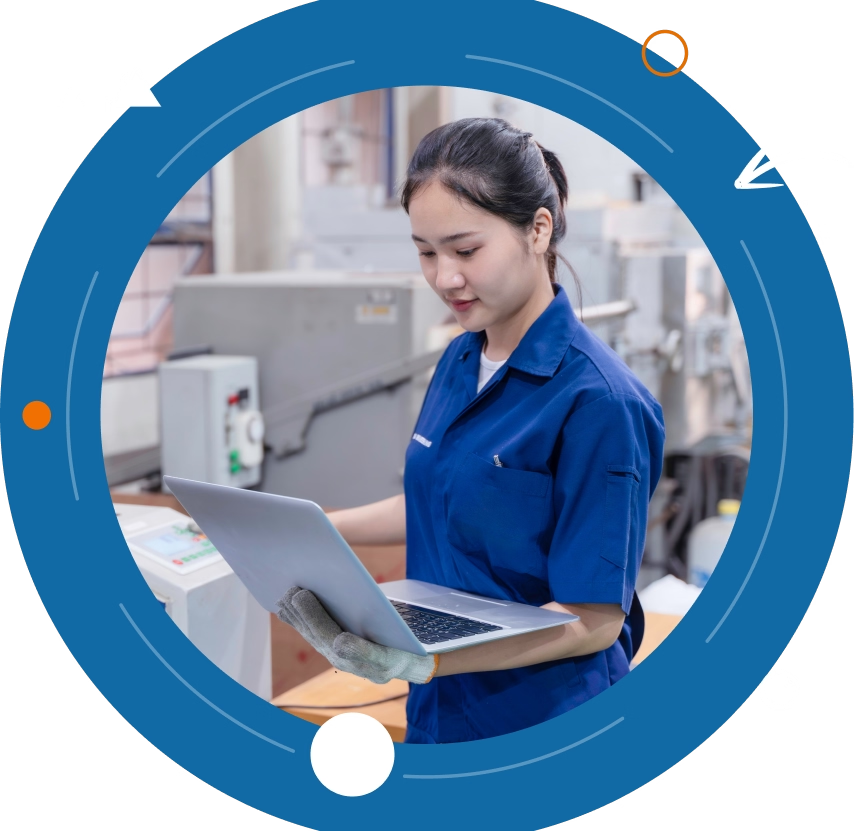
Production planning, quality assurance analysis, process documentation, logistics coordination, inventory management, product design support — the technical and administrative backbone of a manufacturing operation can run effectively from the Philippines. At 60–76% less than local equivalents, without moving a single piece of equipment.
Manufacturing is the category where the physical vs. desk-based distinction matters most. Getting this wrong — trying to offshore something that requires on-site presence — is how offshore manufacturing arrangements fail before they start.
Manufacturing business owners sometimes dismiss offshore support options entirely because they picture the production floor and correctly conclude it can’t move. That’s right. But in doing so, they sometimes overlook the significant proportion of manufacturing operations that is desk-based, systems-driven, and entirely transferable to a skilled remote professional.
Cannot be done offshore — physical presence is essential:
Can be done offshore — and done well:
The offshore functions all share the same characteristics: they happen in software systems — SAP, Oracle, Epicor, SolidWorks, Excel — and they require analytical thinking, process knowledge, and clear written communication. Those skills exist in abundance in the Philippines. Physical presence on the production floor does not.
Manufacturing margins are under pressure from multiple directions — raw material costs, energy, logistics, and the steadily rising cost of skilled support staff in Australia, the US, and the UK. The production floor costs what it costs. But the administrative and technical support layer around it is a category where many manufacturers are significantly overspending relative to what an offshore arrangement would cost
In Australia, a production planner or supply chain coordinator in manufacturing earns AUD $75,000–$95,000 fully loaded. A quality analyst or QA documentation specialist: AUD $70,000–$90,000 fully loaded. A process engineer in a support role: AUD $90,000–$115,000 fully loaded. A product design drafter or CAD support role: AUD $75,000–$95,000 fully loaded.
n the US, equivalent desk-based manufacturing support roles run USD $60,000–$90,000 fully loaded. In the UK, GBP £38,000–£58,000 fully loaded.

The offshore equivalent — a degree-qualified, manufacturing-experienced professional in the Philippines with the relevant system and technical skills — typically costs 60 to 76% less. For a manufacturer running three or four desk-based support roles, that’s a meaningful reduction in overhead that doesn’t touch production capacity, site safety, or product quality.
The Philippines has a specific combination of engineering and technical education, manufacturing system experience, and international operations exposure that makes it a consistent performer for manufacturing support roles.
The Philippines produces a significant number of industrial engineering, mechanical engineering, and manufacturing-related graduates annually. Engineering is one of the most respected and widely pursued professional pathways in the country, and the academic standard — while it varies by institution — produces graduates with genuine technical foundations in manufacturing processes, quality systems, and production management principles.
SAP PP (Production Planning), Oracle Manufacturing Cloud, Epicor ERP, SolidWorks PDM, Arena PLM — Filipino manufacturing support professionals working for international manufacturers have been working in these systems on real production environments for years. This is a market where the tools are familiar and the experience is genuine, not claimed.
ISO 9001, ISO 14001, lean manufacturing principles, Six Sigma methodology, SOP documentation standards — Filipino quality professionals and process engineers working in manufacturing support functions have been calibrated to international quality management frameworks. Many hold formal certifications (ISO Lead Auditor, Six Sigma Green or Black Belt, Lean practitioner). The quality management vocabulary and process discipline that manufacturing businesses expect is built into the training of this talent pool.
Manufacturing support functions involve constant technical documentation — SOPs, work instructions, quality reports, non-conformance reports, engineering change notices. Filipino manufacturing professionals write and communicate in English at a professional technical standard. The documentation quality from experienced candidates in this space is consistently high.
The Philippines BPO sector has included manufacturing operations support for well over a decade — procurement coordination, materials planning, supplier management, and production scheduling support have been established offshore functions. Filipino professionals with experience supporting Australian, US, and UK manufacturers have been calibrated to the operational expectations and documentation conventions of those markets.
Seven roles where offshore hiring consistently works for manufacturing businesses — each with a dedicated page covering what to look for, which systems to screen for, and how to structure the role within your production environment.
Production Planning & Management
Manages the production scheduling function — translating demand forecasts and customer orders into production plans, maintaining the master production schedule in your MRP/ERP system, coordinating materials availability with procurement, monitoring capacity constraints, and flagging scheduling conflicts to the operations team.
Production planning is fundamentally a systems and analytical function. The planner works in SAP PP, Oracle Manufacturing, Epicor, or equivalent MRP tools — translating demand inputs into workable production sequences. Physical presence on the floor is not what makes a production planner effective. Accurate data, sound planning logic, and clear communication with the site team are. All three can be delivered from an offshore arrangement.
The integration with your on-site operations team is the most important setup consideration. The offshore planner needs a reliable channel to the floor supervisors who are executing the plan — to receive feedback on actual vs. planned output, flag emerging capacity issues, and adjust the schedule in response to real-time production data.
Quality Control & Assurance Analyst
Manages quality documentation, data analysis, and reporting — maintaining quality records, analysing defect and non-conformance data, preparing quality reports for management review, supporting internal and external audit preparation, maintaining SOPs and work instructions to current revision, and tracking corrective action completion.
This is an important distinction: offshore QA support is for the data, documentation, and reporting layer of quality management — not physical product inspection, which requires hands-on presence on the line. The offshore QA analyst ensures the quality management system is maintained, the data is accurate, and the documentation is audit-ready. The on-site quality team handles physical inspection and in-process checks.
For manufacturers operating under ISO 9001, AS9100, IATF 16949, or similar quality management systems, the documentation workload is substantial. An offshore QA analyst dedicated to that function frees up on-site quality engineers for the inspection and problem-solving work that genuinely requires physical presence.
Process Engineering Support
Supports process improvement and documentation functions — developing and maintaining SOPs and work instructions, analysing process data to identify improvement opportunities, supporting lean and continuous improvement initiatives, preparing process documentation for new product introductions, and conducting time and motion analysis from recorded data.
The offshore process engineer handles the documentation, analysis, and improvement project support layer of process engineering — not the hands-on observation and adjustment of live production processes, which requires physical presence. For manufacturers running active CI programs or managing high documentation volume for new product introductions, this split is a practical and effective model.
Filipino process engineers with lean manufacturing, Six Sigma, and SOP documentation experience have worked in this support capacity for international manufacturers across a range of industries.
Product Design & Development Support
Supports the product design function — producing detailed engineering drawings and 3D models in SolidWorks, Autodesk Fusion 360, or equivalent CAD platforms, managing drawing registers and revision control, supporting design documentation packages for new product introductions, and preparing design data for manufacturing release.
Product design support is one of the most established categories of offshore technical work globally. Filipino CAD designers and product design drafters with SolidWorks and Fusion 360 experience on international manufacturing projects have been working in this space for years. The work is entirely deliverable-driven — a drawing package, a 3D model, a BOM — and the output is straightforward to review and verify against design intent.
Inventory & Warehouse Management Support
Manages the data and systems layer of inventory management — maintaining accurate stock records in the ERP or WMS, reconciling physical counts against system records, managing reorder point calculations, monitoring slow-moving and obsolete inventory, and producing inventory performance reports.
Like the logistics category, the distinction is important: the offshore inventory management specialist manages the systems and data, not the physical materials. The warehouse team on-site handles physical stock; the offshore specialist ensures the digital representation of inventory is accurate, current, and actionable.
For manufacturers carrying significant raw material, WIP, and finished goods inventory across multiple locations, inventory record accuracy is a direct driver of production efficiency and working capital performance. Dedicated offshore inventory management support typically improves accuracy significantly compared to having the function managed as a secondary task by warehouse or admin staff.
Logistics & Supply Chain Coordination — Manufacturing
Manages the supply chain coordination function for a manufacturing operation — tracking inbound materials from suppliers, coordinating with freight forwarders on inbound and outbound shipments, managing purchase order status in the ERP, liaising with suppliers on delivery schedules, and maintaining supply chain performance data.
Supply chain coordination in a manufacturing context has the same characteristics as the logistics category — desk-based, systems-driven, communication-intensive. Filipino supply chain coordinators with manufacturing industry experience have direct familiarity with MRP-driven procurement cycles, supplier lead time management, and the documentation requirements of import/export for manufacturing inputs.
Customer Support — Manufacturing
Handles customer enquiries related to order status, delivery timelines, product specifications, warranty claims, and general account management for manufacturing clients. A customer-facing role that requires both product and process knowledge specific to the manufacturing business, and professional communication skill.
This role links to the customer service section because the skills profile is shared — but the manufacturing context is important. Candidates need familiarity with manufacturing lead times, technical product terminology, and how to manage customer expectations in a production environment where delivery commitments are tied to production schedules.
Most manufacturers offshore production planning or quality documentation first — the two desk-based functions that most directly affect operational efficiency without requiring on-site presence. A short conversation about your specific operation usually clarifies which makes the most sense as a starting point.
Browse candidates by platform:
Click any platform to view candidates with verified hands-on experience in that system.
Manufacturing support roles need a thorough operational brief — the production environment, the systems landscape, the specific functions the role covers, and how the offshore team integrates with your on-site production and engineering teams.
We need to understand your manufacturing type (discrete, process, job shop, repetitive), your production environment and key constraints, your systems landscape (ERP, MRP, PLM, CAD), the specific functions the offshore role will cover, and — critically — how the offshore team integrates with the on-site production or engineering team they'll be coordinating with. For technical roles like process engineering and product design, we also need examples of the kind of work the hire will be expected to produce.
We search our active manufacturing network and run targeted recruitment where needed. For planning and analytical roles, shortlists include a practical assessment component — a production scheduling exercise, a data analysis task, a quality reporting scenario. For design and CAD roles, portfolio review is mandatory.
You meet shortlisted candidates. For all technical manufacturing support roles, a practical component is standard — a scheduling problem, a CAD task using your standard drawing conventions, a quality data analysis exercise. It adds a day and eliminates most uncertainty about whether the technical knowledge transfers to your specific manufacturing context.
We handle employment, payroll, HR, and Philippines compliance. Your new hire gets access to your ERP, PLM, or CAD environment, is walked through your production processes and documentation standards, and is introduced to the on-site team members they'll coordinate with. The integration design between offshore support and on-site production needs to be deliberate — who the offshore hire contacts for what, through what channel, with what turnaround expectation.
We manage payroll, leave, benefits, and HR throughout the engagement. You manage the manufacturing work. We manage everything behind it.
Offshore manufacturing support arrangements that underperform almost always trace back to the same set of avoidable issues — most of them about the integration between desk-based offshore functions and on-site production reality.
The offshore production planner working from MRP data cannot see the production floor. They don't know that Machine 3 has been running slow all week, or that the team on Line 2 is two people short because of illness. That contextual knowledge lives on-site and needs to flow to the offshore planner through regular, structured communication — not just the data in the system. If that communication loop isn't designed, the plan becomes increasingly disconnected from production reality. Design the feedback loop before the hire starts.
A production planner or quality analyst working from ERP data that hasn't been maintained properly, inventory records that are months out of date, or quality data that's been entered inconsistently is fighting with one hand tied behind their back. Offshore support functions are only as useful as the data they work from. Before hiring, assess the quality of your systems data honestly. If there's a cleanup project required first, do it — the offshore hire will perform significantly better working from clean data.
Product design support offshore introduces questions about drawing authority, revision control, and design release that need to be answered before work starts. Who has authority to release a drawing? What does the review and approval process look like? Which revision control system is being used and who has what access? These aren't complicated questions but they need explicit answers. The engineering team that discovers that an offshore CAD drafter has been releasing drawings without going through the formal approval process has a document control problem that takes time to untangle.
A production planner or process engineer offshore who doesn't understand your product mix, your key constraints, your customer priorities, and your typical production rhythm will make planning decisions that make sense in the abstract but don't fit the reality of your floor. The technical onboarding — system access, process documentation — is the easy part. The harder and more important part is transferring the production context: what matters most, where the constraints usually sit, how exceptions are typically handled. That knowledge transfer is worth investing time in deliberately.
Quality documentation in a manufacturing context isn't just administration — it's the evidence base for your quality management system certification, your customer audits, and your regulatory compliance. Offshore quality documentation support works well when it's taken seriously: proper document control, revision management, audit trail maintenance, and a clear connection between document changes and the engineering or process changes that drove them. Treating it as a filing function rather than a quality system function produces documentation that looks complete but doesn't hold up under audit.
“Our biggest pain point wasn’t the production floor — it was keeping up with the drawing packages. Every job has its own set of detailed drawings and we were always behind on revisions and as-built documentation because the engineers were too busy to keep it current.
We hired an offshore CAD drafter with SolidWorks experience. The onboarding was more involved than I expected — she needed to understand our drawing standard, our title block conventions, our revision control process, and the way we structure a fabrication drawing package for a job shop environment. We spent about three weeks getting that right before she was working independently.
Now she maintains the drawing register, produces detail drawings from our engineers’ sketches and markups, and keeps our SolidWorks PDM up to date. The engineers’ time has shifted from drawing work to the customer and technical work that actually needs them. The drawing backlog that used to be a constant source of stress is gone.”
“Running a food manufacturing QMS means constant documentation work — SOPs, work instructions, CCP monitoring records, audit preparation, corrective action tracking. My quality team was spending more time on documentation maintenance than on the floor work that actually matters for food safety.
We hired an offshore QA documentation specialist. She handles SOP updates, prepares audit documentation packs, tracks corrective actions through to completion, and produces the monthly quality metrics report that goes to management review.
I was careful about one thing: she doesn’t sign off on anything that goes to a regulator or external auditor. I review and approve all documents before they’re formally released. That’s not a lack of trust in her work — her work is good — it’s the appropriate structure for a certified QMS. The approvals sit with the quality manager. The preparation and maintenance sits with her.”
Medium-size FMCG manufacturer, ISO 22000 certified, high SOP volume
“We were chronically understaffed on production planning. We had one planner trying to manage the schedule for four production lines, and the result was constant firefighting rather than forward planning.
We added an offshore production planner through Kinetic. He has SAP PP experience and was familiar with MRP-driven scheduling in a discrete manufacturing environment. The biggest challenge in the first couple of months was the production context — he had the system knowledge but needed to understand our specific capacity constraints, our key customer priorities, and how we typically handle schedule changes when something goes wrong on the floor.
We structured a daily 15-minute production review call between him and our floor supervisors, which was the thing that made the arrangement work. He gets real-time feedback on actual vs. planned output, they understand what the schedule is trying to achieve, and the gap between the plan and reality has narrowed significantly over the past six months.”
Contract manufacturer, primarily automotive and aerospace supply chain
Direct answers to what operations managers, plant managers, and manufacturing business owners typically want to know — including the specific questions about production floor integration and quality system implications.
Yes — when the communication structure is right. Production planners work from data: demand forecasts, inventory levels, capacity data, production actuals. That data lives in your ERP system. The critical missing piece is the real-time production floor context that doesn’t always make it into the system quickly — machine downtime, team absenteeism, unexpected quality holds. Bridging that gap requires a deliberate communication structure: a daily or shift-end update from the floor to the offshore planner covering actual vs. planned output and any emerging issues. When that loop exists, the plan stays realistic. Without it, the plan drifts from reality. The arrangement works — the communication structure is your responsibility to design.
This varies by candidate and should be specifically verified in the interview. Filipino quality professionals who have worked in manufacturing environments operating under ISO 9001, IATF 16949, or equivalent standards are familiar with the documentation requirements, audit preparation process, and corrective action methodology those frameworks require. Ask specifically about which standards they’ve worked under, in which manufacturing contexts, and what their experience with audit preparation looks like. Candidates who genuinely know the standards will answer with specifics; those who don’t will be vague.
The same thing that would happen if a local drafter released drawings with errors — you find them, correct them, and adjust the process to catch them earlier. The answer is a proper design review and approval process: all drawings reviewed by a qualified engineer before formal release, revision control enforced through your PDM system, and a clear approval authority structure. These are good design management practices regardless of where your drafter sits. If those practices don’t currently exist, establishing them before hiring offshore reduces the risk for local and offshore outputs equally.
You should configure ERP access to match the offshore role’s function — the same principle that applies to any remote team member. A production planner needs access to the planning and scheduling modules. An inventory specialist needs access to inventory management. Neither needs admin access to financial modules. Role-based ERP permissions are standard in SAP, Oracle, and Epicor — configure them before the hire starts rather than provisioning broad access for convenience.
Through the employment agreement (explicit IP ownership and confidentiality provisions), system access controls configured to the relevant production and design data (not broader IP repositories than the role requires), and your standard data security practices applied deliberately to the offshore arrangement. The IP ownership of any design work or process documentation produced by your offshore hire is yours — that should be explicit in the employment agreement. If it isn’t, raise it with your staffing partner before work starts.
Pricing varies by role. A quality documentation specialist sits at a different price point from an experienced production planner with SAP PP background, or a CAD designer with complex product design experience. We publish transparent pricing rather than requiring a discovery call to get a ballpark.
Browse active manufacturing support candidates by role type and platform, or talk through your production environment and specific support requirements before looking at candidates.
The candidate search gives you a live view of what’s available — filter by role and manufacturing system to see the current pool. If you’d rather work through the operational integration questions first — how the offshore team connects to your production floor, what the data quality looks like, which functions to prioritise — book a consultation. Manufacturing arrangements benefit from that conversation before the brief is written.

You will receive an email with the link to download your free candidate list. Don’t worry, we take privacy laws very seriously.
Send me the free manufacturing candidate list.

Comparable talent with up to 76% savings.

Free EBook download
Discover how to build a high-performing remote team, reduce costs, and scale your business effortlessly. Get your free copy of The Complete Guide to Remote Staffing now!