
AI video interview platforms collect asynchronous, one-way candidate responses and run recordings through natural language processing (NLP) and computer vision models that score word choice, speech cadence, facial expression, and sentiment — delivering a ranked shortlist before a human has watched a single clip. Traditional screening relies on synchronous recruiter judgment: live phone screens, structured panels, real-time probing. Agency owners evaluating a switch are not choosing between a flawed system and a perfect one. They are choosing between two distinct risk profiles.

What AI Video Platforms Actually Do — and Where They Stop
AI video interview platforms automate the top-of-funnel screening stage. A candidate records responses to pre-set questions; the platform’s models analyze linguistic and behavioral signals and return a ranked shortlist. No recruiter is present during the recording. No live exchange occurs.
That is the ceiling. The floor is more complicated.
Traditional screening — recruiter phone screens, structured panel interviews — operates on synchronous judgment. A recruiter reads hesitation, probes an inconsistency, adjusts for context. That human layer introduces bias, yes. It also introduces nuance that no commercially available scoring model has reliably replicated at scale, particularly across non-native English-speaking candidate pools.
The Regulatory Minefield You Cannot Outsource Away
Employer liability does not transfer to the vendor. The US Equal Employment Opportunity Commission (EEOC) has clarified that employers remain liable for discriminatory outcomes produced by AI hiring tools even when the algorithm is operated by a third-party vendor. The “employer of record” liability principle applies regardless of who built the model. If your AI video platform produces disparate impact against a protected class, the legal exposure lands on your agency — not on the SaaS vendor’s terms of service.
Illinois was the first US state to address AI video interviews directly. The Artificial Intelligence Video Interview Act (AIVIA, effective 2020) requires employers to notify applicants that AI will analyze their video, obtain explicit consent, explain how the AI works, and conduct annual bias audits of the model.
New York City and Maryland have enacted algorithmic hiring bias audit laws requiring third-party audits and public disclosure of bias audit results for automated employment decision tools. If your agency places candidates into NYC-based client roles using an AI video pipeline, Local Law 144 compliance is not optional.
The EU AI Act (2024) classifies AI systems used in employment screening as high-risk, requiring conformity assessments, transparency obligations, and documented human oversight before deployment in EU-adjacent hiring pipelines. For agencies with any European client exposure, this is a material compliance layer.
The Bias Problem Is Not Hypothetical
AI video scoring models evaluate dimensions — word choice, speech pace, facial expression, sentiment — that researchers have flagged as potentially encoding socioeconomic, accent, and disability-related bias. This is not an abstract academic concern for offshore staffing agencies.
AI models trained predominantly on Western English-language datasets underperform when evaluating candidates from non-native English-speaking markets. For agencies whose entire value proposition is sourcing offshore talent, deploying a model with this limitation without independent validation is an operational and legal risk simultaneously.
What to demand from vendors before signing:
- Independent third-party bias audit results (not vendor-produced summaries)
- Validation studies showing predictive validity against actual job performance data
- Disclosure of training data demographics
- Contractual annual bias audit disclosure as a renewal condition
One composite procurement case (below) found that no vendor would share independent bias-audit results before signing — a pattern that led to a new baseline contractual requirement.
The Structured Interview Standard Being Overlooked
The comparison AI video platforms implicitly make is against unstructured phone screens — a recruiter calling a candidate with no standardized rubric, asking whatever comes to mind. That is a low bar.
Industrial-organizational psychology practitioners broadly recognize that structured interviews — standardized questions, consistent scoring rubrics, behavioral anchors — demonstrate substantially higher predictive validity for job performance than unstructured interviews. The meaningful comparison for AI video platforms is not “better than a bad phone screen.” It is “better than a well-designed structured interview conducted by a trained recruiter.” That comparison is rarely made in vendor materials. Agency owners should make it themselves, using their own post-placement retention and performance data as the reference point.
Anonymized composite case studies based on engagements and industry patterns; no real firm names or fabricated incidents are attributed.
The AI Video Screening Pipeline
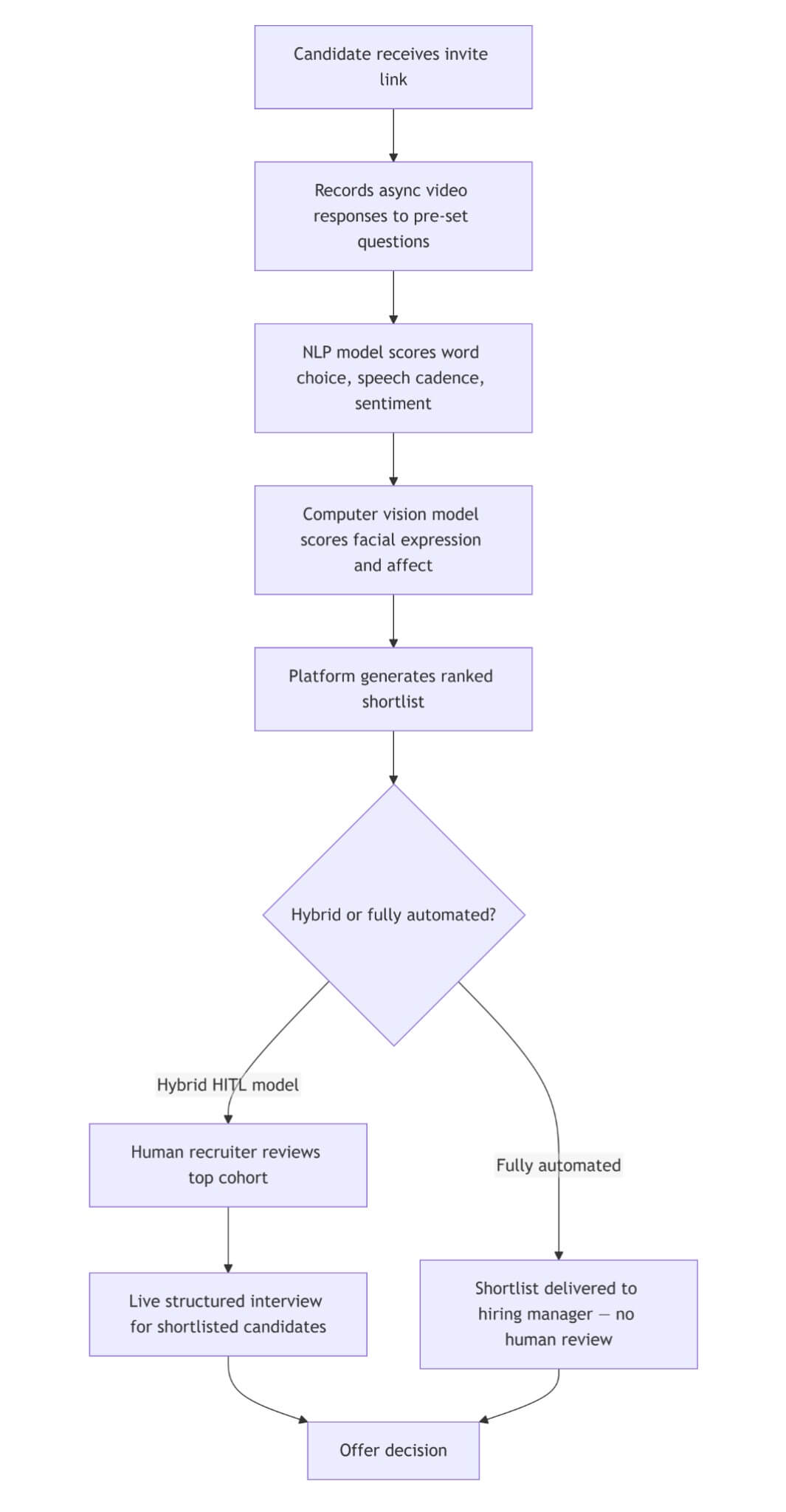
An AI video platform routes candidates through a defined sequence before any human reviewer is involved.
AI Video Interview Platform — Candidate Pipeline
Where the Efficiency Gain Is Real
At high applicant volumes — 200 or more applications per open role — AI video pre-screening can compress shortlisting meaningfully. Illustrative estimates from operator experience suggest time-to-shortlist reductions in the range of 30–60% for volume roles when AI replaces initial recruiter phone screens. The gain is real when three conditions hold:
- Applicant volume is genuinely high
- Question design is tight and role-specific
- Downstream human review is limited to a top cohort rather than the full ranked list
Where the Efficiency Gain Evaporates
The gain compresses or reverses when:
- Human review is still required downstream. Many employment law practitioners now recommend human-in-the-loop (HITL) hybrid models — AI pre-screens and ranks, a human recruiter reviews the top cohort via live interview — as the minimum risk-mitigation standard. If your process requires human review anyway, the time savings shrink.
- Candidate drop-off is high. Asynchronous AI video platforms consistently show higher abandonment rates than live recruiter screens. Illustrative operator observations suggest 15–40% higher abandonment on async platforms, with drop-off concentrated among candidates who receive no clear explanation of how AI scoring works. In a competitive talent market, that is not a rounding error — it is qualified candidates self-selecting out.
- Infrastructure is uneven in the source market. Provincial Philippines presents a specific operational constraint. Candidates in Cebu’s outer municipalities, Davao’s secondary cities, or Luzon’s rural corridors may lack the stable high-definition video connections that AI video platforms require for accurate facial expression and speech analysis.
The Hybrid Architecture: Where the Evidence Points
The operational and legal evidence converges on a hybrid architecture:
AI pre-screen → Human recruiter review → Live structured interview for shortlisted cohort
This model captures the volume-processing efficiency of AI at the top of the funnel while preserving the human judgment, cultural fit assessment, and candidate experience that protect offer acceptance rates and reduce legal exposure. Employment law practitioners increasingly recommend HITL hybrid models as the minimum risk-mitigation standard for agencies deploying AI hiring tools.

Key Benefits
Speed at Scale — With Conditions Attached
AI video pre-screening delivers its clearest benefit at high applicant volumes. Illustrative operator experience suggests time-to-shortlist reductions in the range of 30–60% for volume roles, provided question design is tight, applicant volume is genuinely high, and downstream human review is scoped to a top cohort only.
Standardization of the Initial Screen
Every candidate answers the same questions under the same conditions. This removes the recruiter-to-recruiter variability that makes unstructured phone screens difficult to compare across a large applicant pool. When paired with a structured scoring rubric, the initial screen becomes auditable in a way that an ad hoc phone call is not.
Scalability Without Linear Recruiter Headcount Growth
For agencies managing seasonal hiring surges or rapid client ramp-ups, AI video platforms allow the top-of-funnel to scale without proportional increases in recruiter labor hours. This is the core economic argument for the technology — and it holds when hiring volume is genuinely high and sustained.
Documented Screening Records
AI video platforms generate timestamped, recorded candidate responses that can be retained as part of a hiring audit trail. For agencies subject to EEO documentation requirements, a consistent recorded screen is easier to defend than recruiter call notes of variable quality.
Reduced Scheduling Friction
Asynchronous video eliminates the coordination overhead of scheduling live phone screens across time zones — a material benefit for offshore staffing agencies managing candidate pools in the Philippines and client stakeholders in the US.
Important caveat: Each of these benefits is conditional. The efficiency gains compress when candidate drop-off is high, when human review is still required downstream, or when the candidate population’s infrastructure or accent profile does not match the model’s training data. Benefits should be validated against your specific candidate market before full deployment.
AI Video Platform Cost Model
AI video platforms typically charge per seat or per interview volume — SaaS subscription structures that are predictable at scale but front-loaded in cost relative to hiring volume. At low hiring volumes, the per-interview cost can exceed the recruiter labor cost it was meant to replace.
Traditional Screening Cost Model
Traditional screening costs are embedded in recruiter labor hours. The fully-loaded cost of a US-based recruiter conducting phone screens — including benefits, overhead, and management time — is materially higher than the equivalent cost of a Philippines-based recruiter. That variable changes the break-even math significantly for agencies already operating offshore recruiting functions.
The Hidden Costs That Break the Model
| Cost Category | AI Video Platform | Traditional Screening |
| Direct per-hire cost | SaaS subscription + setup | Recruiter labor hours |
| Compliance overhead | Bias audits, DPA review, consent management | Standard EEO documentation |
| Candidate drop-off cost | Potentially high (15–40% illustrative abandonment) | Lower for live screens |
| Vendor lock-in/data portability | Material risk at contract end | Minimal |
| Infrastructure dependency | High (bandwidth, device access) | Low (phone screen fallback available) |
| Senior role offer acceptance | Reduced in fully automated pipelines | Higher with human touchpoint |
| Legal exposure (disparate impact) | Employer retains liability | Employer retains liability |
The Break-Even Calculation Agency Owners Skip
The break-even point is not just a function of subscription cost versus recruiter hours. It includes:
- The cost of compliance infrastructure (bias audits, DPA review, consent management systems)
- The cost of candidate drop-off in a competitive talent market
- The cost of offer acceptance decline for senior roles in fully automated pipelines
- The cost of legal review and potential renegotiation if vendor data processing terms conflict with Philippine DPA obligations
One composite case (detailed in the case studies section below) shows this exposure clearly: a staffing firm’s renegotiation costs after a vendor data-license conflict exceeded its entire annual subscription cost.
Anonymized composite case studies based on engagements and industry patterns; no real firm names or fabricated incidents are attributed.
Global Case Studies
Composite Case: Accent Bias in an Offshore Accounting Pipeline
An anonymized US accounting firm using an offshore staffing agency found that AI video scores systematically ranked candidates with neutral American-adjacent accents higher than equally qualified candidates with regional Philippine accents, despite comparable technical test scores. A subsequent human review pass reversed rankings in approximately one-fifth of cases reviewed.
That one-in-five reversal rate is not a minor calibration issue. It is a structural signal that the model’s training data did not adequately represent the candidate population being evaluated.
Composite Case: Vendor Data Terms Conflicting with DPA Obligations
A BPO-adjacent staffing firm discovered mid-contract that its AI video vendor’s terms of service granted the vendor a broad license to use candidate video data for model training. Upon legal review against Philippine Data Privacy Act obligations, the firm was required to renegotiate data processing agreements and notify affected candidates. The renegotiation cost — in legal fees, operational disruption, and candidate trust — exceeded the platform’s annual subscription cost.
Composite Case: Provincial Bandwidth Limiting Platform Effectiveness
See the Philippines Relevance section below for a detailed case on how provincial bandwidth constraints affected one agency’s platform rollout.
Composite Case: Vendor Audit Transparency at Procurement
One composite agency owner evaluated three AI video platforms and found that none would provide independent third-party bias audit results under NDA prior to contract signing. The agency ultimately required a contractual clause mandating annual bias audit disclosure as a condition of renewal. That procurement practice is now a baseline recommendation for agencies sourcing from non-native English-speaking markets.
All cases are anonymized composites based on industry patterns. No real firm names or fabricated incidents are attributed.
Philippines Relevance & Local Examples
The Philippine Data Privacy Dimension
For offshore staffing agencies sourcing from the Philippines, the regulatory surface area doubles when AI video platforms enter the pipeline.
The Philippine Data Privacy Act of 2012 (Republic Act 10173) requires that personal data — including video recordings and AI-generated candidate scores — be processed under a lawful basis, with data subjects informed of the purpose, retention period, and any automated decision-making involved. Candidate scores generated by an AI model are personal data under RA 10173.
The National Privacy Commission (NPC) requires Data Processing Agreements (DPAs) between personal information controllers (PICs — typically the US-based agency owner) and personal information processors (PIPs — typically the Philippine offshore staffing partner or the SaaS platform itself) when candidate data crosses organizational or jurisdictional boundaries. NPC Circular 16-01 establishes the minimum organizational, physical, and technical security measures that PIPs must implement.
This creates a specific due-diligence obligation before deploying any AI video platform for Philippine candidate pipelines:
- Confirm that the vendor’s data processing terms are compatible with NPC-mandated PIP-PIC agreements
- Confirm that candidate data is not being retained or used for model training without explicit consent
- Confirm that deletion rights are enforceable at contract end
Infrastructure Constraints in Provincial Markets
Candidates in Cebu’s outer municipalities, Davao’s secondary cities, or Luzon’s rural corridors may lack the stable high-definition video connections that AI video platforms require for accurate facial expression and speech analysis. One composite US-based offshore staffing agency piloting AI video for Philippine accounting and finance candidates observed notably higher drop-off among provincial applicants, ultimately reintroducing an optional asynchronous audio-only fallback. The platform’s efficiency promise assumed Metro Manila bandwidth. The talent pool did not.
Accent and NLP Bias in the Philippine Candidate Pool
AI models trained predominantly on Western English-language datasets underperform when evaluating candidates from non-native English-speaking markets. As the accounting-pipeline case above illustrates, this isn’t theoretical — it’s a documented pattern with a real reversal rate when human review is added back in.
For agencies whose entire value proposition is sourcing offshore talent, deploying a model with this limitation without independent validation is an operational and legal risk simultaneously.
Philippines-Specific Deployment Checklist
Before deploying any AI video platform for Philippine candidate pipelines, agency owners should confirm:
- NPC-mandated PIP-PIC agreement executed with the SaaS vendor covering candidate video data and AI-generated scores
- Candidate disclosure of automated decision-making, retention period, and data purpose — in plain language, not buried in terms of service
- Data deletion rights contractually enforceable at contract end, with export capability for candidate records
- Vendor training data disclosure — confirm the model has been validated on non-native English-speaking candidate populations
- Audio-only fallback available for candidates in low-bandwidth locations (provincial Cebu, Davao, regional Luzon)
- Bias audit clause in vendor contract requiring annual third-party audit disclosure
- EEOC and applicable state law compliance confirmed for the jurisdiction of the US client receiving candidate shortlists
- HITL review protocol documented — who reviews AI scores, at what threshold, and with what override authority.
The Recruiter Relationship Advantage That AI Cannot Yet Replicate
For offshore staffing agencies specifically, the recruiter relationship and cultural fit assessment remain difficult to automate reliably. A Philippines-based recruiter with domain expertise in accounting and finance talent can read signals — career trajectory, motivation for offshore work, communication style under pressure — that no current commercial AI model scores with validated accuracy across that candidate population.
Anonymized composite case studies based on engagements and industry patterns; no real firm names or fabricated incidents are attributed.
Comparison Table
AI Video Platforms vs. Traditional Screening vs. Hybrid — Side-by-Side
| Dimension | AI Video Platform | Traditional Recruiter Screen | Hybrid (AI + Human) |
| Time-to-shortlist (high volume) | Faster (illustrative: 30–60% compression) | Slower at scale | Moderate — faster than pure traditional |
| Candidate drop-off risk | Higher (illustrative: 15–40% abandonment) | Lower | Moderate |
| Accent/dialect bias risk | High without validated multilingual training | Present but human-adjustable | Reduced with human override layer |
| Infrastructure dependency | High (HD video required) | Low (phone fallback) | Moderate (audio fallback option) |
| Regulatory compliance burden | High (EEOC, state AEDTs, Philippine DPA) | Standard EEO | High — same as AI platform |
| Predictive validity | Unvalidated for most offshore markets | High when structured | High when structured human stage retained |
| Senior role offer acceptance | Reduced in fully automated pipelines | Higher | Preserved |
| Vendor lock-in / data risk | Material | Minimal | Moderate |
| Cost at low hiring volume | Potentially higher per-hire | Lower | Moderate |
| Cost at high hiring volume | Lower per-hire | Higher | Moderate |
How to Read This Table
No column is uniformly superior. The AI video platform column wins on speed at scale and cost at high volume. The traditional recruiter screen column wins on predictive validity (when structured), offer acceptance, and regulatory simplicity. The hybrid column preserves the efficiency gains of AI while recovering the predictive validity and candidate experience advantages of human review — at the cost of maintaining both infrastructure layers simultaneously.
The right choice depends on your hiring volume, your candidate market’s infrastructure profile, your regulatory exposure, and whether your current traditional screen is structured or unstructured. An agency replacing a well-designed structured interview with a fully automated AI pipeline is likely moving backward on predictive validity, not forward.
Conclusion & Actionable Takeaway
AI video interview platforms are not a category to avoid. They are a category to deploy with precision, contractual discipline, and a clear-eyed view of where the technology’s limitations intersect with your specific candidate market.
For offshore staffing agencies sourcing from the Philippines, the operational calculus is more complex than vendor sales decks suggest. Bandwidth disparities, NLP accent bias, Philippine DPA obligations, and EEOC employer liability do not disappear because a SaaS platform handles the screening. They transfer to your agency’s risk register.
The agencies that will extract durable value from AI video tools are those that deploy them as a volume-processing layer — not as a replacement for recruiter judgment — and that build the compliance infrastructure before the first candidate recording is collected, not after the first legal review.
The Recommended Starting Point
Start with a pilot: one role type, one geographic cohort, one quarter of data. Measure these four metrics over a minimum 90-day post-placement window:
- 90-day retention rate of AI-screened placements versus traditionally screened placements
- Hiring manager satisfaction scores for both cohorts
- Offer acceptance rates by screening method and role seniority
- Human override rate in your HITL review stage — a high override rate concentrated in candidates with regional accents or non-standard video setups is a direct signal of model bias requiring vendor escalation or contract renegotiation
The data from that pilot will tell you more than any vendor’s own materials — your post-placement outcomes in your specific candidate market are the only performance reference that reflects your actual hiring context.
For KineticStaff’s offshore staffing framework, see our offshore staffing overview, and for onboarding protocols, see our Philippines data compliance and onboarding checklist.
FAQs
If my AI video vendor is EEOC-compliant, does that protect my agency from disparate impact liability?
No. EEOC guidance is explicit: employer liability for discriminatory outcomes from AI hiring tools remains with the employer, not the vendor, even when the algorithm is operated by a third party. Vendor compliance certifications reduce your vendor’s exposure; they do not transfer liability away from your agency. You must independently validate that the tool does not produce disparate impact against protected classes in your specific candidate population.
What specific contractual clauses should I require from an AI video platform vendor before deploying for Philippine candidate pipelines?
At minimum, require five provisions: (1) a Data Processing Agreement compatible with NPC-mandated PIP-PIC requirements under RA 10173; (2) an annual third-party bias audit disclosure clause as a condition of contract renewal; (3) explicit data deletion and export rights enforceable at contract end; (4) a prohibition on using candidate video data for model training without separate, documented candidate consent; and (5) disclosure of the training data demographics used to build the scoring model.
Does the EU AI Act apply to a US-based offshore staffing agency that only places candidates with US clients?
It depends on whether any part of your hiring pipeline touches EU-based candidates, EU-based client operations, or EU-resident data subjects. If your US client has EU operations and you are screening candidates who may be evaluated for EU-based roles, the high-risk classification under the EU AI Act may apply. Agencies with any EU client exposure should obtain a legal opinion specific to their pipeline architecture before deploying AI video tools.
How do I measure whether AI video pre-screening is actually improving hiring quality, not just speed?
Track four metrics over a minimum 90-day post-placement window: (1) 90-day retention rate of AI-screened placements versus traditionally screened placements; (2) hiring manager satisfaction scores for both cohorts; (3) offer acceptance rates by screening method and role seniority; and (4) the rate at which human reviewers override AI rankings in your HITL review stage. A high override rate — particularly concentrated in candidates with regional accents or non-standard video setups — is a direct signal of model bias requiring vendor escalation or contract renegotiation.
Related Services & Next Steps
Assess Your Current Screening Architecture First
Before evaluating any AI video platform, document your existing screening process: is your current phone screen structured or unstructured? Do you have a standardized rubric and behavioral anchors? If not, the highest-ROI intervention may be structuring your traditional screen before adding AI tooling on top of an inconsistent baseline.
KineticStaff Compliance and Onboarding Resources
For agencies moving toward hybrid or AI-assisted screening for Philippine candidate pipelines, KineticStaff provides:
- Data processing agreement templates compatible with NPC PIP-PIC requirements
- Offshore staffing onboarding protocols covering candidate disclosure, consent management, and HITL review documentation
- Pricing structures for offshore recruiting functions that change the break-even math on AI platform adoption
- Full offshore staffing framework — see KineticStaff
Procurement Checklist Before Signing with Any AI Video Vendor
- Request independent third-party bias audit results — not vendor-produced summaries
- Require validation studies showing predictive validity against actual job performance data in your candidate market
- Confirm training data demographics include non-native English-speaking populations comparable to your source market
- Execute a Data Processing Agreement before any candidate data is collected
- Insert an annual bias audit disclosure clause as a condition of contract renewal
- Confirm audio-only fallback availability for low-bandwidth candidate locations
- Document your HITL review protocol before go-live — who reviews, at what threshold, with what override authority
The Pilot-First Approach
Run a structured pilot before full deployment: one role type, one geographic cohort, one quarter of data. Measure 90-day retention, hiring manager satisfaction, offer acceptance rates, and human override rates. The pilot data will surface model limitations specific to your candidate population before those limitations become compliance events.
For KineticStaff’s offshore staffing services, compliance frameworks, and pricing structures, see KineticStaff, compliance and service structures guide, and offshore team pricing and engagement models.