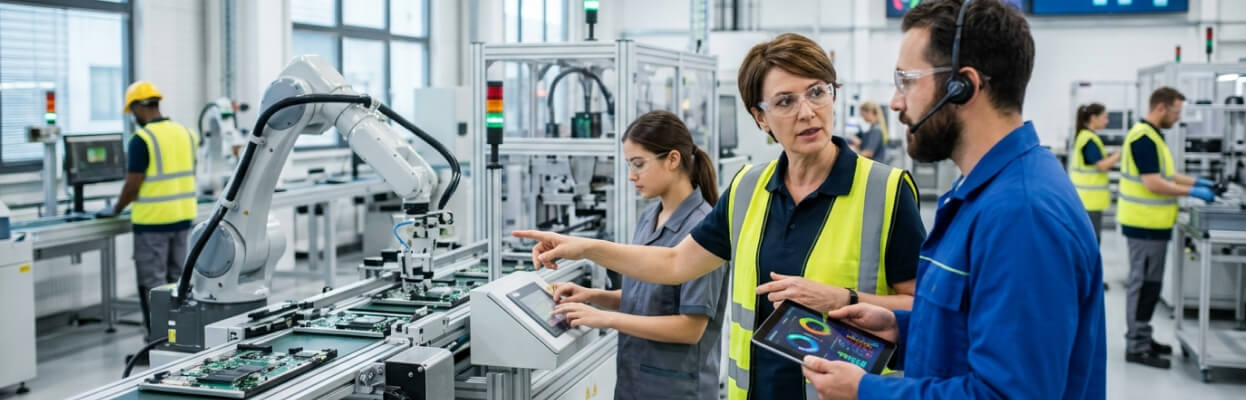
PART 1 — The ROI Pressure Behind Modern Manufacturing and Why Delegation Is Now a Structural Shift
Manufacturing ROI Is Under Real Pressure (Not Theoretical)
If you’ve spent any real time around manufacturing operations in the last few years, you already know the industry has changed significantly.
Margins are tighter. Labor is harder to stabilize. And complexity keeps piling up faster than most teams can absorb it.
Here’s the uncomfortable truth:
Manufacturing isn’t struggling from a lack of effort; it’s struggling because operating models haven’t evolved.
What used to work—fully in-house technical teams, linear workflows, and predictable production cycles—now feels stretched. Not broken, but clearly under strain.
And ROI? It’s no longer just about output.
It’s about structure.
ROI in Manufacturing Has Quietly Changed
Let’s strip it down.
Traditionally, ROI in manufacturing was treated like a clean financial ratio. Input vs. output. Costs vs. profit. Straightforward.
ROI is commonly calculated using the following formula:
ROI = Net Profit ÷ Total Investment
But here’s where most organizations are still thinking too narrowly.
“Investment” today includes far more than machines and materials. It now includes operational friction—things that don’t always show up clearly in financial reports.
Modern ROI is shaped by:
- Workforce efficiency (how talent is actually used)
- Technical execution speed (how fast work gets done)
- Digital system maturity (ERP, MES, IoT integration)
- Downtime behaviour (how quickly issues are resolved)
- Scalability limits (how easily operations expand)
So yes, production might be steady—but ROI can still decline.
That’s the part many teams miss until it shows up in margins.
The Real Drivers of ROI Pressure (What’s Actually Happening on the Ground)
Let’s break down what’s really pushing ROI in the wrong direction. Not theory—actual operational patterns.
1. Skilled labor is becoming a structural constraint.
This is not a temporary shortage. It’s a pipeline issue.
Across manufacturing hubs globally, companies are dealing with:
- Aging technical workforce
- Slower replacement of senior engineers
- Declining entry-level interest in manufacturing roles
- Longer training cycles for complex systems
And the impact is very real.
McKinsey Insight:
Manufacturers that fail to streamline the onboarding experience experience 20–30% lower productivity in early ramp-up phases.
That doesn’t sound dramatic—until you realize it compounds across every shift, every project, every delay.
What this looks like operationally:
- Projects stall waiting for experienced engineers
- Junior staff are overloaded too early
- Knowledge transfer becomes inconsistent
- Critical decisions slow down under uncertainty
The result isn’t chaos. It’s a drag.
Quiet, persistent drag.
2. High-Skill Talent Is Frequently Misused
This is the situation where most executives become uncomfortable.
Because it’s not a hiring problem. It is a deployment problem.
In many facilities:
- Senior engineers are writing documentation
- QA specialists are buried in manual reporting
- Technicians are handling repetitive administrative tasks
Not because they should, but because systems evolved that way.
Impact of Role Misalignment
| Role Level | Task Allocation | ROI Outcome |
| Senior Engineers | Documentation, reporting | Underutilized expertise |
| Mid-level Engineers | Routine coordination | Moderate inefficiency |
| QA Teams | Administrative data entry | Bottleneck creation |
| Technicians | Repetitive tracking tasks | Low-value output |
Here’s the unvarnished truth:
You don’t lose ROI because people aren’t working hard.
You lose it because their effort is not aligned with their value.
3. Workflow Fragmentation Is Slowing Everything Down
Most factories don’t fail in dramatic moments. They slow down in small, almost invisible ways.
You see it in:
- Shift-to-shift reporting delays
- Maintenance requests are getting lost in communication loops
- Lack of centralized operational visibility
- Teams are optimizing locally instead of globally
Individually, none of these feels like an emergency.
But together, they reshape performance.
Operational impact of fragmentation:
- Longer production cycles
- Reduced machine uptime
- Slower issue resolution
- Increased defect probability
And once again, ROI suffers—not from one failure, but from accumulated friction.
4. Training Has Become a Hidden Cost Center
Training used to be a simple onboarding function.
That era is gone.
Modern manufacturing requires the following:
- Digital literacy across multiple systems
- Compliance-heavy technical understanding
- Cross-functional coordination ability
- Machine-specific operational expertise
And that takes time. A lot of it.
World Economic Forum (2025):
Digitized onboarding systems reduce training time by 25–40%, improving time-to-productivity significantly.
But here’s the catch:
Most organizations still rely on fragmented or manual training structures.
So they pay twice:
- Once in training costs
- Again in productivity
The Hidden ROI Leak Most Leaders Underestimate
If visible losses are the obvious problems, hidden losses are the ones that quietly erode competitiveness.
These are the inefficiencies that rarely get executive attention—but consistently impact margins.
Common hidden ROI drains:
- Rework caused by incomplete or delayed documentation
- Machine downtime from slow reporting loops
- Underutilized engineering capacity
- Poor prioritization of technical tasks
- Communication breakdowns between operations and engineering
Visible vs Hidden ROI Losses
| Category | Example | Visibility | Financial Impact |
| Visible | Machine breakdown | High | High |
| Visible | Material waste | High | High |
| Hidden | Engineering inefficiency | Low | Very High |
| Hidden | Reporting delays | Low | Medium–High |
| Hidden | Skill mismatch | Low | High |
Let this sink in:
The most expensive problems are usually the least visible ones.
The Structural Shift: Manufacturing Is Moving Away From the Old Model
This phase is where the industry is quietly rewriting itself.
The traditional model looked like this:
Old Manufacturing Model
- Fully in-house technical teams
- Fixed workforce structures
- Linear production workflows
- Department silos with limited overlap
It worked in a slower, more predictable environment.
But that environment no longer exists.
Now we’re seeing a shift toward the following:
New Manufacturing Model
- Hybrid workforce structures
- Delegated technical execution models
- Distributed engineering support systems
- AI-assisted production workflows
This isn’t future speculation. It’s already happening in mature manufacturing ecosystems.
Delegation Is No Longer Administrative — It’s Technical
This is the point where most companies underestimate the shift.
Delegation is no longer about outsourcing simple tasks.
It now includes core technical functions:
Modern delegation includes the following:
- Engineering documentation support
- QA reporting and compliance tracking
- Maintenance planning and diagnostics coordination
- Production data processing and analysis
- Digital workflow execution support
What’s changed is not the concept of delegation.
It’s the depth of what can now be delegated safely and effectively.
Why This Shift Is Accelerating
There are only a few real drivers behind this change:
- Complexity is increasing faster than internal capacity
- Skilled engineers are too valuable for repetitive work
- Speed of execution is becoming a competitive advantage
- Scaling operations requires flexibility, not fixed overhead
And underneath all of this is a simple truth:
Most manufacturing organizations don’t actually need more people.
They need better distribution of work.
How Delegation Impacts ROI (Mechanically, Not Theoretically)
When executed properly, delegation affects ROI in three measurable ways:
1. Cost Structure Optimization
- Converts fixed labor costs into variable costs
- Reduces dependency on high-cost internal resources
- Enables access to specialized external skill pools
2. Productivity Concentration
High-value teams focus on:
- Process optimization
- System improvement
- Engineering innovation
Instead of administrative overhead.
3. Operational Scalability
- Faster response to demand shifts
- Reduced hiring friction
- Easier expansion without structural bottlenecks
Part 1 Closing: What This Really Means
If you step back, the pattern is impossible to ignore.
Manufacturing ROI is no longer primarily a production issue.
It’s a structural efficiency issue.
And the organizations that recognize this early are already making a shift—not by adding more labor, but by rethinking how labor is used.
Delegation isn’t the end goal. It’s the response to a deeper reality:
Work has become too complex to stay centralized.
Key Takeaways
- ROI in manufacturing is now driven heavily by workforce structure and efficiency
- Hidden inefficiencies often have a greater financial impact than visible losses
- Skilled labor shortages are creating systemic operational pressure
- Traditional in-house-only models are becoming less effective
- Delegation is evolving into a technical and strategic necessity, not just a cost tactic

PART 2 — Delegating Manufacturing Technical Roles: How Efficiency Is Actually Built
Delegation Is No Longer a Cost Conversation
If Part 1 was about pressure, Part 2 is about response.
And let’s be clear—most companies still misunderstand delegation in manufacturing. They treat it like a procurement decision. A way to “reduce cost.”
That’s outdated thinking.
In practice, delegation is not about cutting expenses. It’s about restructuring how technical work flows through the organization so that we don’t bury high-value talent in low-value execution.
Here’s the reality from an operator’s perspective:
If your engineers are doing administrative work, you don’t have a productivity problem. You have a design problem.
And design problems don’t fix themselves.
What Delegation Actually Means in Modern Manufacturing
Let’s strip away the buzzwords.
Delegation today is not just outsourcing. It’s not just offshore staffing. And it’s definitely not “moving tasks elsewhere.”
It’s something more structural:
Modern Delegation = Work Segmentation + Execution Redistribution
That means:
- Breaking technical workflows into value tiers
- Assigning execution based on cost, speed, and expertise
- Keeping high-cognition work in-house
- Moving repetitive or standardized execution outward
Simple idea. Hard execution.
Why Companies Are Moving Toward Delegation Models
There are only a few real drivers behind this shift—and none of them are theoretical.
Key drivers:
- Engineering time is too expensive to waste
- Technical workflows are increasingly standardized
- Digital systems make remote execution viable
- Talent shortages are slowing internal capacity
- Speed-to-output is now a competitive metric
Let’s be honest:
Most manufacturers didn’t plan this shift. They were pushed into it.
Which Manufacturing Technical Roles Can Actually Be Delegated?
This is where execution matters.
Not every function should be centralized. Not every task needs senior engineering oversight.
Below is a grounded breakdown based on how modern manufacturing operations are actually restructuring work.
Table: Delegable Manufacturing Technical Functions
| Function Area | Typical Tasks | Why It Can Be Delegated | Risk Level |
| Engineering Support | CAD drafting, BOM updates | Standardized output | Low |
| Quality Control Support | Inspection reporting, data logging | Rule-based processes | Medium |
| Maintenance Coordination | Scheduling, tracking logs | Process-driven execution | Medium |
| Production Analytics | KPI reporting, dashboards | Data structured & repeatable | Low |
| Documentation | SOPs, manuals, compliance reports | Template-based work | Low |
| Digital Systems Support | ERP/MES updates | Structured system inputs | Medium |
Important distinction most companies miss:
Delegation is not about removing responsibility.
It’s about removing non-critical execution loads.
The Three Real Models of Manufacturing Delegation
Most companies think there’s only one outsourcing model. There isn’t.
In practice, manufacturing organizations evolve through three distinct stages.
1. Internal Delegation: Reallocation Model
Most companies take this initial step, frequently without realizing it.
What it looks like:
- Engineers offloading tasks to junior staff
- Teams redistributing administrative work
- Internal specialization increasing
Pros:
- No external dependency
- Easier control
Cons:
- Limited scalability
- Internal bottlenecks remain
2. Hybrid Delegation: Most Common Model Today
This is where things start to become structurally compelling.
What it looks like:
- Core engineering stays in-house
- Execution-heavy tasks handled externally
- Offshore or remote technical teams support operations
Pros:
- Scalable
- Cost-efficient
- Flexible capacity
Cons:
- Requires strong coordination systems
- SOP discipline becomes non-negotiable
3. Distributed Technical Ecosystem: Advanced Model
This is where leading manufacturers are heading.
What it looks like:
- Global execution teams
- AI-assisted workflows
- Real-time data integration across locations
- Specialized external partners embedded into operations
Pros:
- Maximum scalability
- High efficiency
- Continuous optimization capability
Cons:
- High governance requirement
- Requires a mature digital infrastructure
Where Delegation Actually Breaks Down: Most Companies Don’t Admit This
Delegation fails in predictable ways.
Not because the model is wrong, but because execution discipline is weak.
Common failure points:
- No standardized SOPs
- Unclear task boundaries
- Weak quality control loops
- Overdependence on verbal instructions
- Lack of KPI tracking
Let’s be blunt:
Delegation without structure is just distributed chaos.
How High-Performing Manufacturers Make Delegation Work
The difference between success and failure is not strategy. It’s discipline.
What strong operators actually do:
- Define every task in repeatable formats
- Standardize output expectations before delegation
- Separate “thinking work” from “execution work.”
- Build measurable KPIs for outsourced functions
- Maintain centralized visibility across all teams
Execution Framework: How Delegation Improves Manufacturing ROI
Let’s clarify the connections.
Delegation improves ROI through three direct mechanisms:
1. Cost Structure Transformation
Instead of fixed internal cost growth, companies move toward flexible cost models.
- Lower dependency on high-cost internal labor
- Shift from fixed overhead to scalable support
- Access to specialized labor pools
2. Productivity Reallocation
This area is where most of the value is actually created.
- Engineers focus on design, optimization, and problem-solving
- Repetitive execution moves to specialized teams
- Cycle time reduces because bottlenecks shift out of core teams
3. Speed and Throughput Gains
Speed is underrated in ROI discussions.
But in manufacturing, speed compounds everything:
- Faster reporting = faster decisions
- Faster maintenance response = less downtime
- Faster documentation = faster compliance cycles
Table: ROI Impact Before vs After Delegation
| Metric | Traditional Model | Delegated Model |
| Engineering Focus | Mixed (admin + technical) | High-value work only |
| Cycle Time | Slower due to bottlenecks | Faster execution flow |
| Cost Structure | Fixed-heavy | Flexible and scalable |
| Downtime Response | Delayed | Distributed support |
| Scalability | Limited | High |
The Real Competitive Advantage Behind Delegation
Let’s take a moment to reflect.
Delegation is not just an operational fix. It’s a competitive lever.
Companies that get this right are not simply cutting costs—they are changing their ability to scale.
And in manufacturing, scale determines survival more often than efficiency does.
Where Many Organizations Still Get It Wrong
Even mature manufacturers struggle with the same blind spots:
- Treating delegation as a temporary fix
- Failing to invest in documentation systems
- Over-centralizing decision-making
- Underestimating coordination overhead
- Ignoring cultural alignment across teams
Here’s the stark truth:
Delegation doesn’t reduce complexity. It redistributes it. If you don’t manage that redistribution, you lose control instead of gaining efficiency.
Part 2 Summary: What Actually Matters
If we simplify everything, Part 2 can be summarized as follows:
Delegation only works when it is designed—not improvised.
And the manufacturers, seeing real ROI gains, are not just outsourcing tasks. They are rebuilding how technical work flows across their entire organization.
Key Takeaways
- Delegation is a structural redesign, not a cost-cutting tactic
- Manufacturing technical roles can be safely segmented when standardized
- Hybrid and distributed models are becoming the global norm
- Execution discipline (SOPs, KPIs, governance) determines success
- ROI improves through cost flexibility, productivity focus, and speed gains

PART 3 — Turning Delegation Into ROI: How Technology, AI, and Execution Discipline Are Reshaping Manufacturing Competitiveness
This Is Where Manufacturing Strategy Stops Looking Good on Slides—and Starts Affecting Margins
By the time most manufacturers reach this stage, the conversation usually sounds familiar.
They already know:
- Workforce models are changing
- Skilled labor shortages are getting worse
- Technical roles can no longer stay structured the way they were a decade ago
- AI and automation are no longer optional discussions
But here’s the reality most companies run into:
Delegation alone does not improve ROI.
A surprising number of manufacturers restructure teams, outsource technical functions, and install new software platforms—and still fail to improve operational performance in any meaningful way.
Why?
Because they redesign labor… but ignore execution systems.
That’s where things break.
I’ve seen plants spend millions modernizing operations, while engineers remain trapped in low-value administrative work. Different reporting formats and disconnected systems mean maintenance decisions get buried under layers of approval. Leadership expects transformation, but operational friction quietly multiplies beneath the surface.
This is where the real divide happens:
The manufacturers pulling ahead are not simply delegating work.
They are redesigning:
- Decision flow
- Operational visibility
- Technical execution systems
- Workforce structure
- Performance accountability
And that’s a very different conversation.
3.1 The Direct Relationship Between Delegation and Manufacturing ROI
Most discussions around ROI stay too financial.
In real manufacturing environments, ROI is operational before it becomes financial.
The Modern Manufacturing ROI Equation
ROI can be viewed as the relationship between output efficiency and cost optimization relative to operational complexity.
or
ROI = (Output Efficiency + Cost Optimization) ÷ Operational Complexity
That denominator—operational complexity—is where many organizations quietly lose profitability.
Not because production collapses.
Because friction compounds.
Where Operational Complexity Usually Shows Up
Common friction points:
- Slow maintenance escalation
- Layered approval systems
- Manual reporting processes
- Engineering bottlenecks
- Disconnected ERP/MES workflows
- Poor coordination across technical teams
None of these individually destroys performance.
Together? Different story.
Three Operational Levers That Actually Improve ROI
Manufacturers are seeing measurable ROI improvements through delegation and usually optimize three areas simultaneously.
1. Cost Structure Flexibility
This aspect is often misunderstood.
Smart delegation is not about “cheap labor.”
That mindset creates low-quality execution fast.
The real advantage is structural flexibility.
Operational benefits include:
- Converting fixed labor costs into scalable variable models
- Reducing dependency on overloaded internal engineering teams
- Accessing specialized technical support without permanent headcount expansion
- Scaling execution capacity during production surges
Table: Traditional vs Flexible Labour Structures
| Workforce Model | Characteristics | Operational Impact |
| Traditional Fixed Model | High permanent overhead | Lower flexibility |
| Hybrid Delegated Model | Variable execution support | Faster scalability |
| Distributed Technical Teams | Shared global execution | Higher efficiency potential |
2. Productivity Reallocation
This stage is where the biggest ROI gains often happen.
Not because employees suddenly become more productive, but because skilled talent finally gets redirected toward high-value work.
Common examples of poor allocation:
- Engineers managing repetitive documentation
- QA specialists are buried in reporting tasks
- Technical managers handling manual coordination work
- Maintenance leaders are chasing operational updates manually
That’s expensive cognitive waste.
When delegation is structured correctly:
- Engineers focus on optimization and innovation
- QA teams improve process quality instead of processing paperwork
- Technical leaders solve operational issues instead of administrative bottlenecks
Small structural changes. Massive operational difference.
3. Throughput and Decision Speed
Speed matters more than most manufacturers publicly admit.
Not reckless speed. Decision speed.
Because manufacturing environments are compounding systems.
What happens when execution slows down:
- Maintenance response delays increase downtime
- Downtime affects production schedules
- Production delays affect fulfillment
- Fulfillment issues, pressure margins, and customer retention
One slow decision becomes multiple operational losses.
Table: Operational Performance Before vs After Delegation
| Operational Metric | Traditional Structure | Delegated + Integrated Structure |
| Engineering Focus | Mixed-value work | High-value technical focus |
| Downtime Recovery | Slower escalation cycles | Faster distributed response |
| Reporting Accuracy | Inconsistent | Standardized |
| Decision Speed | Layered approvals | Faster execution flow |
| Operational Visibility | Fragmented systems | Centralized dashboards |
3.2 Technology Is What Prevents Delegation From Becoming Operational Chaos
This approach is the mistake many organizations make.
They delegate work… but never redesign operational visibility.
That creates fragmentation quickly.
Different spreadsheets. Different reporting structures. Different interpretations of the same process.
And eventually:
- Accountability weakens
- Coordination slows
- Leadership loses visibility
Core Technologies Driving Modern Manufacturing Efficiency
The manufacturers seeing measurable gains are usually investing in systems that reduce operational friction—not just flashy innovation projects.
1. ERP and MES Platforms
ERP and MES systems aren’t optional anymore. They’re operational infrastructure.
But here’s what most companies get wrong: they think these systems are mainly about reporting. They’re not.
They’re about decision speed.
When production data lives across disconnected spreadsheets, siloed departments, and inconsistent reporting structures, execution slows down fast.
- Maintenance sees one issue
- Production sees another
- Leadership gets delayed visibility
- Bottlenecks repeat themselves
I’ve seen facilities lose more production time from poor information flow than from actual equipment failures.
What strong ERP and MES systems actually improve:
- Centralized production visibility
- Better cross-facility coordination
- Faster operational awareness
- Real-time workflow tracking
- Reduced reporting delays
- Faster escalation response
- Standardized reporting structures
- Consistent operational data
- Better KPI accuracy
- Cross-functional coordination
- Faster communication between:
- Engineering
- QA
- Maintenance
- Production teams
The real value isn’t the dashboard.
It’s operational clarity.
2. Industrial IoT (IIoT)
IIoT has transformed the manufacturing industry by shifting operations from a reactive to a predictive approach.
That’s the real transformation.
Manufacturers no longer have to wait for equipment failure before taking action.
What IIoT actually improves:
- Real-time machine monitoring
- Continuous equipment visibility
- Faster issue identification
- Predictive maintenance alerts
- Early warning before breakdowns
- Reduced downtime risk
- Continuous equipment diagnostics
- Better root-cause visibility
- Improved maintenance planning
- Faster operational response
- Reduced downtime duration
- Quicker production recovery
- Improved forecasting
- Better production planning
- Reduced operational uncertainty
But here’s the hard truth:
Installing sensors is easy.
Using the data effectively is where most manufacturers struggle.
Many companies collect massive amounts of operational data and still make slow decisions. More dashboards. More alerts. Same bottlenecks.
The manufacturers seeing real ROI from IIoT focus on one thing:
Reducing uncertainty.
3. Digital Twin Technology
A few years ago, digital twins sounded more impressive than practical.
That changed quickly.
Modern manufacturing systems have become too interconnected for trial-and-error decision-making.
One production adjustment can affect:
- Scheduling
- Maintenance
- Staffing
- Throughput
- Quality control
That’s why digital twins matter now.
Why manufacturers are adopting digital twins:
Simulate production changes before implementation
- Reduce operational disruption
- Improve planning accuracy
Lower operational risk
- Test changes virtually first
- Reduce costly implementation errors
Improve process optimization
- Better workflow modeling
- Faster bottleneck identification
Test workflow adjustments safely
- Minimize production interruptions
- Improve execution confidence
Industries seeing the strongest adoption:
- Automotive manufacturing
- Electronics manufacturing
- Aerospace production environments
Because at scale, guessing gets expensive very fast.
4. AI-Driven Operational Analytics
Let’s cut through the noise.
Most manufacturers are not replacing engineering teams with AI.
What they are doing is reducing repetitive operational friction.
Practical AI applications in manufacturing include the following:
- Predictive maintenance forecasting
- Quality deviation detection
- Production optimization recommendations
- Workflow anomaly identification
- Automated reporting assistance
Manufacturing Technology Trends (2025–2026)
Recent industry findings show:
- Over 40% of manufacturers are actively investing in AI-enabled operational systems
- Integrated digital workflows significantly reduce process waste and downtime
- Data-driven facilities outperform traditional plants in:
- Cost efficiency
- Operational speed
- Production consistency
Table: Technology Impact on Manufacturing ROI
| Technology | Primary Benefit | ROI Impact |
| ERP/MES | Operational visibility | Faster coordination |
| IIoT | Predictive maintenance | Reduced downtime |
| Digital Twins | Risk simulation | Lower implementation cost |
| AI Analytics | Decision support | Higher efficiency |
3.3 Workflow Standardization: The Most Underrated Competitive Advantage
Nobody gets excited about standardization.
But experienced operators understand something important:
Scale collapses without consistency.
Delegation doesn’t fail because external teams lack talent.
It fails because internal systems lack clarity.
Areas High-Performance Manufacturers Standardize Aggressively
Core standardization priorities:
- SOPs for technical execution
- Engineering documentation formats
- QA reporting systems
- Maintenance escalation workflows
- Production data protocols
- KPI measurement frameworks
What Happens Without Standardization
Common operational problems:
- Teams interpret tasks differently
- Output quality becomes inconsistent
- Reporting accuracy declines
- Coordination overhead increases
- Error correction costs multiply
What Happens With Strong Standardization
Operational benefits include:
- Predictable execution
- Faster scaling capability
- Improved training efficiency
- Better production consistency
- Reduced management friction
Table: Standardized vs Non-Standardized Operations
| Operational Area | Weak Standardization | Strong Standardization |
| Reporting | Inconsistent | Reliable |
| Training | Slow onboarding | Faster ramp-up |
| Quality Control | Variable output | Stable output |
| Delegation Efficiency | Low | High |
| Scalability | Limited | Flexible |
3.4 Why Delegation Creates Competitive Advantage Beyond Cost Savings
This is the stage where the conversation becomes strategic.
The manufacturers winning right now are not just reducing costs.
They are redesigning operational speed.
Three Competitive Advantages Created by Delegation
1. Speed Advantage
Faster organizations benefit from:
- Faster engineering decisions
- Faster production adjustments
- Faster issue resolution
- Faster product iteration cycles
And speed compounds.
The faster an organization moves, the faster it learns.
2. Structural Cost Efficiency
This is not about becoming “cheap.”
It’s about improving productive output per dollar spent.
Cost advantages include the following:
- Lower fixed overhead
- Better use of engineering resources
- Reduced downtime exposure
- Flexible scaling capability
3. Innovation Capacity
This area is where the strongest manufacturers will separate themselves from the rest.
When technical teams stop drowning in repetitive execution work:
- Process innovation improves
- System redesign accelerates
- Experimentation becomes operationally possible
Innovation is rarely a creativity issue.
Usually, it’s a bandwidth issue.
Table: Competitive Positioning Shift
| Capability | Legacy Manufacturing Model | Modern Delegated Model |
| Speed to Market | Moderate | High |
| Scalability | Slow | Flexible |
| Innovation Capacity | Constrained | Expanded |
| Operational Visibility | Fragmented | Centralized |
| Decision Speed | Delayed | Accelerated |
3.5 Where Manufacturers Still Fail
Even strong organizations struggle with execution.
Not because delegation is flawed.
Because discipline breaks halfway through implementation.
Most Common Failure Points
Operational breakdowns usually involve:
- Weak documentation systems
- Informal communication structures
- Lack of KPI accountability
- Poor workflow governance
- Cultural disconnect across distributed teams
- Treating delegation as temporary labor arbitrage
The Hard Truth
Delegation does not reduce complexity.
It redistributes complexity.
If leadership fails to manage this reallocation proactively, inefficiency will spread at an accelerated rate.
Conclusion: Manufacturing Is Undergoing Structural Redesign, Not Incremental Optimization
This is the larger shift happening underneath the industry.
Manufacturing is no longer evolving through small efficiency gains.
The sector is being structurally rebuilt around:
- Distributed technical execution
- AI-assisted operations
- Digital infrastructure
- Scalable workforce systems
- Faster decision environments
And the companies adapting successfully tend to share three things:
Winning manufacturers typically combine:
- Delegated workforce structures
- Strong operational visibility
- Ruthless execution discipline
Not perfection. Discipline.
Because manufacturing companies rarely fail suddenly.
They lose competitiveness gradually:
- One bottleneck at a time
- One overloaded engineering team at a time
- One delayed decision at a time
Final Key Takeaways
- ROI in manufacturing is increasingly tied to workforce structure and operational efficiency
- Delegation succeeds only when paired with strong systems and execution discipline
- Technology determines whether distributed operations scale successfully
- Standardization is the foundation of manufacturing scalability
- Competitive advantage now comes from speed, adaptability, and decision efficiency
- Innovation improves when technical talent is protected from repetitive execution work
Frequently Asked Questions (FAQ)
1. What does delegating manufacturing technical roles actually mean?
It’s simpler than most companies make it sound.
Too many manufacturers still have highly skilled engineers stuck doing repetitive operational work:
- Documentation
- Reporting
- ERP updates
- QA admin tasks
- Maintenance coordination
That’s not a talent problem. It’s a workflow problem.
Delegation means shifting those execution-heavy tasks to specialized support teams so your core technical people can focus on the work that actually improves production, efficiency, and output.
2. How does delegation improve manufacturing ROI?
Most people assume it’s about cutting labor costs.
That’s only part of the story.
The real value usually comes from speed and focus.
Delegation helps manufacturers:
- Reduce fixed overhead
- Free engineers from repetitive work
- Respond faster to operational issues
- Reduce downtime delays
- Scale more efficiently during demand spikes
The companies seeing the best ROI aren’t just saving money.
They’re moving faster operationally.
3. Which manufacturing roles can be delegated safely?
Not every role should be outsourced. Some decisions need to stay close to the business.
But if you structure processes properly, you can absolutely delegate a lot of technical support work.
Common examples include the following:
- CAD drafting
- QA documentation
- Production reporting
- ERP/MES support
- Maintenance scheduling
- Engineering support tasks
The key is knowing the difference between strategic engineering work and repeatable execution work.
Many companies make those lines unclear. That’s where inefficiency starts.
4. What technologies support manufacturing delegation?
Delegation falls apart quickly without effective systems behind it.
You can’t run distributed operations off spreadsheets and scattered reporting anymore.
Most manufacturers rely on:
- ERP systems
- MES platforms
- Industrial IoT (IIoT)
- AI-driven analytics
- Digital twin technology
- Predictive maintenance systems
At the end of the day, the goal isn’t just automation.
It’s visibility.
Because once operations become distributed, leadership needs to see problems early—not after production is affected.
5. Why is workflow standardization so important?
Because inconsistency gets expensive fast.
Without standardized systems:
- Teams interpret work differently
- Reporting becomes unreliable
- Errors multiply
- Coordination slows down
And once that confusion spreads across departments or external teams, fixing it becomes painful.
Most manufacturers standardize things like the following:
- SOPs
- QA workflows
- Reporting templates
- KPI structures
- Maintenance escalation processes
It’s not glamorous work.
But standardization is what makes delegation scalable rather than chaotic.
6. How is AI changing manufacturing operations right now?
Honestly, AI isn’t replacing entire manufacturing teams the way headlines make it sound.
It removes repetitive operational friction.
That’s where the real value is.
Manufacturers are using AI for:
- Predictive maintenance
- Quality issue detection
- Workflow optimization
- Production planning
- Equipment monitoring
The strongest companies aren’t using AI to replace engineers.
They’re using it to help teams move faster and make better decisions.
7. What are the biggest risks when delegating technical functions?
Usually, the problems aren’t technical.
They’re operational.
The biggest issues tend to be:
- Weak documentation
- Poor communication
- Inconsistent SOPs
- Lack of KPI accountability
- Limited visibility across teams
Here’s the stark truth:
Delegation doesn’t reduce complexity.
It redistributes it.
And if leadership doesn’t manage that properly, inefficiency spreads faster than expected.
8. How do manufacturers maintain quality control with distributed teams?
The good ones become even more disciplined operationally.
They usually rely on:
- Centralized reporting systems
- Real-time dashboards
- Clear KPI tracking
- Standardized QA procedures
- Regular workflow audits
Distributed operations don’t work with loose processes.
If anything, they require tighter execution discipline.
9. Why are manufacturers moving toward hybrid workforce models?
Because traditional staffing models are getting harder to sustain.
Manufacturers are dealing with:
- Skilled labor shortages
- Rising labor costs
- Slower hiring cycles
- Increasing production complexity
Hybrid workforce models create flexibility where rigid structures struggle.
They help companies:
- Scale faster
- Access specialized talent globally
- Improve operational flexibility
- Reduce hiring bottlenecks
- Expand execution capacity without massive overhead growth
That flexibility matters a lot right now.
10. How should manufacturers start implementing delegation strategies?
Slowly. And strategically.
The companies that fail usually try to scale too fast before their systems are ready.
Most successful manufacturers start with the following:
- Workflow audits
- Role segmentation
- SOP standardization
- Technology integration
- KPI tracking
- Small pilot programs
The smartest operators don’t rush delegation.
They standardize first. Then scale.
Resources and References
- Kinetic Innovative Staffing
- Deloitte Insights — Manufacturing Industry Outlook
- McKinsey Manufacturing & Industrials Insights
- World Economic Forum — Advanced Manufacturing and Value Chains
- Siemens — Digital Twin & Industrial AI
- MIT Sloan — AI in Manufacturing
- PwC — Artificial Intelligence Insights
- Microsoft Manufacturing Industry Solutions
- IBM Manufacturing Technology Solutions