
Offshore and remote staffing solutions involve the structured engagement of full-time or part-time workers located in a lower-cost labor market — most commonly the Philippines, India, or Eastern Europe — to perform knowledge work previously executed onshore. Unlike project outsourcing or freelance marketplace transactions, offshore staffing produces a dedicated, managed extension of your internal team, operating under your workflows, your quality standards, and your governance model — with a materially lower all-in cost structure. A vendor delivers outputs; an offshore team member delivers capacity.

Three forcing functions have converged to make distributed team construction a C-suite priority rather than an IT or HR experiment.
| Model | Structure | Who Owns Output Quality | Best Fit | Key Risk |
|---|---|---|---|---|
| Staff Augmentation | Individual contributors embedded in client workflows | Client-side team lead | Early-stage pilots; peak-season capacity | High client management burden; no offshore supervision layer |
| Managed Service Team | Output-accountable pod with offshore supervisor and QA | Shared: offshore lead + client oversight | Established functions with documented SOPs | Requires SOP maturity before handoff |
| Build-Operate-Transfer (BOT) | Offshore entity built and operated by a partner, then transferred to client ownership | Partner (build/operate phase), then client | Long-horizon, high-volume operations | High setup cost; 18–36 month horizon before transfer |
The practical sequencing most firms follow: Start with staff augmentation to validate role fit and output quality. Transition to a managed service model once SOPs are documented and a qualified offshore team lead is identified. Reserve BOT for firms with 50+ offshore FTEs and a multi-year commitment.
Phase 1 — Pre-Launch (Weeks 1–8)
Launching before SOPs are documented is the most common pre-launch failure. Offshore contributors cannot perform to standard if the standard is not written down. The SOP library must exist before go-live — not as a post-launch project. Require SOP sign-off as a go-live gate.
Phase 2 — Ramp-Up (Months 1–3)
Treating offshore onboarding as identical to onshore onboarding is the defining ramp-up failure mode. The absence of physical proximity, informal mentorship, and hallway context means structured onboarding must compensate explicitly. Illustratively, 60–120 days is the typical range to full productivity for an offshore knowledge worker — longer for complex roles with thin SOP coverage. A 90-day structured ramp program with weekly check-ins, a dedicated offshore team lead as the primary point of contact, and explicit career pathing conversations at the 60-day mark materially improves year-two retention.
Phase 3 — Steady State (Month 4+)
Governance decay is the steady-state failure mode. The three-layer oversight model erodes when the client-side team lead becomes a bottleneck or the offshore team lead role is left vacant after turnover. Quality variance widens. Calibration sessions stop. The offshore team operates in isolation. Quarterly governance reviews, blind QA cycles on a defined sample of output, and scheduled synchronous calibration calls — even monthly — prevent drift.
For a function-by-function view of which roles are best suited for offshore deployment, see Which Roles Are Best Suited for Offshore Staffing? A Function-by-Function Breakdown.
The most operationally resilient distributed teams run on a three-layer oversight structure. Single points of failure in communication or output review are the primary cause of quality degradation in offshore engagements.
Three-Layer Offshore Governance Model
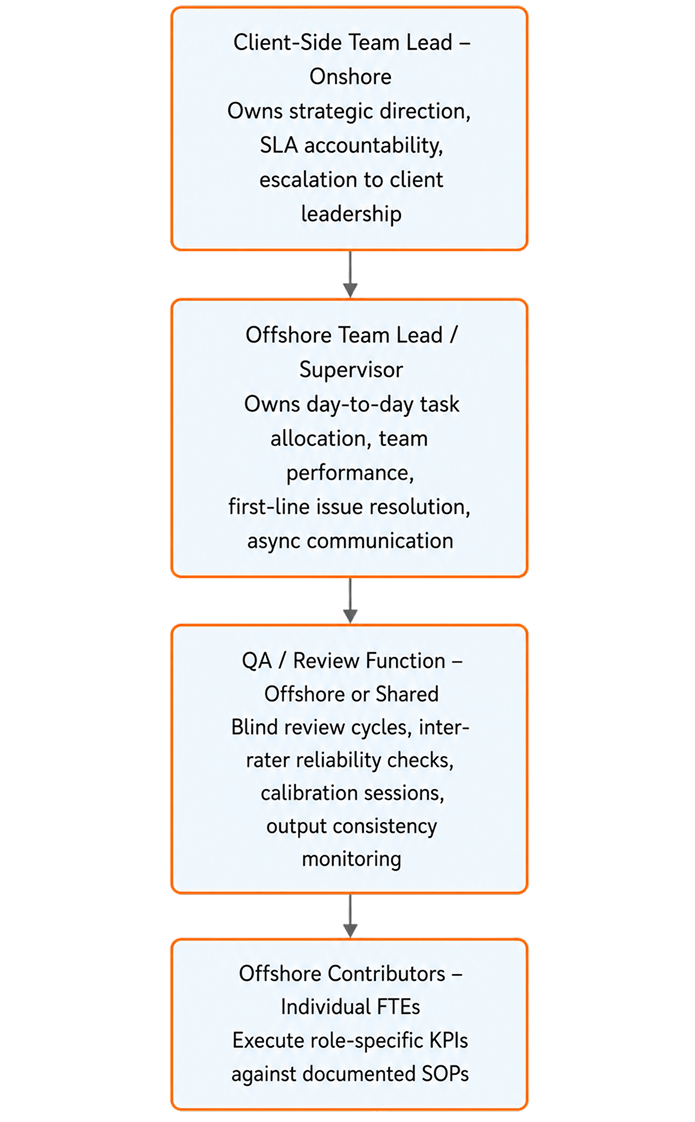
The escalation matrix is non-negotiable. Every distributed team needs a documented artifact specifying who owns a problem at each severity level and what the response SLA is. Without it, cross-timezone incidents default to email chains and missed handoffs.
Philippine Standard Time (UTC+8) sits 12–13 hours ahead of US Eastern time. The overlap window for standard business hours is effectively zero. This is a design constraint, not a dealbreaker — but it requires explicit architectural decisions.
The async-first protocol is the operational standard for high-performing US-Philippines distributed teams:
For a deeper treatment of communication, culture, and performance management in distributed teams, see Managing Offshore and Remote Teams: Communication, Culture, and Performance That Actually Works.
| Lever | Mechanism |
|---|---|
| Manager quality | Offshore team lead accessibility and coaching quality is the single strongest predictor of early retention |
| Career pathing | Explicit 6-month and 12-month role progression conversations — offshore contributors who see a path stay longer |
| Psychological safety | Inclusive communication norms; offshore contributors who feel safe raising quality concerns catch errors before they reach clients |
| Compensation benchmarking | Annual market rate review against current Philippine labor market data; below-market compensation is the most common trigger for voluntary attrition |
| Recognition cadence | Structured performance recognition — not just annual reviews — reduces disengagement in remote environments |
Cross-cultural training is not a soft-skills luxury. Organizational behavior research consistently identifies psychological safety and deliberate cross-cultural communication norms as significant predictors of distributed team cohesion. Train client-side team leads on communication style differences, document expected norms in the team handbook, and build explicit feedback loops between onshore and offshore contributors.
Cost Arbitrage That Survives Full-Stack Modeling
The all-in cost differential between equivalent onshore US and offshore Philippine professional roles is illustratively in the range of 40–70% lower — not on salary alone, but when the full cost stack (statutory load, EOR fees, tooling, management overhead, and attrition replacement) is modeled against US market benchmarks. That differential is the structural margin lever that makes offshore staffing a capital allocation decision rather than a line-item reduction.
For a detailed breakdown of what your firm can realistically save, see Offshore Staffing Cost Savings: How Much Can Your Business Actually Save?.
ust be addressed before the first hire starts, not after the first payroll cycle.
Access to a Deep, Formally Credentialed Talent Pipeline
The Philippines produces substantial annual graduate output in accountancy, business administration, and IT — the disciplines most relevant to back-office and professional services offshoring. This is not a thin freelance market; it is a structured professional labor pool with formal credentials, established offshore work norms, and English proficiency at scale.
Operational Resilience Through Distributed Capacity
A well-governed offshore team is not a cost center — it is a capacity buffer. Firms with established offshore teams can absorb peak-season volume, cover onshore attrition, and extend operating hours without the lead time and cost of onshore hiring cycles.
Compliance-Ready Engagement Structures
Employer-of-record (EOR) arrangements allow US-based companies to engage Philippine workers without establishing a local legal entity, with statutory employer obligations — SSS, PhilHealth, Pag-IBIG remittance, payroll processing, and mandatory benefit administration — assumed by the EOR. This reduces setup time from months to weeks and eliminates the entity registration risk for firms at early offshore maturity stages.
Compounding Returns on SOP and Governance Investment
The SOP library, escalation matrix, and governance architecture built for an offshore team of four to six FTEs scales to a team of twenty without proportional reinvestment. The infrastructure compounds. Firms that build correctly in the first engagement cycle extract disproportionate value in subsequent growth phases.
For a comprehensive overview of why Australian and US businesses choose the Philippines as their primary offshore destination, see Offshore Staffing in the Philippines: Why Australian Businesses Choose It and How to Start.
Simple salary comparison is the most common analytical error in offshore business case construction. The accurate model includes every layer of cost.
| Cost Component | Notes |
|---|---|
| Base salary | Market rate for role and seniority in target city — Metro Manila vs. Cebu vs. secondary cities |
| Statutory benefit load | SSS, PhilHealth, and Pag-IBIG employer contributions — approximately 12–15% above base salary per published contribution schedules |
| 13th month pay | Mandatory under Philippine labor law — equivalent to one month’s base salary, paid annually |
| EOR or entity setup fees | EOR markup typically charged as a percentage of salary or flat monthly fee per headcount |
| Tooling and infrastructure | Endpoint management, VPN/zero-trust access, project management platform, communication stack |
| Management overhead | Offshore team lead salary, QA function, client-side coordination time |
| Attrition replacement cost | Recruitment, onboarding, and ramp-up cost per replacement hire — illustratively 60–120 days to full productivity |
| Training and SOP development | One-time investment; amortizes over team tenure |
adds approximately 12–15% above base salary per published contribution schedules from each agency. This figure excludes the 13th month pay obligation (one additional month of base salary, mandatory under the Philippine Labor Code), which should be modeled as a separate line item. Total statutory and mandatory benefit cost above base salary is therefore closer to 20–27% when 13th month is included — a figure that materially changes offshore cost modeling if omitted.
When this full stack is modeled against US market benchmarks for equivalent onshore roles, the all-in offshore cost differential remains substantial — illustratively 40–70% lower depending on role and model. But the floor is higher than the salary line alone suggests.
One anonymized composite financial services back-office operation found that salary-only comparison had understated true offshore cost by a meaningful margin, prompting a revised capacity model. Build the full cost stack before committing to a business case.
Metro Manila (BGC, Makati, Ortigas) carries the highest wage levels in the Philippines. Cebu City runs illustratively 10–20% below Metro Manila for comparable roles. Secondary cities — Davao, Iloilo, Clark — run illustratively 15–25% below Metro Manila. The secondary city arbitrage is real but requires EOR infrastructure that can operate outside the primary hubs.
For a structured view of pricing models and engagement options, see offshore team pricing and engagement models.
Anonymized composite case studies referenced throughout this section are based on generalized engagement patterns and do not represent specific named organizations.
A US tax and advisory firm (anonymized composite) piloted staff augmentation for tax return preparation support during peak season. After two seasons of validated output quality, it transitioned to a year-round managed service team — reducing per-return processing cost and eliminating the annual rehiring cycle. The transition worked because the SOP library was built during the augmentation phase, not after. This sequencing — augment first, earn the right to managed services — is the pattern that consistently produces durable outcomes.
A US-based accounting practice (anonymized composite) in the $8–20M revenue band transitioned bookkeeping and accounts payable functions to a Philippine team of 4–6 FTEs. The practice achieved documented per-transaction cost reduction specifically because SOP documentation was completed before the first offshore hire started. The SOP-first discipline was the operational differentiator — not the wage arbitrage alone.
A composite healthcare-adjacent services firm implemented the three-layer governance model for its offshore data processing team. The QA layer enabled it to meet HIPAA-aligned data handling requirements and pass a client security audit — without restructuring the offshore engagement. The governance architecture was the compliance mechanism, not just an operational convenience.
A mid-sized US legal services support firm (anonymized composite) implemented NPC-compliant Data Processing Agreements and endpoint security controls for its Philippine offshore team processing client documents. This enabled it to satisfy its own clients’ data security questionnaires without restructuring the offshore engagement. The compliance investment was a one-time setup cost; the operational benefit was ongoing.
A mid-market professional services firm (anonymized composite) that redesigned its offshore onboarding program — adding a 90-day structured ramp with weekly check-ins, a dedicated offshore team lead as the primary point of contact, and explicit career pathing conversations at the 60-day mark — saw materially improved year-two retention after elevated first-year attrition in its initial offshore cohort. The redesign cost was modest; the retention improvement compounded over subsequent hiring cycles.
For a broader view of how legal and compliance structures protect offshore engagements, see Offshore Staffing Legal and Compliance Guide: Contracts, IP Protection, and Data Security.
The Philippines occupies a specific and defensible position in the global offshore labor market. It is not the cheapest destination — Vietnam and parts of Eastern Europe can undercut on raw salary for certain technical roles. What the Philippines offers is a combination of factors that matter specifically for knowledge-intensive, client-facing, or compliance-adjacent work.
English proficiency at scale. A US-influenced education system has produced a large English-proficient labor pool with cultural familiarity with Western business norms — reducing the communication friction that degrades output quality in other offshore markets.
Deep professional services talent pipeline. Substantial annual graduate output in accountancy, business administration, and IT — the disciplines most relevant to back-office and professional services offshoring — flows from Philippine universities each year.
Established IT-BPM infrastructure. Metro Manila (BGC, Ortigas, Makati) and Cebu City have mature commercial real estate, redundant fiber connectivity, and a workforce already conditioned to offshore professional work norms. Secondary cities — Davao, Iloilo, Clark — offer lower attrition and lower wage pressure for firms willing to operate outside the primary hubs.
Employer-of-record (EOR) ecosystem. US-based companies can engage Philippine workers without establishing a local legal entity. An EOR assumes statutory employer obligations under Philippine labor law, reducing setup time from months to weeks.
| Control Layer | Minimum Requirement |
| Endpoint management | MDM policy enforced on all offshore devices; remote wipe capability |
| Network access | VPN or zero-trust network access (ZTNA); no public Wi-Fi for sensitive data processing |
| Access controls | Role-based access; MFA on all client-facing systems |
| Data handling | Contractual data security annexes aligned to client’s home-country requirements (SOC 2, HIPAA, GDPR as applicable) |
| Incident response | Documented escalation matrix with defined SLAs for security incidents |
| Audit readiness | Logging and monitoring sufficient to support client security questionnaire responses |
For a complete guide to operating compliantly in the Philippines, see Offshore Staffing in the Philippines: Why Australian Businesses Choose It and How to Start.
| Model | Structure | Who Owns Output Quality | Best Fit | Key Risk |
|---|---|---|---|---|
| Staff Augmentation | Individual contributors embedded in client workflows | Client-side team lead | Early-stage pilots; peak-season capacity | High client management burden; no offshore supervision layer |
| Managed Service Team | Output-accountable pod with offshore supervisor and QA | Shared: offshore lead + client oversight | Established functions with documented SOPs | Requires SOP maturity before handoff |
| Build-Operate-Transfer (BOT) | Offshore entity built and operated by a partner, then transferred to client ownership | Partner (build/operate phase), then client | Long-horizon, high-volume operations | High setup cost; 18–36 month horizon before transfer |
Regional Hub Comparison: Metro Manila vs. Cebu vs. Secondary Cities
| Dimension | Metro Manila (BGC/Makati/Ortigas) | Cebu City | Secondary Cities (Davao, Iloilo, Clark) |
|---|---|---|---|
| Talent pool depth | Largest; widest range of specializations | Strong in IT, BPO, accounting | Narrower but growing; strong for specific disciplines |
| Wage levels | Highest in Philippines | 10–20% below Metro Manila (illustrative) | 15–25% below Metro Manila (illustrative) |
| Attrition pressure | Highest; competitive poaching common | Moderate | Lower; less competitive labor market |
| Infrastructure | Mature; redundant connectivity | Strong; established BPO infrastructure | Variable; improving but less redundant |
| EOR/entity availability | Widest provider network | Good coverage | Limited; may require Metro Manila-based EOR |
| Best fit | Complex professional services; senior roles | Mid-complexity BPO; IT support; accounting | High-volume, lower-complexity functions; retention-sensitive roles |
Offshore Destination Comparison: Philippines vs. Alternatives
| Dimension | Philippines | India | Eastern Europe |
| English proficiency | High; US-influenced education system | High; large English-proficient pool | Variable; strong in major tech hubs |
| Professional services depth | Strong in accounting, finance, legal support, healthcare admin | Strong in IT, finance, engineering | Strong in IT, software development |
| Time zone (vs. US Eastern) | UTC+8; 12–13 hours ahead | UTC+5:30; 9.5–10.5 hours ahead | UTC+1 to UTC+3; 6–8 hours ahead |
| EOR ecosystem maturity | Mature; wide provider network | Mature | Variable by country |
| Wage trend | Rising, particularly Metro Manila | Rising in major tech hubs | Rising in primary hubs |
| Best fit for US firms | Knowledge work, compliance-adjacent, client-facing roles | IT, engineering, large-scale BPO | IT, software, nearshore-adjacent functions |
Firms prioritizing retention over raw cost savings increasingly route mid-complexity roles to Cebu or Iloilo, where the competitive poaching dynamic is less acute than in Metro Manila.
Offshore staffing is a capital allocation decision, not a cost-cutting tactic. Firms that treat it as the latter build fragile teams with high attrition, governance gaps, and quality variance that erodes the cost savings within 18 months. Firms that treat it as the former — investing in SOP infrastructure, governance architecture, compliance frameworks, and retention programs before the first hire starts — build distributed teams that compound in value over time.
Organizations that treat offshore and remote staffing as a structural capability — not a short-term cost lever — will build compounding advantages in talent access, operational resilience, and margin expansion. Long-term solvency depends on locking in compliant EOR or entity structures early, standardizing performance infrastructure before scaling headcount, and continuously auditing jurisdiction risk to avoid reclassification penalties or regulatory exposure that can erase cost savings overnight.
The sequencing that consistently produces durable outcomes:
Document before you hire.
SOP library, escalation matrix, and communication protocol must exist at go-live.
Start with augmentation, earn the right to managed services.
Validate output quality before transferring supervision accountability offshore.
Model the full cost stack.
Statutory load, EOR fees, attrition replacement, and management overhead are not optional line items.
Build the governance architecture on day one.
Three-layer oversight is not bureaucracy — it is the mechanism that prevents quality decay at scale.
Invest in the offshore team lead role.
This is the highest-leverage hire in the entire offshore model. A weak team lead is the most common single point of failure.
The Philippines remains the most defensible offshore destination for US professional services firms requiring English-proficient, compliance-adjacent knowledge work. The cost arbitrage is real. The talent pipeline is deep. The infrastructure is mature. The constraints — time zone, wage inflation, first-year attrition — are manageable with deliberate design.
The firms that will extract durable value from offshore staffing over the next decade are not the ones that move fastest. They are the ones that build correctly.
For a structured assessment of your firm’s offshore readiness, explore KineticStaff’s offshore staffing solutions at KineticStaff.
Permanent establishment risk is triggered when a foreign company’s offshore workers are deemed to constitute a taxable presence in the host jurisdiction — typically through factors such as the authority to conclude contracts on behalf of the foreign entity, a fixed place of business, or a dependent agent relationship. In the Philippines, the Bureau of Internal Revenue (BIR) applies PE analysis under applicable tax treaties and domestic law; in India, the Income Tax Act and relevant DTAA provisions govern; in Colombia, the Tax Statute and OECD-aligned treaty network apply. The practical risk threshold is not a single headcount number — it is a function of the contractual structure, the degree of operational control exercised by the offshore workers, and whether an EOR or direct engagement model is used. An EOR arrangement, where the EOR is the statutory employer and the foreign client retains only operational direction, materially reduces PE exposure compared to a direct independent contractor engagement where the contractor acts as a de facto agent. Firms should obtain jurisdiction-specific tax counsel before scaling beyond early-stage pilots, and should review PE exposure annually as headcount and role scope evolve.
Under a direct independent contractor agreement, the foreign client assumes full misclassification exposure under both US law (FLSA economic reality test, IRS common-law control test) and the host jurisdiction’s labor code. In the Philippines, the DOLE applies a four-fold test and economic dependence doctrine to determine employment status; misclassification findings can result in back-payment of statutory benefits (SSS, PhilHealth, Pag-IBIG, 13th month pay), regularization orders, and administrative penalties. Under an EOR arrangement, the EOR is the statutory employer of record in the host jurisdiction — it assumes the labor law compliance obligation, remits statutory contributions, and administers mandatory benefits. The foreign client’s residual misclassification exposure is limited to the US-law question of whether the EOR structure constitutes a joint employer relationship, which is governed by the degree of behavioral and financial control the client exercises. The practical risk differential is substantial: a direct contractor engagement with a Philippine worker performing full-time, integrated work under client direction carries high misclassification exposure; an EOR engagement for the same worker, properly structured, carries materially lower exposure on both the Philippine and US-law dimensions.
Several enterprise and mid-market HRIS platforms offer multi-currency, multi-jurisdiction payroll modules with APAC and LATAM coverage — including platforms such as Rippling, Deel, Remote, Papaya Global, and Workday (with appropriate payroll connectors). The critical evaluation criteria for distributed teams spanning the Philippines (APAC) and Colombia or Mexico (LATAM) simultaneously are: native statutory compliance updates for each jurisdiction (SSS/PhilHealth/Pag-IBIG in the Philippines; IMSS/INFONAVIT in Mexico; SENA/ICBF/Caja in Colombia); multi-currency payroll processing with FX rate management; integration with the firm’s existing EOR provider network; and audit trail depth sufficient to support statutory reporting requirements in each jurisdiction. No platform eliminates the need for local statutory expertise — the platform automates calculation and remittance; jurisdiction-specific compliance counsel remains necessary for edge cases, regulatory changes, and misclassification risk management. Firms should evaluate platforms against their specific jurisdiction footprint rather than selecting on feature breadth alone.
IP assignment clauses governed solely by US law are not automatically enforceable against Philippine or Indian employees or contractors. In the Philippines, the Intellectual Property Code (Republic Act 8293) governs ownership of works created in the course of employment — employer ownership of employee-created works is recognized, but the clause must be explicitly drafted and executed under Philippine law to be enforceable; a US-law-only assignment clause creates enforceability risk. In India, the Copyright Act 1957 and Patents Act 1970 govern IP ownership; work-for-hire doctrine applies differently to employees versus contractors, and assignment clauses must be in writing and specifically identify the works assigned. Data residency clauses must reference the Philippine Data Privacy Act of 2012 (Republic Act 10173) and NPC regulations for Philippine workers, and the Information Technology Act 2000 and DPDP Act 2023 for Indian workers — a generic GDPR-aligned data handling clause does not satisfy Philippine or Indian regulatory requirements. Non-solicitation provisions are enforceable in both jurisdictions but must be reasonable in scope and duration; Philippine courts apply a reasonableness standard and will void provisions that function as de facto non-compete clauses. The practical requirement is jurisdiction-specific legal review of every employment or contractor agreement before execution — not a US-template agreement with a governing law clause appended. For a structured compliance framework, see Offshore Staffing Legal and Compliance Guide: Contracts, IP Protection, and Data Security.
Assess Your Offshore Readiness Before You Hire
The most common implementation failure is launching an offshore engagement before the internal infrastructure — SOP library, escalation matrix, governance architecture — is ready to support it. Use the onboarding checklist at Philippines data compliance and onboarding checklist to assess readiness across the five go-live gates: SOP documentation, communication protocol, governance structure, compliance framework, and recruitment quality gates.
Explore Engagement Models and Pricing
Staff augmentation, managed service teams, and build-operate-transfer structures carry materially different cost profiles, management burdens, and risk allocations. Review the pricing and engagement model options at offshore team pricing and engagement models to identify the right structure for your firm’s current offshore maturity stage.
Protect These Savings With Strong Team Management
For firms processing personal data through a Philippine offshore team, the compliance structure — Data Processing Agreements, NPC-mandated outsourcing agreements, endpoint security controls, and data security annexes — must be in place before go-live.
Explore the Full Offshore Staffing Knowledge Base
Anonymized composite case studies referenced throughout this article are based on generalized engagement patterns and do not represent specific named organizations.
Free EBook download
Discover how to build a high-performing remote team, reduce costs, and scale your business effortlessly. Get your free copy of The Complete Guide to Remote Staffing now!