
Philippine offshore staffing is a structured employment model in which an Australian business engages skilled workers based in the Philippines — through a managed staffing provider, an Employer of Record (EOR), or a directly registered Philippine entity — to perform defined business functions remotely. The arrangement transfers labour execution offshore while retaining operational control onshore. It is not outsourcing a process to a vendor; it is building a dedicated, managed headcount extension in a lower-cost, English-proficient labour market.

Most offshore staffing engagements are designed around cost and talent. The legal architecture is treated as a downstream formality — something the lawyers handle after the commercial terms are agreed. That sequencing is operationally backwards.
The contract structure you choose determines IP ownership, chain of title, data liability exposure, labor law classification risk, and tax treatment — before a single hire is made. Getting it wrong after the fact is expensive to unwind and, in some jurisdictions, impossible to fully remediate.
This guide is written for CFOs, General Counsel, COOs, and senior operations leads who are either entering the Philippine offshore market for the first time or auditing an existing engagement for legal and compliance gaps. For a broader view of how distributed teams are structured before the legal layer is applied, see Offshore and Remote Staffing Solutions: How to Build a High-Performing Distributed Team.
The Philippines has simultaneously deepened its professional graduate pipeline. The country produces well over 500,000 tertiary graduates annually across disciplines including accounting, finance, IT, engineering, and business administration — fields that map directly onto Australian B2B service needs. English is an official language. The cultural orientation toward Western business norms is genuine, not performable.
The time-zone alignment is the structural advantage that often goes underweighted in initial analysis. Philippine Standard Time (UTC+8) sits only 2–3 hours behind Australian Eastern Standard Time (UTC+10). During AEST business hours, Philippine staff is already mid-morning. No night-shift premium. No asynchronous lag on urgent client deliverables. Real-time collaboration is the default, not the exception.
The 2024 contraction of the Philippine Offshore Gaming Operator (POGO) sector has added a secondary supply effect: a cohort of English-proficient, tech-literate workers re-entering the professional labour market, modestly expanding the available talent pool for legitimate BPO and professional services roles.
The following role categories represent the highest-volume offshore functions for Australian clients in the Philippines, ranked by operational maturity and volume:
| Role Category | Typical Seniority Offshore | Key Compliance Consideration |
|---|---|---|
| Bookkeeping & Management Accounting | Junior–Mid | Philippine CPAs cannot sign Australian financial statements; review/sign-off must remain onshore |
| Tax Preparation Support | Mid | Work product reviewed by Australian CPA/CA; offshore staff perform preparatory functions only |
| Mortgage Processing & Loan Administration | Mid | ASIC back-office perimeter analysis required |
| Software Development & QA Testing | Mid–Senior | IP ownership clauses critical in employment contracts |
| Digital Marketing & Content Creation | Junior–Mid | Brand governance and approval workflows must be defined |
| Virtual Assistance & Administrative Support | Junior–Mid | Data handling protocols for client information |
| Customer Service & Helpdesk | Junior | ACCC/Australian Consumer Law liability remains with Australian entity |
A critical note for accounting firms: Philippine CPAs are regulated by the Board of Accountancy under the Professional Regulation Commission (PRC). They hold valid professional credentials in the Philippines. They cannot, however, sign Australian financial statements or hold an Australian CPA or CA designation without separate accreditation processes. The offshore model for accounting functions is a preparatory and processing model — work is prepared offshore and reviewed, signed, and issued by an Australian-licensed professional onshore. Firms that attempt to blur this line create both regulatory and professional indemnity exposure.
Australian businesses operating under the Privacy Act 1988 (Cth) and the Australian Privacy Principles (APPs) carry cross-border disclosure obligations that do not disappear when data moves to Manila. APP 8 specifically governs cross-border disclosure of personal information, requiring Australian entities to take reasonable steps to ensure overseas recipients handle information consistently with the APPs.
In practice, this means:
This is not optional. It is a structural compliance requirement for any Australian business handling personal information of Australian individuals — which includes virtually every accounting, legal, real estate, and financial services firm.
On the Philippine side, the Data Privacy Act of 2012 (Republic Act No. 10173), enforced by the National Privacy Commission (NPC), requires Philippine entities processing personal data to register with the NPC as Personal Information Controllers (PICs) or Personal Information Processors (PIPs) and to implement Privacy Management Programs.
When conducting due diligence on a Philippine staffing provider, NPC registration status is a non-negotiable verification checkpoint. A provider that cannot produce evidence of NPC registration is a compliance liability, not a cost saving.
Australian businesses in financial services face an additional compliance layer. ASIC’s regulatory framework distinguishes between activities that constitute “financial services” — requiring an Australian Financial Services (AFS) licence — and back-office support functions that fall outside the licensing perimeter.
Offshore staff performing data entry, document preparation, reconciliation support, or administrative processing for an AFS-licensed firm are typically operating within the back-office perimeter. Offshore staff providing advice, making discretionary decisions on client accounts, or directly interfacing with retail clients on financial matters may trigger licensing obligations.
This distinction must be mapped explicitly before role design is finalised. The cost of getting it wrong — ASIC enforcement action, licence conditions, or client remediation — dwarfs any labour cost saving.
Australian businesses managing offshore staff with access to internal systems should benchmark their security posture against the Australian Cyber Security Centre (ACSC) Essential Eight framework. The Essential Eight covers application control, patching, multi-factor authentication, and data backup — controls that become more operationally critical when system access extends across international borders.
ISO/IEC 27001 certification and SOC 2 Type II reports are the relevant third-party assurance standards to request from Philippine staffing providers operating technology-adjacent or data-intensive functions.
For a broader view of how distributed workforce models are structured across multiple geographies, see Offshore and Remote Staffing Solutions: How to Build a High-Performing Distributed Team.
Australian businesses have three primary pathways to engage Philippine workers. Each carries a distinct risk-cost-control profile.
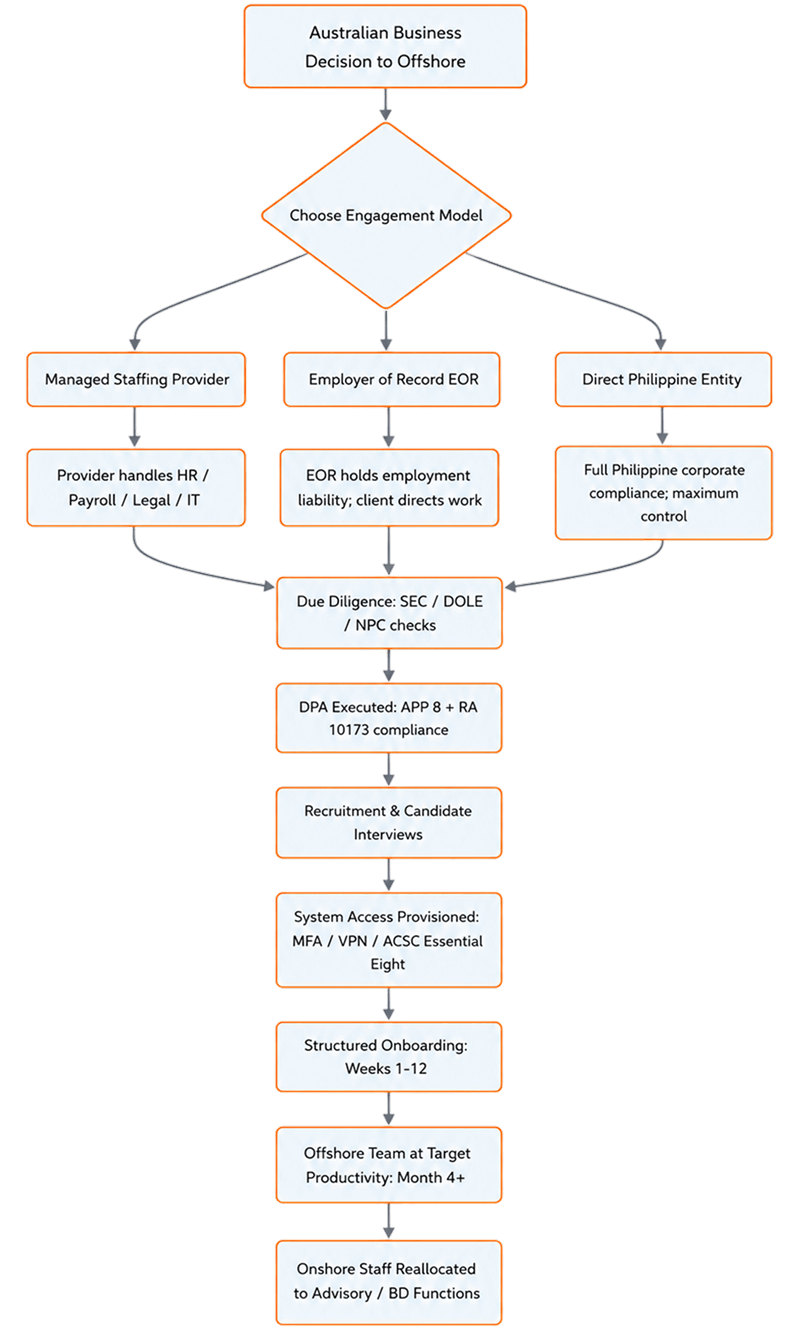
| Engagement Structure | Control Level | Compliance Burden | Speed to Hire | Cost Efficiency |
|---|---|---|---|---|
| Managed Staffing Provider | High (client directs work) | Low (provider handles HR/payroll/legal) | Fast (4–12 weeks) | High (bundled seat fee) |
| Employer of Record (EOR) | High (client directs work) | Medium (EOR holds employment liability) | Medium | Medium-High |
| Direct Philippine Entity | Maximum | High (full Philippine corporate compliance) | Slow (3–6+ months setup) | Highest long-term, highest upfront |
| Independent Contractor | Medium | High (misclassification risk) | Fast | Appears low, hidden risk |
The independent contractor route deserves a specific warning. Under the Philippine Labor Code (Presidential Decree No. 442), workers engaged on a regular basis — typically after a six-month probationary period — acquire security of tenure. Misclassifying a de facto regular employee as a contractor exposes the Australian client to back-pay claims, reinstatement orders, and reputational risk with Philippine labour authorities. This is not a theoretical risk; it is a documented operational failure mode in early-stage offshore arrangements.
The managed staffing model is the dominant entry point for Australian SMEs and mid-market firms precisely because it bundles seat-leasing (physical or virtual workspace), HR administration, payroll processing, IT infrastructure, and compliance management into a single per-seat monthly fee. The cost structure is predictable. The compliance burden sits with the provider.
The following is an anonymized composite based on observed engagement patterns. It does not represent a specific named firm.
A mid-market Australian accounting practice in the $8–20M revenue band with a domestic headcount of 12 professional staff engaged a Manila-based managed staffing provider to build an offshore team of four bookkeepers and two administrative support staff.
The friction points in this composite were not technical. They were managerial: the Australian practice initially underestimated the time investment required from senior staff during the onboarding phase, and the first replacement hire (one bookkeeper resigned at month three) took six weeks to backfill — a timeline that would have been faster had a replacement guarantee clause been negotiated upfront.
Before signing a service agreement, Australian buyers should verify the following:
Legal & Corporate
Operational
Commercial
Philippine offshore staffing delivers value across four distinct dimensions when the engagement is structured correctly.
Philippine Standard Time (UTC+8) sits only 2–3 hours behind Australian Eastern Standard Time (UTC+10). During AEST business hours, Philippine staff is already mid-morning. No night-shift premium. No asynchronous lag on urgent client deliverables. Real-time collaboration is the default, not the exception. This separates the Philippines from nearshore alternatives in Eastern Europe or Latin America that serve North American markets but create genuine working-hours friction for Australian operators.
Philippine Standard Time (UTC+8) sits only 2–3 hours behind Australian Eastern Standard Time (UTC+10). During AEST business hours, Philippine staff is already mid-morning. No night-shift premium. No asynchronous lag on urgent client deliverables. Real-time collaboration is the default, not the exception. This separates the Philippines from nearshore alternatives in Eastern Europe or Latin America that serve North American markets but create genuine working-hours friction for Australian operators.
Philippine Standard Time (UTC+8) sits only 2–3 hours behind Australian Eastern Standard Time (UTC+10). During AEST business hours, Philippine staff is already mid-morning. No night-shift premium. No asynchronous lag on urgent client deliverables. Real-time collaboration is the default, not the exception. This separates the Philippines from nearshore alternatives in Eastern Europe or Latin America that serve North American markets but create genuine working-hours friction for Australian operators.
Free EBook download
Discover how to build a high-performing remote team, reduce costs, and scale your business effortlessly. Get your free copy of The Complete Guide to Remote Staffing now!