
Managing offshore and remote teams is a distinct operational discipline requiring deliberate async infrastructure, cultural calibration for high-context communication norms, output-based performance architecture, and statutory compliance with applicable labor law — all running simultaneously before the first deliverable reaches your desk. It is not remote management with a time-zone adjustment. Firms that treat it as such consistently encounter the same failure modes: manager time erosion, false-positive status updates, first-year attrition spikes, and data security gaps that surface only during client audits.

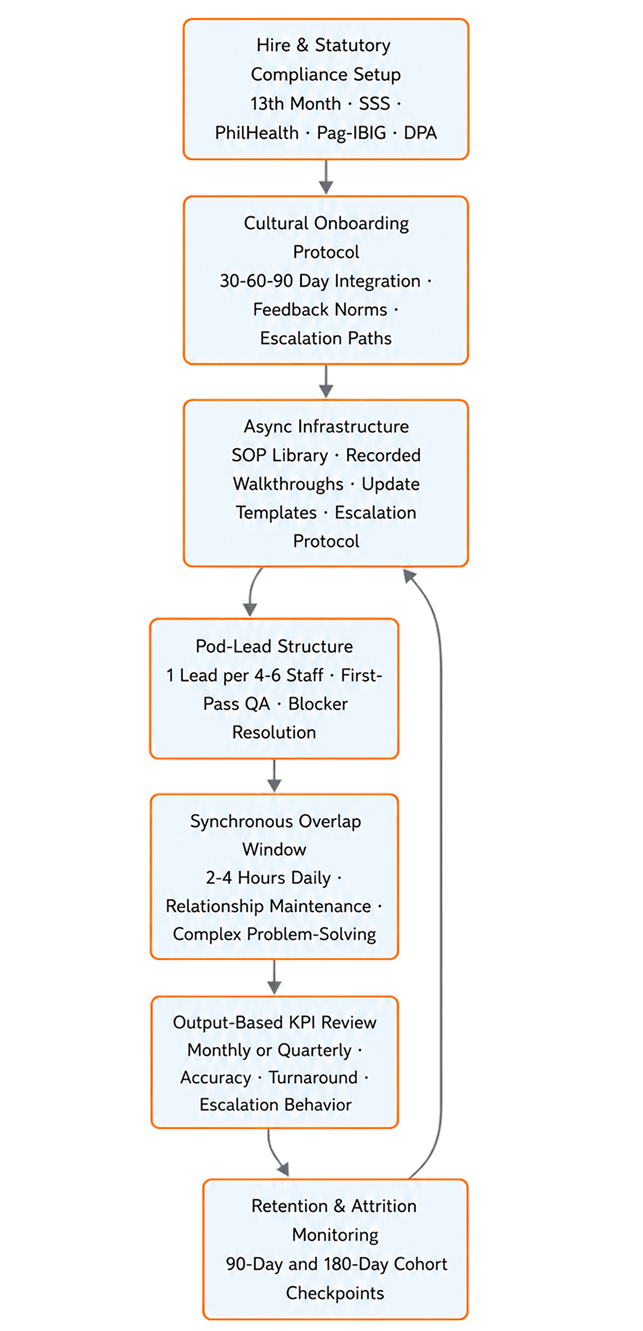
Offshore team management fails most often not at the hiring stage — but at the operational layer. Most failures cluster around five identifiable points that function as a sequence, not isolated incidents. Understanding that sequence is the diagnostic frame that separates firms that course-correct from firms that cycle through offshore vendors without improving outcomes.
Technical onboarding covers systems, tools, and task procedures. Cultural onboarding covers something different: how feedback is given and received, what escalation paths look like, how disagreement is expressed, and what “done” means in the context of client confidentiality and quality standards. Firms that skip cultural onboarding discover the gap at the worst possible moment — typically when a quality issue surfaces that the offshore team had identified internally but did not escalate because the escalation path was unclear or the cultural norm suppressed upward communication.
Screen-time monitoring, hours-logged dashboards, and keystroke tracking are surveillance mechanisms, not performance management systems. They measure presence, not productivity. In offshore accounting and finance contexts, they actively depress engagement by signaling distrust — and they provide no actionable data on whether work quality meets client standards. Output-based KPIs — tasks completed per cycle, error rate per review pass, turnaround time versus SLA, first-pass accuracy rate — measure what actually matters and create an auditable performance record that supports both coaching conversations and, where necessary, performance improvement processes.
A single onshore manager directly supervising eight to twelve offshore staff across a 10-hour time-zone gap is not a management structure — it is a communication bottleneck. Every question, every blocker, every escalation routes through one person who is asleep for most of the offshore team’s working day. The pod-lead model addresses this structurally: one senior offshore team lead per four to six staff serves as the operational and cultural bridge, handling day-to-day task clarification, conducting first-pass quality review, surfacing blockers before they become delays, and maintaining team cohesion during the hours when onshore managers are offline.
Psychological safety — the organizational behavior concept that team members will not be punished or humiliated for surfacing errors — is not a cultural default in high-context communication environments. It is built through consistent behavioral signals from managers: how they respond when errors are raised early, whether they distinguish between systemic process failures and individual performance failures, and whether they create structured channels for upward feedback that do not require a team member to publicly contradict a manager. In offshore accounting and compliance work, the operational stakes are direct: a team member who surfaces a data discrepancy early enables a quick correction; a team member who conceals it creates a downstream rework event — or worse, a client-facing quality failure.
Every offshore team member needs to know, explicitly, what constitutes an escalation-worthy issue, who to escalate to, and what the expected response time is. In the absence of a defined escalation path, team members default to either waiting (which creates delays) or escalating everything (which creates noise). Neither is functional.
A 2–4 hour daily overlap between onshore and offshore working hours is generally sufficient for synchronous stand-ups, escalation handling, and relationship maintenance — provided the async infrastructure is functioning. That window is not for task instruction. It is for relationship maintenance, complex problem-solving that genuinely requires real-time dialogue, and the kind of brief human connection that sustains engagement across a time-zone gap.
Video-on norms during synchronous calls, introduced as a team standard rather than a surveillance mechanism, are broadly associated with faster relationship-building and higher engagement levels in distributed teams. The framing matters: “We use video because it helps us work better together” lands differently than “We require video to verify attendance.”
Context-switching between multiple project management platforms, communication channels, and document repositories is a hidden productivity tax on offshore teams. The standard for a functional offshore operation is one project management platform, one primary communication channel, one document repository, and one video conferencing tool. The specific tools matter less than the discipline of standardization and the enforcement of norms around where work lives.
Annual performance reviews are structurally incompatible with offshore team management. By the time an annual review surfaces a performance issue, the cost of that issue — in rework, client risk, and management time — has already compounded for months. Monthly or quarterly review cadences, combined with the async update template record, allow early course-correction and create the regular one-on-one touchpoints consistently associated with higher offshore staff retention.
For a broader view of how these mechanics integrate into a distributed workforce strategy, see Offshore and Remote Staffing Solutions: How to Build a High-Performing Distributed Team.
The ceiling on offshore team performance is genuinely high when the operational infrastructure is in place. The benefits below are structural — they compound over time rather than delivering a one-time cost reduction.
Credential Depth at Scale
Philippine professionals in accounting, finance, and compliance roles carry credential depth — CPA, CMA, ACCA pathways — English fluency, and institutional familiarity with client-service environments that are difficult to replicate at comparable cost in most markets. The IT-BPM sector employs over 1.3 million workers directly, meaning established training pipelines and professional credential pathways already exist at scale.
Output-Based Performance Visibility
Replacing activity monitoring with output-based KPIs — first-pass accuracy rate, turnaround versus SLA, escalation behavior — gives onshore managers actionable performance data rather than presence data. This creates an auditable performance record that supports coaching conversations, compensation reviews, and, where necessary, performance improvement processes.
Manager
Structured async infrastructure — SOPs, recorded walkthroughs, update templates — reduces the "manager tax" of repeated re-explanation and reactive review. Onshore managers operating within a structured async model commonly observe meaningful reductions in time spent per deliverable review, because deliverables arrive with documented context rather than requiring verbal reconstruction.
Attrition Risk Reduction
First-year attrition in offshore professional services carries a replacement cost typically estimated in the range of several months' fully loaded salary. Structured cultural onboarding, regular one-on-one cadences, and CPD accommodation for Philippine CPAs are direct levers on that attrition risk — making them financial decisions, not soft HR preferences.
Scalable Pod Structure
The pod-lead model creates a reporting architecture that scales without proportionally increasing onshore management overhead. One pod lead per four to six staff absorbs communication latency, conducts first-pass quality review, and maintains team cohesion during offshore hours — enabling onshore managers to oversee larger teams without the bottleneck dynamics of flat direct-report structures.
Dual-Compliance Readiness
Firms that proactively address both Philippine Data Privacy Act obligations and US data security requirements — VPN enforcement, endpoint management, WISP alignment, Data Processing Agreements — carry materially lower regulatory exposure than firms that address only one side of the dual-compliance equation.
The base salary comparison between onshore and offshore staff is the starting point, not the endpoint, of cost modeling. Firms that model only base salary against onshore equivalents consistently underestimate offshore engagement costs — and then attribute the gap to “offshore not working” rather than to incomplete cost modeling.
The fully loaded offshore cost includes the following components, each of which must be modeled before committing to a headcount plan:
For firms directly employing Philippine-based staff, the following are hard statutory obligations, not discretionary benefits:
The combined statutory employer cost load is typically estimated in the 12–15% range above base salary — a figure that must appear in total cost-of-engagement modeling from the outset.
Offshore teams handling US client financial data require VPN enforcement on all devices accessing client systems, endpoint management (device encryption, remote wipe capability), clean-desk policies for staff working from home or shared office environments, and Written Information Security Plan (WISP) compliance for tax practices handling taxpayer data — in line with applicable IRS data security guidance for tax professionals. These are not optional infrastructure items — they are compliance prerequisites that carry cost.
See offshore team pricing and engagement models for current engagement structure details.
The following anonymized composite case studies are based on generalized engagement patterns in offshore professional services. They do not represent specific named organizations.
A US-based accounting practice in the $5–15M revenue band transitioned from ad-hoc email-based task assignment to a structured async workflow — daily update templates, shared SOPs, recorded walkthroughs for each service line. Within a 90-day window, onshore managers observed a meaningful reduction in time spent per offshore deliverable review, primarily because deliverables arrived with documented context rather than requiring verbal reconstruction.
A mid-market CPA firm we advised experienced elevated first-year attrition among offshore staff and traced the root cause to the absence of cultural onboarding. No explicit feedback-norm calibration had occurred. No escalation path had been defined. Staff who encountered ambiguity defaulted to silence rather than surfacing issues. The remediation — a structured 30-60-90 day cultural integration protocol that explicitly addressed communication norms, feedback expectations, and escalation mechanics — measurably reduced both attrition and error escape rates in the following cohort.
A professional services firm replaced activity-based monitoring (hours logged, screen time) with output-based KPIs (tasks completed per sprint, error rate per review pass, turnaround versus SLA). Offshore team engagement scores improved. Voluntary attrition declined. The onshore management team found that performance conversations became more specific and less adversarial because both parties were working from the same output data.
A financial services back-office operation implemented a pod-lead model and observed measurable improvement in error escape rate and SLA adherence compared to its prior flat direct-report structure. The pod leads absorbed the communication latency that had previously caused deliverable delays and reduced the volume of escalations reaching the onshore manager by a meaningful margin.
Anonymized composite case studies referenced above are based on generalized engagement patterns in offshore professional services; they do not represent specific named organizations.
The Philippines is not a generic offshore destination. It carries structural advantages that are genuinely differentiated, and structural dynamics that require active management — both of which have direct implications for how engagements are designed.
English is a constitutional medium of instruction in the Philippines, producing a workforce with deep professional English fluency consistently ranked among the highest in Asia. This is codified in the educational system and reflected in the country’s dominant position in English-language BPO and professional services outsourcing. The IT-BPM sector employs over 1.3 million workers directly, meaning institutional infrastructure — established training pipelines, professional credential pathways (CPA, CMA, ACCA), and a workforce accustomed to structured client-service environments — already exists at scale.
Philippine CPAs and finance professionals are subject to Continuing Professional Development (CPD) requirements under RA 10912, meaning offshore accounting staff carry active professional development obligations. This is a retention and engagement lever that is frequently underutilized by onshore managers. Offshore engagements that build CPD leave allowances into employment terms and identify CPD-eligible training that overlaps with firm-relevant skills — IFRS updates, tax law changes, audit standards — treat CPD compliance as an engagement investment rather than an administrative burden.
Philippine Standard Time is UTC+8. Depending on US daylight saving periods, the gap with US time zones runs 8–13 hours. That is not a scheduling inconvenience — it is a structural constraint that forces a decision: either build async-first workflows that function without real-time handoffs, or accept that your offshore team operates in a perpetual reactive posture waiting for onshore direction.
Filipino professional culture is shaped by pakikisama (group harmony) and hiya (face-saving). These are not personality quirks — they are deeply embedded social operating systems. A team member who does not understand a task instruction will frequently signal confusion indirectly rather than state it explicitly. A manager who asks “Does everyone understand?” and receives universal affirmation has not confirmed comprehension — they have confirmed that no one wants to be the person who admits they don’t understand. This dynamic has direct operational consequences in accounting and compliance work, where unresolved ambiguity compounds into downstream errors.
The diagnostic fix is to replace verbal confirmation checks with comprehension-verification tasks: ask the team member to summarize the task back in their own words, or to complete a small first step and share it before proceeding. The structural fix is to move task instruction out of synchronous calls and into written SOPs and recorded walkthroughs, so comprehension can be verified asynchronously without the social pressure of a live group setting.
The Labor Code of the Philippines (Presidential Decree No. 442) and Presidential Decree No. 851 mandate 13th-month pay, SSS contributions, PhilHealth contributions, and Pag-IBIG contributions for directly employed Philippine workers. The Telecommuting Act (RA 11165) additionally governs how remote work arrangements are structured for Philippine-based employees, including requirements around work conditions, data protection, and voluntary participation.
The Philippine Data Privacy Act of 2012 (RA 10173) requires organizations processing personal data to execute Data Processing Agreements between data controllers and processors. The National Privacy Commission additionally requires registration of data processing systems for organizations meeting specified thresholds — a compliance layer frequently overlooked by offshore engagements handling sensitive client financial data.
For US-based firms, the data security layer extends further. Offshore teams handling US client financial data require VPN enforcement on all devices accessing client systems, endpoint management, clean-desk policies, contractual data handling clauses aligned with applicable US state privacy laws, and WISP compliance in line with applicable IRS data security guidance for tax practices handling taxpayer data. The intersection of Philippine DPA requirements and US data security standards creates a dual-compliance obligation. Firms that address only one side carry unquantified regulatory exposure.
| Dimension | Ad-Hoc / Unstructured Model | Structured Async-First Model |
|---|---|---|
| Task Assignment | Verbal or email, undocumented | SOP-driven, recorded walkthroughs |
| Status Visibility | Manager-initiated check-ins | Structured async update templates |
| Error Detection | Onshore review catches errors post-delivery | Pod-lead first-pass review + output KPIs |
| Escalation | Informal, ad-hoc, often delayed | Defined protocol, response SLA |
| Cultural Calibration | Assumed, not addressed | Explicit 30-60-90 day integration protocol |
| KPIs | Hours logged, activity metrics | Output-based: accuracy, turnaround, throughput |
| Manager Time Cost | High (repeated re-explanation, reactive review) | Lower (structured context reduces re-explanation) |
| First-Year Attrition Risk | Elevated (no cultural onboarding, unclear expectations) | Reduced (structured integration, regular 1:1s) |
| Data Security | Contractual only, operationally unverified | VPN, endpoint management, WISP-aligned protocols |
| Statutory Compliance | Often reactive | Proactive: 13th month, SSS, PhilHealth, Pag-IBIG, DPA |
The KPI framework below maps the specific metrics that predict outcomes in offshore accounting and finance contexts — and the reason each metric matters operationally.
| Metric Category | Illustrative KPI | Why It Matters |
|---|---|---|
| Output Volume | Tasks completed per sprint vs. target | Measures productive throughput, not hours present |
| Quality | Error rate per review pass (first-pass accuracy) | Direct proxy for rework cost and client risk |
| Timeliness | Turnaround time vs. SLA commitment | Measures reliability of delivery, not just completion |
| Escalation Behavior | Blockers surfaced before deadline vs. after | Proxy for psychological safety and communication health |
| Ramp Velocity | Time to first-pass accuracy target for new hires | Measures onboarding effectiveness |
| Retention Signal | 90-day and 180-day retention rate by cohort | Early warning system for cultural or management issues |
Activity-based metrics — hours logged, screen time, keystrokes — appear in this framework nowhere. They measure presence. The metrics above measure performance.
The firms that extract durable value from Philippine offshore teams share a common structural profile: they treat offshore management as a distinct operational discipline, not a cost-reduction tactic with a time-zone adjustment. They build async infrastructure before they hire. They invest in cultural onboarding as seriously as technical onboarding. They measure output, not activity. They create escalation paths that make it safe to surface problems early. And they model the fully loaded cost — including statutory obligations, attrition risk, and infrastructure — before committing to a headcount plan.
The ceiling on offshore team performance is genuinely high. Philippine professionals in accounting, finance, and compliance roles bring credential depth, English fluency, and institutional familiarity with client-service environments that are difficult to replicate at comparable cost in most markets. The floor — what happens when the operational infrastructure is absent — is equally real: manager time erosion, quality escapes, attrition cycles, and compliance exposure.
The distance between ceiling and floor is not determined by the talent. It is determined by the management architecture.
Teams that treat offshore management as a structural discipline — not a supervisory workaround — build compounding operational advantages: lower attrition, faster onboarding cycles, and audit-ready performance documentation that supports long-term workforce scaling without dependency on any single manager or timezone.
Start with the async infrastructure. Build the cultural onboarding protocol. Define the KPIs before the first hire starts. The operational investment required to reach the ceiling is front-loaded. The cost of operating at the floor compounds indefinitely.
Explore how KineticStaff structures offshore engagements at KineticStaff.
Async contribution requires that KPI frameworks weight output and outcome metrics — first-pass accuracy rate, tasks completed per sprint versus target, turnaround time versus SLA — rather than presence or participation metrics that inherently disadvantage async contributors. For compensation reviews specifically, individual performance scores should be calculated from the async update template record (which creates a time-stamped, auditable log of contribution) rather than from manager recall or synchronous participation. OKR frameworks should distinguish between individual key results and team key results, and async contributors should be scored on their individual key results with explicit documentation of any team-level dependencies that affected delivery. The adjustment that most firms fail to make is removing meeting-participation and responsiveness-speed metrics from individual scoring entirely — these systematically penalize offshore contributors operating in non-overlapping time zones and create compensation inequity that accelerates attrition.
Several enterprise and mid-market HRIS platforms offer multi-timezone attendance tracking and multi-jurisdiction payroll compliance modules, but native support for all three functions — attendance, payroll compliance, and structured performance documentation — in a single platform is less common than vendors represent. The practical evaluation criteria are: whether the platform supports Philippine statutory deduction schedules (SSS, PhilHealth, Pag-IBIG, 13th-month pay) natively or requires manual configuration; whether performance documentation (PIP records, review cycles, async update logs) is stored in a format that is exportable for audit purposes; and whether attendance records are timezone-aware at the individual employee level rather than normalized to a single timezone. Firms spanning three or more jurisdictions typically find that a core HRIS handles payroll compliance per jurisdiction while a separate project management or performance management layer handles output-based KPI documentation — and the integration between those systems, not the individual platforms, is the operational risk point.
Under GDPR, any transfer of EU personal data to the Philippines (a country without an EU adequacy decision as of current regulatory status) requires a lawful transfer mechanism — Standard Contractual Clauses (SCCs) are the most commonly used instrument, and they must be accompanied by a Transfer Impact Assessment evaluating Philippine law’s ability to protect the data. Under CCPA, offshore access to California residents’ personal information by a service provider requires a written contract specifying that the service provider will not sell or share the data, will use it only for the specified business purpose, and will comply with applicable CCPA obligations — the offshore location does not reduce this obligation. IP assignment provisions for offshore team members accessing proprietary codebases must be explicit in the employment or contractor agreement: Philippine law does not automatically vest IP created by an employee in the employer in all circumstances, and contractor agreements carry even less automatic IP assignment. The practical requirement is a written IP assignment clause, a confidentiality agreement, and — for codebase access specifically — access controls that limit exposure to the minimum necessary for the assigned work scope, with audit logging of access events.
Building a structurally sound offshore engagement requires decisions across hiring, compliance, onboarding, and performance management — not just headcount planning. The following resources and next steps map to the operational layers covered in this guide.
Review the Compliance Framework
Philippine statutory obligations — 13th-month pay, SSS, PhilHealth, Pag-IBIG, Data Privacy Act compliance, and Telecommuting Act requirements — must be addressed before the first hire starts, not after the first payroll cycle.
Explore Engagement Pricing
Fully loaded offshore cost modeling — base salary, statutory contributions, infrastructure, onboarding investment, pod-lead premium, and attrition cost — determines whether an offshore engagement is financially sound before headcount is committed. See offshore team pricing and engagement models for current engagement structure details.
Access the Onboarding Checklist
The 30-60-90 day cultural integration protocol, async infrastructure setup, and escalation path definition are front-loaded investments that determine first-year retention and error escape rates. [Get the full Onboarding Checklist here]
Build a High-Performing Distributed Team
For a broader strategic view of how offshore management integrates into a distributed workforce architecture — including team structure, role design, and scaling mechanics — see Offshore and Remote Staffing Solutions: How to Build a High-Performing Distributed Team.
Start with KineticStaff
Explore how KineticStaff structures offshore engagements — from compliance setup through pod-lead model implementation — at KineticStaff.
Free EBook download
Discover how to build a high-performing remote team, reduce costs, and scale your business effortlessly. Get your free copy of The Complete Guide to Remote Staffing now!