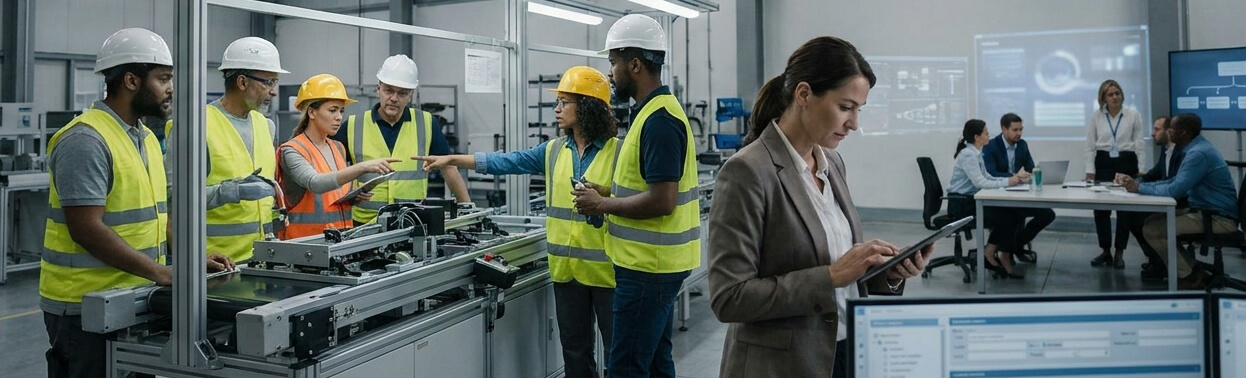
The Manufacturing Skills Crisis Is Already Here — and It’s Accelerating
Let’s be clear about something most executives already feel on the floor but rarely say out loud:
The manufacturing labor problem is no longer a future risk. It’s an active operational constraint.
And it’s getting worse—not because companies aren’t hiring, but because the system producing skilled workers is breaking down.
1. The Real Problem: A Shrinking Pipeline of Skilled Manufacturing Talent
Here’s the reality.
The manufacturing skills gap is widening across three fronts. Manufacturers aren’t just struggling to hire manufacturing workers — they’re struggling to find workers ready for modern, technology-driven production environments.
That gap is widening across three fronts:
A. Retirement is a draining experience, faster than it’s being replaced
- Nearly 25% of manufacturing workers are expected to retire within the next decade (Bureau of Labor Statistics, 2025 projection)
- That’s not just headcount loss—it’s institutional knowledge loss
- Most of what leaves is not documented: troubleshooting instincts, machine behaviour patterns, process shortcuts that keep production stable
Bottom line: You’re not just replacing workers. You’re replacing experience that took 20–30 years to build.
B. Technology is moving faster than workforce adaptation
Modern manufacturing is no longer mechanical. It’s digital.
- AI-assisted production systems are now standard in advanced plants
- Robotics is integrated into core production lines
- IoT systems continuously monitor uptime, quality, and efficiency
- Digital twins simulate production before physical execution
This creates a hard requirement:
Operators are no longer just “doing the job.” They’re interpreting systems.
And most training pipelines are still catching up.
C. The talent perception gap is shrinking the pipeline
There’s also a demand-side problem that’s often ignored.
- Only ~30% of younger workers (18–25) consider manufacturing an attractive career path
- Many still associate it with outdated factory environments, repetitive labor, or limited growth
That perception is now directly impacting hiring velocity.
And perception, unlike wages or equipment, is harder to fix quickly.
2. What This Looks Like in Real Operations
Let’s ground this in reality.
Midwest Automotive Plant — A Real-World Disruption Case
Within a single year:
- 15 senior operators retired
- No immediate replacements had equivalent experience
What followed wasn’t dramatic, but it was expensive:
- Production bottlenecks across multiple lines
- 12% increase in quality defects
- Extended machine downtime (+40% longer repair cycles)
- Increased dependency on overtime labor
Nothing “broke” in the traditional sense.
But performance quietly degraded.
That’s what makes this type of issue dangerous—it doesn’t announce itself. It compounds.
What changed the trajectory
The company stopped relying on external hiring alone and shifted to internal capability rebuilding:
Intervention Model
- One senior-to-two junior mentorship structure
- Hands-on technical workshops (CNC, robotics, quality systems)
- Weekly production-linked performance tracking
- Partnership with a local technical college
No theory-heavy programs. Everything was tied to actual production output.
Results after 6 months
- 25% reduction in downtime
- 10% reduction in quality defects
- Over 90% retention of trained employees after 12 months
- Estimated $450,000 savings in hiring + overtime costs
Key insight: Stability didn’t come from hiring faster. It came from transferring capability faster.
3. What Actually Works: Building a Workforce Pipeline (Not Just Hiring)
Companies that are stabilizing their workforce are doing one thing differently:
They’re not waiting for the labor market to solve the problem.
They’re building their own pipeline.
A. Structured training pipelines (what works in practice)
Effective systems usually include:
- Entry-level technical training programs
- Apprenticeships tied directly to production lines
- Internship programs embedded in real factory environments
- Role-specific onboarding (not generic orientation)
B. Why partnerships with schools matter
This is not CSR. It’s an operational strategy.
Done correctly, school partnerships deliver:
- Predictable talent flow
- Lower hiring costs
- Faster onboarding cycles
- Better retention rates
C. Case Example: Industrial Skills Academy (Illinois Manufacturing Company)
A structured partnership between a manufacturer and vocational institutions created a 6-month production-focused training pipeline.
Program design
- Robotics and automation training
- Lean manufacturing principles
- Safety and compliance systems
- Real factory shift exposure
- Simulation-based troubleshooting labs
Program outcomes (measurable impact)
| Metric | Result |
| Graduate employment rate (12 months) | 80% |
| Hiring cost reduction | $350,000 saved |
| Productivity uplift (new hires) | +15% in first 90 days |
| Workforce engagement | Higher retention and satisfaction |
What made it work: training wasn’t classroom-based—it was production-based.
4. The Hidden Cost of Not Solving the Skills Gap
Delaying workforce investment doesn’t preserve cash. It shifts cost into operations.
Operational impact of unfilled roles
| Issue | Operational Impact | Business Outcome |
| Open maintenance roles | Longer machine downtime | Production loss |
| Missing skilled operators | Reduced throughput | Delayed output |
| Understaffed teams | Higher error rates | Quality issues |
| Overtime dependency | Workforce fatigue | Higher turnover |
Example: Food Processing Plant
- Delayed hiring for maintenance roles
- Result: $120,000 production loss in 3 months
Not because demand dropped, but because equipment uptime collapsed.
Core truth
Unfilled skilled roles don’t save money.
They quietly erode capacity until the cost becomes visible.
Key Takeaway
The manufacturing skills gap is not a labor shortage.
It’s a system failure in how skills are created, transferred, and retained.
And companies that treat it as a hiring problem will always fall behind those that treat it as a capability-building problem.

Hiring & Retention in Manufacturing During Economic Uncertainty — Building Stability When the Ground Keeps Shifting
Here’s something most manufacturing leaders only fully internalize after a few challenging cycles:
Economic uncertainty doesn’t just slow demand. It distorts decision-making.
Hiring freezes feel responsible. Headcount cuts feel efficient. Delayed replacements feel cautious.
On a spreadsheet, it all makes sense.
On the factory floor, it plays out differently.
And usually later. When the damage has already compounded.
Factories don’t collapse in a single moment. They erode. Quietly. Through small gaps that nobody closes in time.
Skill by skill. Shift by shift.
1. The Hiring Paradox Nobody Likes to Admit
Strip it down, and most organizations assume three things:
- Hiring fewer people saves money
- Waiting improves flexibility
- Existing teams can absorb the pressure
It sounds logical. Until you watch it unfold in real operations.
Because here’s what actually happens:
- Output slows down, but not immediately
- Error rates creep up in ways dashboards don’t catch early
- Downtime becomes “normal” instead of exceptional
- Your best people start carrying more than they should
- And eventually, they leave
That last part is where the real cost shows up.
Not in payroll. In replacement difficulty.
The real tension
Cutting hiring doesn’t eliminate cost.
It relocates the data into the system itself.
And system costs are harder to see—and harder to fix.
Hiring Delay vs Operational Reality
| Decision | Short-Term Story | What Actually Happens |
| Freeze hiring | Cost control | Workload concentration rises |
| Delay replacements | Financial discipline | Output consistency declines |
| Reduce headcount | Efficiency gain | Knowledge gaps widen |
| Push overtime | Operational flexibility | Burnout accelerates turnover |
The pattern is consistent. The timing just varies.
2. What Actually Works: The Flexible Workforce Model
Companies that stay stable in volatile conditions don’t “optimize headcount.”
They redesign the workforce structure.
Not reactively. Intentionally.
Think less HR policy. More operating systems.
Flexible Workforce Architecture
- Core Workforce — the stability backbone
This is the non-negotiable layer.
- Engineers
- Maintenance technicians
- Quality control specialists
- Production supervisors
Reality check:
If this layer weakens, everything downstream becomes unstable.
No exceptions.
- Elastic Workforce — the pressure valve
This is where adaptability lives.
- Contract workers
- Temporary operators
- Seasonal labor
- Staffing agency support
Purpose: absorb demand spikes without breaking the core team
- Capability Overlap Layer — the insurance policy
This is where most companies underinvest.
- Cross-trained employees
- Multi-skill operators
- Backup coverage for critical roles
Purpose: prevent single points of failure inside production
What this structure actually achieves
| Layer | Function | Why it matters |
| Core workforce | Stability | Keeps operations running |
| Elastic workforce | Flexibility | Handles volatility |
| Cross-trained layer | Resilience | Prevents breakdown cascades |
Simple model. Hard discipline.
3. Case in Point: Packaging Operations Under Demand Swings
One packaging manufacturer kept running into the same issue—sharp seasonal spikes followed by sudden drops.
The default response would’ve been obvious: hire more permanently.
They didn’t.
Instead, they restructured how labor flowed through the system.
What they changed
- Maintained a lean, stable core team
- Used staffing agencies only during peak demand
- Cross-trained supervisors to manage temporary workers
- Built staffing forecasts using historical production data
No complexity. Just structure.
What changed on the ground
- Output increased by 25% during peak periods
- Annual labor costs dropped by 12%
- Core team burnout decreased noticeably
- Production schedules became more predictable
The takeaway that matters
Flexibility isn’t chaos.
It’s controlled variability.
Most companies confuse the two. That mistake is expensive.
4. Hiring in Modern Manufacturing: Treat It Like a Supply Chain
Traditional hiring processes still behave like administrative workflows.
High-performing manufacturers don’t think that way anymore.
They treat talent like inventory flow.
Modern Hiring Framework
Step 1: Build upstream supply channels
You don’t start hiring when you have vacancies.
You start before.
- Technical schools
- Apprenticeship pipelines
- Internship programs
- Industry partnerships
Step 2: Increase screening efficiency
Speed matters—but not at the cost of signal quality.
- AI-assisted filtering
- Skills-based assessments
- Practical job simulations
- Structured technical evaluations
Step 3: Reduce onboarding friction
This is where most hires succeed or fail.
- Standardized onboarding paths
- Role-specific training tracks
- Early assignment of mentors
No ambiguity. No improvisation.
Hiring model comparison
| Approach | Time to Fill | Quality Consistency | Risk |
| Traditional hiring | 30–60 days | Inconsistent | High |
| AI-assisted hiring | 10–20 days | More consistent | Moderate |
| Pipeline-based hiring | Continuous | High | Low |
The difference isn’t speed alone. It’s predictability.
5. Retention: Why People Actually Stay (or Leave)
Retention isn’t a compensation problem in manufacturing.
That’s the surface explanation.
Underneath, it’s three things:
- Whether people see a future
- Whether the work feels stable
- Whether the system respects their time
When any of those break, turnover follows.
Retention framework that actually holds
- Skill progression
People stay when they see movement.
- Multi-role certifications
- Structured upskilling paths
- Clear technical advancement ladders
Stagnation is what drives exits—not workload alone.
- Embedded mentorship
Embedded mentorship value is often underestimated.
- Senior-junior pairing
- Shift-based knowledge transfer
- Hands-on coaching inside production, not outside it
Real learning happens on the floor, not in a classroom.
- Operational predictability
Chaos is expensive—not just for operations, but for retention.
- Stable shift planning
- Controlled overtime
- Transparent workload expectations
People don’t leave jobs. They leave unpredictability.
Retention impact—before vs after structure
| Factor | Without System | With System |
| Skill growth | Flat | Structured progression |
| Engagement | Low | Ownership-driven |
| Turnover | High | Reduced |
| Productivity | Erratic | Stable |
6. The Roles That Actually Anchor Manufacturing Stability
Not every role has equal strategic weight.
Some roles quietly hold the system together.
| Role | Strategic Weight | Real Impact |
| Maintenance technicians | High | Prevent downtime spirals |
| Quality engineers | High | Prevent systemic defects |
| Production managers | High | Stabilize execution |
| Machine operators | Medium | Drive throughput |
| Temporary labor | Variable | Absorb demand |
If the first three weaken, everything else becomes reactive.
7. Speed Case: AI-Assisted Hiring at Scale
One manufacturer redesigned its recruitment flow using automation and structured filtering.
- 1,000+ applicants processed
- 50 hires completed
- Timeline: under 2 weeks
Previously? Over 45 days.
What changed operationally
- Automated early screening
- Skills-based filtering replaced resume scanning
- Shortlisting cycles compressed
- Manual bottlenecks removed
What improved
- Faster production ramp-ups
- Lower hiring overhead
- More consistent candidate quality
Speed mattered—but structure made it sustainable.
8. Workforce Development Is No Longer Optional
Let’s be blunt.
Companies that treat training as optional eventually pay for it—one way or another.
Usually in three currencies:
- turnover
- inefficiency
- operational risk
The modern workforce development system includes
- Cross-training across roles
- Digital learning platforms
- Simulation-based training (including VR where applicable)
- Continuous upskilling cycles
- Institutional partnerships
Real-world outcome example
A Midwest food processing company:
- Cross-trained 60% of the workforce across 3 roles
- Reduced downtime from staffing gaps
- Increased operational flexibility
- Lowered dependency on emergency hiring cycles
Nothing flashy. Just durable capability.
Closing Insight
Manufacturing resilience during economic uncertainty doesn’t come from hiring more aggressively.
It comes from something more fundamental.
A system that can expand when needed, contract when necessary, and reconfigure without breaking its operations.
That’s the real advantage.
And once you see it that way, hiring stops being a reaction.
It becomes infrastructure.

The Future Workforce — Automation, Skill Shifts, and the Real Edge in Manufacturing
There’s a moment that every serious manufacturing leader eventually runs into.
It doesn’t arrive loudly.
It shows up in planning meetings, in missed handovers, and in hiring cycles that keep stretching longer than they should.
At some point, the question stops being
“How do we fill roles faster?”
And quietly, something becomes sharper:
“What kind of workforce are we actually building here—for the next 5, maybe 10 years?”
Because once you get honest about that, the issue is no longer a hiring conversation.
It’s a continuity conversation. A survival conversation.
1. The Direction Is Already Decided — Whether You Planned for It or Not
Let’s not dress this up.
Manufacturing is moving in an obvious direction:
- More automation
- More data dependency
- More connected systems
- Higher precision requirements
- Less tolerance for skill gaps
And the uncomfortable part?
It’s not gradual anymore. It’s compounding.
What was once labeled “advanced manufacturing” is now standard in many plants. Not optional. Expected.
What the floor actually looks like now
Machines don’t just run processes anymore.
They:
- Report their own performance in real time
- Flag failure risks before they happen
- Adjust operating conditions dynamically
- Continuously generate production data
So the role of people shifts.
Not smaller. Just different.
And that difference matters more than most org charts reflect.
2. The Skill Profile Has Already Changed — Even If Job Titles Haven’t
Here’s where the gap is quietly widening.
The job descriptions may still look familiar.
The reality on the floor isn’t.
Then vs Now — the real shift
| Traditional Floor Reality | Modern Manufacturing Reality |
| Manual machine operation | Robotics supervision and oversight |
| Mechanical troubleshooting | Predictive maintenance using data |
| Fixed task execution | Adaptive system control |
| Paper-based reporting | Real-time analytics interpretation |
| Equipment-specific knowledge | Integrated system thinking |
What this actually means in practice
Operators aren’t just “doing the job” anymore.
They’re working inside systems that behave more like networks than machines.
Responsive systems. Data-heavy systems. Interconnected systems.
And that changes the skill requirement in a very real way:
- Less repetition.
- More interpretation
- More judgment under uncertainty.
Not everyone transitions cleanly into that. That’s the challenging part that most companies underestimate.
3. Automation Doesn’t Remove Work — It Repositions It
Let’s clear something up that gets oversimplified too often.
Automation doesn’t erase roles.
It redistributes value.
What automation actually takes off the table
- Repetitive manual execution
- Basic monitoring tasks
- Low-skill operational loops
Nothing controversial there.
What increases demand for
- System oversight and coordination
- Exception handling when things break the pattern
- Maintenance of complex, connected equipment
- Data interpretation and decision support
- Cross-functional operational alignment
The structural shift
So the workforce doesn’t shrink.
It concentrates.
Fewer routine roles.
More high-skill dependency points.
And when dependency increases, fragility increases too—unless capability keeps pace.
That’s the tension.
4. The Real Advantage Now: Capability Density
Here’s a term most organizations are already living through, even if they haven’t named it yet.
It’s not about how many people you have.
It’s about how much capability each person carries inside the system.
That’s capability density.
And it quietly defines performance differences between plants that look similar on paper.
High-performance manufacturing systems tend to share three traits
- Multi-skilled workforce design
Not optional anymore.
- Employees trained across multiple functions
- Less dependency on single-role specialists
- Faster internal coverage when gaps appear
When someone is missing, the system doesn’t stall. It adapts.
- Embedded digital literacy
This area is where the gap is really opening.
- Operators can read production data
- Technicians understand system alerts, not just machines
- Supervisors make decisions off live dashboards, not end-of-shift reports
Data isn’t “IT territory” anymore. It’s an operational reality.
- Continuous adaptation cycles
Not training programs once a year.
Ongoing adjustment.
- Short reskilling loops
- Training tied to actual equipment updates
- Fast integration of new production technologies
Because the environment doesn’t pause. Neither can capability development.
The mindset shift
Old question:
“How many workers do we need?”
New question:
“How much capability is inside each worker?”
That shift quietly separates stable operators from struggling ones.
5. What This Looks Like in Practice
One food processing operation made a decision that didn’t look dramatic at first.
They didn’t expand headcount.
They rebuilt the capability distribution.
What they implemented
- Cross-training across multiple production lines
- Digital monitoring dashboards on the shop floor
- Clear escalation protocols for maintenance issues
- Simulation-based training for new equipment onboarding
No slogans. No transformation branding. Just operational changes.
What changed operationally
- Fewer unexpected breakdowns
- Faster response when issues occur
- Less reliance on external specialists
- More consistent output during demand swings
The real insight
Nothing changed in scale.
But everything changed in how capability was distributed across the system.
That’s where performance actually moves.
6. The Assumption That Quietly Breaks Companies
There’s still a belief floating around many manufacturing strategies:
“If we need people, we’ll just hire them.”
That assumption used to hold loosely.
It doesn’t anymore.
And it’s weakening every year.
Why is it breaking down
- Retirements are accelerating faster than replacements
- Training systems lag behind technological change
- Global competition for skilled labour is intensifying
- Entry-level interest in manufacturing remains low
None of these is a short-term issue.
They compound.
What happens next
Hiring stops being a proactive lever.
It becomes a reactive scramble.
And reactive hiring is always more expensive—money-wise and operationally.
Always.
7. What Future-Ready Manufacturing Actually Looks Like
Forget theory. This is already happening in stronger operations.
A. Skills forecasting
- Workforce needs mapped 12–36 months ahead
- Training budgets aligned with technology roadmaps
- Bottlenecks identified before they surface
Not reactive planning. Predictive planning.
B. Automation + human integration
- Operators working alongside robotics systems
- Shared decision loops between humans and machines
- Reduced manual intervention in stable processes
Not replacement. Coordination.
C. Strategic education partnerships
- Long-term alignment with technical institutions
- Co-designed curricula based on real plant needs
- Factories used as live training environments
This phase is pipeline building, not recruitment.
D. Continuous reskilling systems
- Training is an ongoing cycle, not an event
- Short skill updates tied to production changes
- Internal mobility treated as normal, not exceptional
Learning becomes part of operations, not separate from them.
8. The Hard Truth About All of This
There is no finished version of a workforce anymore.
No stable endpoint where everything is “solved.”
Capability is now a constantly evolving target.
And companies that treat it as static eventually fall behind—even if they don’t notice it immediately.
Because erosion in manufacturing rarely announces itself.
It shows up quietly:
- slightly slower output
- slightly higher defect rates
- slightly longer downtime cycles
- slightly more turnover
Small signals. Repeated. Accumulating.
Until they’re no longer small.
Closing Insight
The future of manufacturing won’t belong to whoever has the largest workforce.
It will belong to whoever builds the most adaptable one.
A system that learns faster than it breaks.
That adjusts faster than technology shifts.
And that stops treating people as headcount…
and starts treating them as a capability infrastructure.
That shift isn’t coming.
It’s already happening.
Frequently Asked Questions (FAQ)
1. What’s actually driving the manufacturing labour shortage?
It’s not just one problem; it’s three problems hitting at the same time.
Aging workers are leaving faster than they can be replaced. Automation is rewriting what “skilled” even means. And the younger pipeline? It’s thin, and in some regions, it’s getting thinner.
Let’s be honest—replacement isn’t keeping up with retirement. That gap doesn’t close on its own. It compounds.
2. Why does hiring get harder during economic uncertainty?
Because companies pull back at the exact moment operations still need stability.
Hiring slows. Production doesn’t. So teams absorb the difference.
At first, it looks manageable. Then overtime creeps in. Then delays. Then fatigue. By the time leadership reacts, the inefficiency is already baked into the system.
What looks like discipline on a balance sheet often turns into operational strain on the floor.
3. What skills are actually in demand right now?
Not the old playbook.
What matters today:
- Robotics and automation systems
- Predictive maintenance using real data
- Data and analytics interpretation
- CNC and IoT-enabled equipment operation
- Supply chain optimization
Different world. Different skill set. Same factories—but not the same work anymore.
4. How do companies actually close the skills gap?
Such progress is not achieved by chasing hires every time a gap appears. That’s reactive—and expensive.
The companies that are stabilizing operations are building pipelines:
- Apprenticeships that start early
- Technical school partnerships tied to real production needs
- Continuous upskilling instead of one-off training
- Cross-training so capability doesn’t sit in silos
It’s slower upfront. But it’s what prevents constant firefighting later.
5. Why does cross-training matter so much?
Single points of dependency are silent risks.
One absence shouldn’t stall a line. One resignation shouldn’t expose a weakness.
Cross-training reduces that fragility. It keeps production moving when people shift, rotate, or leave.
Simple idea. Powerful impact.
6. Which roles actually hold manufacturing together?
Strip away the noise, and a few roles carry disproportionate weight:
- Maintenance technicians — they keep downtime under control
- Quality engineers — they protect output consistency
- Production managers — they stabilize execution under pressure
- Machine operators — they drive throughput directly
If these roles weaken, everyone downstream feels it quickly.
7. Is automation replacing manufacturing workers?
No. That’s the wrong framing.
Automation removes repetition, not responsibility.
What it really does is shift human work upward—toward monitoring systems, interpreting data, and managing exceptions when things don’t behave as expected.
Less manual repetition. More decision pressure.
8. What does workforce planning actually solve?
It forces a shift from reaction to anticipation.
Instead of asking, “Who do we need now?” companies start asking, “What capability will we need next quarter, next year?”
That change sounds subtle. It isn’t.
It’s the difference between constant hiring stress and controlled capability building.
9. What’s the real risk of delaying hiring?
On paper, it looks like cost control.
In reality, it creates operational pressure that builds quietly:
- Machines wait longer for maintenance
- Output slows in small but consistent ways
- Overtime becomes the default fix
- Critical knowledge stops getting replaced
And here’s the part companies underestimate—lost knowledge doesn’t come back when you finally hire.
10. What actually defines a “future-ready” workforce?
Not size. Not headcount.
Capability.
A future-ready team is
- Multi-skilled across functions
- Comfortable with digital systems and data
- Continuously trained, not static
- Able to work alongside automation—not resist it
It’s adaptability under pressure. That’s the real benchmark.
11. How do you attract younger workers into manufacturing?
You stop presenting it like the past.
Because they’re not responding to that version anymore.
What works now:
- Visible robotics and automation on the floor
- Clear, structured career progression
- Hands-on learning instead of theory-heavy onboarding
- Strong partnerships with schools and training institutions
If it still looks like “old manufacturing,” you’ve already lost them.
12. Will automation eliminate manufacturing jobs?
No.
But it will absolutely reshape them.
Routine work declines. Cognitive and technical roles expand.
The value shifts from performing repetitive tasks to managing those that do.
13. What’s the biggest mistake companies make in workforce planning?
They treat hiring like a quick fix.
A gap appears. They fill it. Problem solved—at least on paper.
But that mindset ignores the more profound issue: capability isn’t being built, only patched.
The stronger approach is slower and more deliberate—building pipelines, developing internal talent, and treating workforce capability as infrastructure, not HR activity.
14. What actually defines a strong manufacturing workforce today?
Not stability. Adaptability.
The strongest teams are:
- Flexible across roles
- Continuously learning
- Comfortable working with automation and data
- Able to adjust quickly when conditions change
That’s the real divide now.
Not big vs. small teams.
But rigid vs. adaptable systems.
And the gap between those two keeps widening.
Manufacturing Workforce & Industry Reference Links
Global Consulting & Strategy Firms
- McKinsey & Company
- Deloitte
- Boston Consulting Group (BCG)
- Bain & Company
- PwC (PricewaterhouseCoopers)
- EY (Ernst & Young)
- KPMG
- Accenture
Technology & Industry Leaders
Manufacturing, Workforce & Industry Associations
- World Bank
- OECD
- International Labour Organization (ILO)
- World Economic Forum (WEF)
- American Society of Mechanical Engineers (ASME)
- Project Management Institute (PMI)
Philippines & Workforce Development
- IBPAP (IT & Business Process Association of the Philippines)
- Philippine Statistics Authority (PSA)
- Department of Trade and Industry (DTI Philippines)
Data & Market Intelligence Platforms
Talent, Skills & Workforce Research