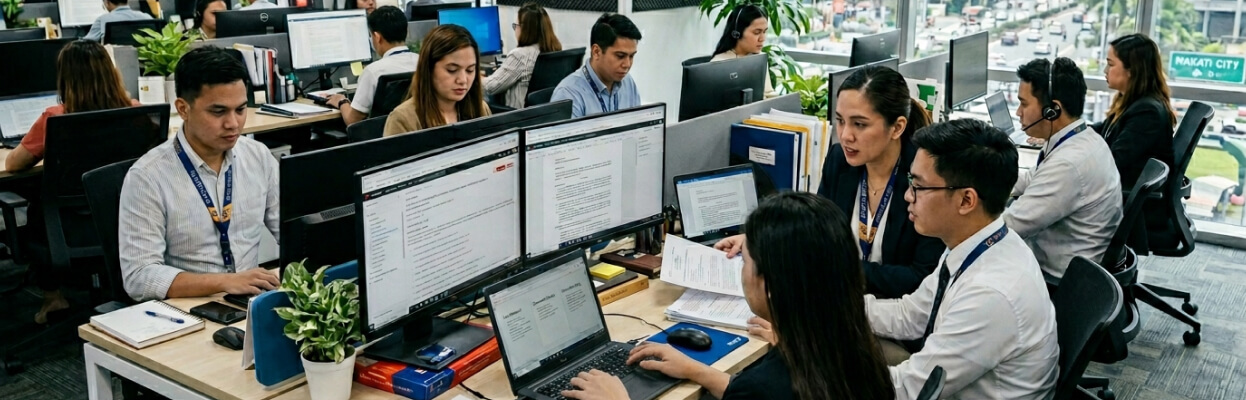
The future isn’t man or machine — it’s man with machine.
Why the Fear of AI Is Misplaced
In boardrooms across Australia, the United States, and beyond, one question keeps surfacing:
“Will artificial intelligence replace my people?”
It’s a fair question — but it’s also the wrong one. The real question forward-thinking leaders are asking is:
“How can my people use AI to outperform?”
For over a decade, companies have turned to offshore staffing to improve efficiency and scalability. But in 2025, the landscape has evolved. The future isn’t just about outsourcing tasks; it’s about building AI-enabled remote teams that use technology to amplify human capability — not replace it.
The Myth of Job Replacement

When it comes to the future of work, many people assume that AI will displace us all, but a 2023 study from the University of Pennsylvania and OpenAI found that while 80% of U.S. workers may have at least 10% of their tasks influenced by AI, only about 19% could see half or more of their tasks affected. In other words, AI is changing how we work — not making human work obsolete.
Supporting this, data from the U.S. Census Bureau shows that despite widespread AI adoption, overall employment remains stable. Jobs aren’t disappearing — they’re transforming.
Workers who are taking hold of AI tools are finding innovative ways to pump up the value of their work. Marketing teams can now launch campaigns faster, data analysts can plumb the depths of their insights, and AI doesn’t supplant these workers. It just gives them the boost they need to be able to do more.
So rather than replacing employees, AI is turning skilled professionals into super-performers — able to do in hours what once took days.
Remote Work: The Other Workforce Revolution
AI was being looked at as a means to navigate the new landscape, and remote work has now become a fundamental feature of the way we work, since the pandemic first hit.
Coming from the United States, a 2025 report from the U.S. Census Bureau shows that 13.8% of Americans now primarily work from home, roughly double the figure pre-pandemic. In Australia, the Australian Bureau of Statistics (ABS) reports that 37% of employed Australians work remotely at least part-time, up from 24% before COVID-19.
This shift has opened doors to a global workforce. Companies are no longer confined to their city, state, or even country when recruiting and can find talent anywhere. In the Philippines and other countries, employers found affordable, highly skilled workers with access to diverse skills training networks.
The combination is a double-barreled effect, and according to economists, it creates an unstoppable digital “productivity multiplier” when technology takes care of the monotonous work, and people, on the other hand, can get their heads around brand-new ideas, fix problems, and plot the direction of the company.
The Winning Formula: AI + Offshore Talent
The most forward-thinking companies are realizing that AI works best in human hands.
Here’s the winning model:
- Businesses hire remote professionals — often offshore — to fill skill gaps and scale quickly.
- These professionals use AI tools to automate, analyze, and optimize their workflows.
- Together, they form a hybrid human-AI team that delivers faster results, smarter decisions, and higher ROI.
This is the new face of outsourcing. It’s not about cheaper labor anymore — it’s about better performance. Offshore staffing isn’t just filling roles; it’s helping companies evolve.
How Businesses Can Build AI-Enabled Remote Teams

The potential is clear. But how do you turn this idea into action?
1. Identify Roles That Thrive with AI Support
When considering the impact of AI, it’s true that not every job is going to be a slam dunk for the technology, and it’s really a matter of which jobs are the best suited to be automated, and where AI can be most empowering.
Coming from the US Department of Labor, we’re told that jobs that require creativity, communication, and problem-solving are basically impervious to being automated, and those are the very areas where AI can be the most helpful.
Here are some examples:
- Marketing Assistants can fire up the creative process with AI-generated ad copy or ideas in seconds.
- Data Analysts can slice through massive datasets with AI-driven visualization tools.
- Customer Support Agents can offload routine questions to chatbots so that they can focus on the meatier, human side of things.
- Administrative Staff can automate scheduling, expense reports, and email sorting to save hours every week.
When you combine these roles with AI tools — and give them remote flexibility — you create an agile, cost-efficient team that scales effortlessly.
2. Recruit and Train “AI-Ready” Remote Talent
Looking at the future of work, the World Economic Forum’s 2025 report highlights analytical thinking, technological literacy, and creativity as the top three skills that will be in high demand over the next five years. With the rise of offshore staffing, businesses now have direct access to a pool of adaptable, digitally-fluent talent.
When hiring remote staff, prioritize professionals who:
- Are naturally curious and willing to learn new tech tools
- Communicate clearly across time zones and cultures
- Take the initiative to solve problems independently
Then, invest in their growth. Offer AI enablement training — teaching them how to use automation, generative tools, and analytics to improve performance.
As the U.S. Department of Education points out, digital fluency — the ability to create value with technology, not just use it — is becoming a basic employability skill worldwide.
3. Measure the Performance Uplift
You can’t improve what you don’t measure.
According to the Pew Research Center, about 21% of U.S. workers now use AI in some part of their jobs — a significant increase from 16% the year before. Many report better speed, accuracy, and creativity as a result.
A Stanford University research showed that AI-assisted customer support staff gave a 14% boost in productivity, and really made the most difference for the newer employees who were able to step up to the plate and deliver results at the level of their more experienced colleagues.
Meanwhile, a Harvard Business Review analysis found remote employees to be 13% more productive than their in-office counterparts. And Global Workplace Analytics reports that remote work saves businesses roughly $11,000 per employee per year in overhead and efficiency gains.
To cut through the noise, it’s clear that teams working remotely with AI outperform the rest.
4. Address the Human Side of the Equation
For the success of a business, technology is only half the story, and the human factor is the remaining half.
Researchers at MIT found that organizations that don’t consider the value of trust and collaboration in AI-augmented teams can see performance drop by as much as 20%.
To avoid this, business leaders must:
- Foster inclusion and teamwork between local and offshore employees
- Hold regular check-ins and transparent discussions about AI use
- Encourage shared learning — where humans teach machines, and machines teach humans
Empathy, creativity, and communication are the glue that make high-performing, tech-driven teams possible.
5. Future-Proofing Through Global, AI-Enabled Teams
The World Economic Forum predicts that by 2027, 42% of all business tasks will be automated. But instead of fewer jobs, we’ll see different jobs — ones that blend human judgment with AI-driven efficiency.
Companies that begin building AI-ready remote teams now will be the ones ready to thrive later. Offshore staffing provides the agility and resilience businesses need to keep pace with innovation and operate around the clock — without overextending local resources.
Case Study: A Small Business That Scaled with Offshore AI-Assisted Teams
Take the example of a small Australian retailer, “BrightPath Homeware.” Facing rising labor costs and growing online demand, the company partnered with Kinetic Innovative Staffing to build a remote support team in the Philippines.
Each offshore professional was trained to use AI tools:
- The marketing assistant used AI to brainstorm product descriptions and create graphics.
- The customer service team used chatbots for common queries, jumping in for complex issues.
- The finance assistant automated invoice processing and sales reporting.
Within six months, BrightPath achieved measurable gains:
- Response times dropped by 65%
- Content output increased by 60%
- Operational efficiency improved by 30%
The results were clear: AI didn’t replace their team — it made their team unstoppable.
Five Strategic Questions for Business Leaders
- Which workflows in my company could benefit from AI-powered automation?
- Do I have the right remote or offshore staff to integrate these tools effectively?
- How am I measuring productivity improvements?
- How do I maintain collaboration and culture across time zones and tools?
- Am I viewing offshore staffing as a growth strategy, not just a cost-saving move?
The Human-AI Partnership Is the Future of Work
The story of AI and the future of work isn’t one of replacement — it’s one of reinvention.
As the OECD’s Future of Work studies emphasize, automation changes tasks, not people. When humans and technology collaborate effectively, both productivity and satisfaction rise.
At Kinetic Innovative Staffing, we see this shift daily. Businesses that combine skilled Filipino remote professionals with AI-powered workflows are the ones scaling faster, operating smarter, and competing globally.
Because the real future of work isn’t about humans versus machines.
It’s about humans with machines, working together — across borders, across time zones, and toward limitless growth.
FAQ Section
Strategic Questions Every Business Leader Should Ask About AI and the Human Workforce
- Are we empowering our teams to use AI — or to think strategically with it?
Leaders often focus on AI adoption rates rather than cognitive transformation. The real edge comes when employees learn to interpret AI insights creatively, challenge assumptions, and make smarter business decisions using data-driven intuition.
- How do we keep human judgment at the core of AI-driven operations?
Automation can accelerate processes, but leadership still depends on ethics, empathy, and contextual understanding. AI should strengthen human judgment — not replace it — especially in decisions that affect people, culture, and long-term trust.
- Which new leadership roles will emerge as humans and machines collaborate?
AI will redefine management. Leaders will need to oversee not just people, but systems that learn. Emerging roles like AI Operations Managers or Human-AI Coordinators will become critical in maintaining balance between automation and accountability.
- Are we tracking productivity — or overlooking human innovation?
Speed and efficiency matter, but they aren’t the full measure of success. Forward-thinking leaders are redefining KPIs to include creativity, adaptability, and the ability to innovate with AI — not just execute faster.
- How can AI-enabled offshore teams support ethical global growth?
AI can equalize opportunities across borders or deepen divides — depending on how it’s implemented. The challenge for executives is to ensure that remote AI adoption enhances inclusion, fair compensation, and sustainable workforce development.
- Is our organizational culture ready for human-AI collaboration?
Cultural readiness is now a leadership metric. Teams must understand AI’s purpose, trust its integration, and stay aligned with company values. Transparency and inclusion are essential for technology adoption to succeed globally.
- Where does accountability lie when AI makes a bad call?
When AI influences key business outcomes, leaders must define responsibility frameworks early. Ethical AI governance — ensuring explainability, fairness, and auditability — is becoming a core pillar of executive leadership.
- Are we preparing tomorrow’s leaders to guide AI-powered organizations?
As roles evolve, leadership development must evolve too. Future-ready executives will be those who combine technological literacy with human-centered thinking — capable of leading teams where people and machines grow together.