

Most firms approach offshore staffing as a cost arbitrage exercise. That framing is incomplete — and it causes preventable failures.
The real question is structural: which functions, if offshored, will increase your firm’s capacity and quality ceiling, and which will create coordination drag, compliance exposure, or client relationship risk that erodes the savings?
Offshore FTE cost arbitrage for professional roles in the Philippines typically runs 50–70% below equivalent fully-loaded US onshore costs (estimated/illustrative). That range is real. But the realized savings depend heavily on role seniority, management overhead, and attrition-adjusted productivity in year one. A role that looks like a 60% saving on paper can deliver 30% net if onboarding is underprepared and attrition hits in months four through eight.
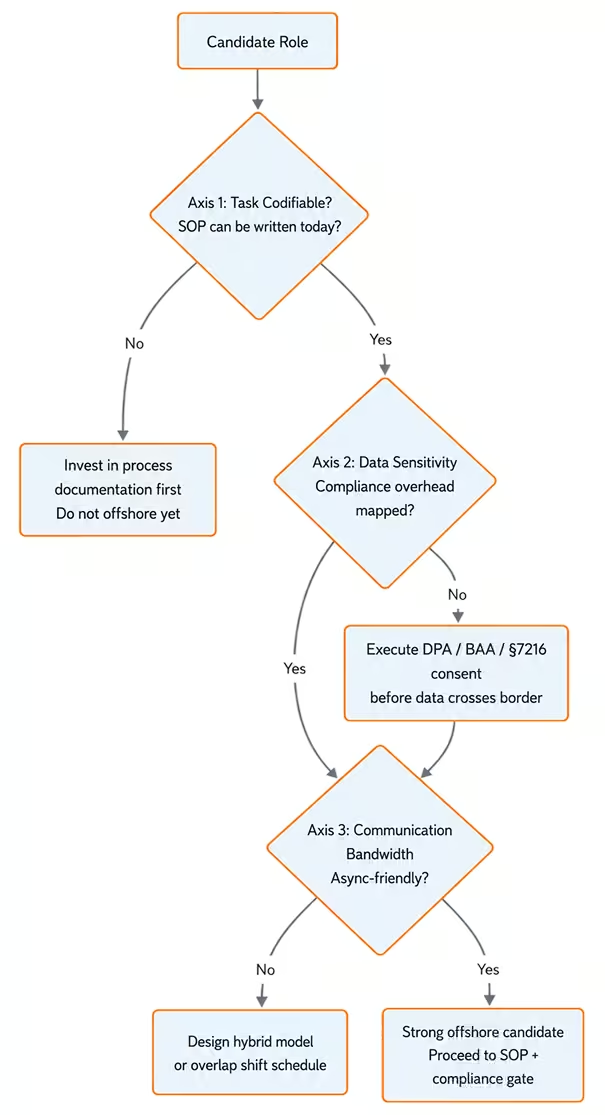
Before offshoring any role, run it through these three questions.
Roles that pass all three axes are strong offshore candidates. Roles that fail Axis 1 need process documentation investment before offshoring. Roles that fail Axis 3 need a hybrid model design, not a full offshore deployment.
For a broader view of how distributed workforce architecture fits into a long-term staffing strategy, see Offshore and Remote Staffing Solutions: How to Build a High-Performing Distributed Team.
The function-by-function breakdown below maps each major business function against the three-axis diagnostic. Each entry identifies the offshore suitability tier, the compliance non-negotiables, and the practical ceiling and floor for that function.
Offshore Role Suitability — Three-Axis Diagnostic Flow
Accounts payable, accounts receivable, bank reconciliation, payroll processing, and month-end close support are the most frequently offshored professional functions globally — and for structural reasons, not trend-following.
The workflows are codified. The platforms are cloud-native: QuickBooks Online, Xero, NetSuite, Sage Intacct. The outputs — reconciled ledgers, aged receivables reports, payroll registers — are objectively verifiable. A mid-market accounting practice can hand off transactional bookkeeping to a Manila-based team and receive completed workpapers within the same business day using a follow-the-sun scheduling model.
The ceiling: A well-structured offshore bookkeeping team operating on documented SOPs can process significantly higher transaction volumes than an equivalent onshore headcount at a fraction of the fully-loaded cost.
The floor: Firms that offshore bookkeeping without written SOPs, chart-of-accounts documentation, and a designated onshore review owner typically see quality degradation within 60–90 days. The offshore team is not the failure point — the absence of process documentation is. One anonymized composite from our advisory work: a US-based accounting practice in the $8–20M revenue band offshored AP processing without a documented exception-handling protocol. Vendor disputes that required judgment calls created a backlog that took three months to clear. The fix was procedural, not personnel.
Compliance note: Philippine offshore staff handling client financial data require NPC-mandated Data Processing Agreements (DPAs) and, where the offshore entity acts as a data processor for a US controller, PIP-PIC agreements under the Data Privacy Act of 2012 (Republic Act 10173).
US CPA firms have offshored tax preparation support — 1040 individual returns, 1065 partnership returns, 1120-S S-corporation returns — to the Philippines, India, and Eastern Europe for well over a decade. The Philippines leads for English-language markets due to its accounting graduate pipeline and cultural alignment with US business norms.
The workflow is well-suited: preparers gather source documents, populate return data in UltraTax, Lacerte, ProConnect, or Drake, and pass completed drafts to onshore reviewers for sign-off. The offshore team handles preparation. The licensed CPA handles review, judgment calls, and client communication.
The compliance non-negotiable: IRC Section 7216 and IRS Circular 230 govern taxpayer consent when tax return preparation is outsourced to third parties, including offshore providers. Consent forms must be obtained before client data is transmitted offshore. This is a federal statutory requirement — firms that skip this step carry material regulatory exposure.
The ceiling: Tax season capacity expands without proportional headcount increases onshore. A firm that previously capped at 400 returns per season can scale to 700+ with an offshore preparation team, without burning out senior staff (illustrative capacity range).
The floor: Time-zone management is real friction. The Philippines (UTC+8) sits approximately 15–16 hours ahead of the US West Coast. Firms that do not build structured handoff protocols — clear daily cutoffs, document upload deadlines, review queues — find that the time-zone gap creates idle time on both ends rather than a productivity multiplier.
Workpaper preparation, lead schedule population, confirmations processing, and tie-out procedures are well-defined, documentable tasks. They are also time-intensive — exactly the category where offshore leverage creates the most capacity relief for onshore audit managers.
The AICPA’s quality management standards (SQMS No. 1) address outsourced service providers and establish that the firm retains responsibility for quality regardless of where preparatory work is performed. That means the offshore team’s work must be subject to the same review and supervision protocols as onshore staff output.
The hybrid model is not optional here — it is the operating standard. Engagement sign-off, client communication, and professional judgment calls on complex accounting issues remain onshore. The offshore team handles the volume work that currently consumes senior staff time.
The floor: Audit engagements with complex, non-standard transactions or first-year clients with poor prior-year documentation are poor candidates for heavy offshore preparation. The tribal knowledge required to navigate ambiguous workpaper trails is not transferable without significant onboarding investment.
Budget variance analysis, financial modeling in Excel or Google Sheets, management reporting packages, and KPI dashboard maintenance are analytically demanding but structurally codifiable. An offshore FP&A analyst with strong Excel and financial modeling skills can produce the same output as an onshore analyst — if the data inputs are clean, the model architecture is documented, and the review cycle is structured.
The ceiling: Offshore FP&A support at the analyst level frees onshore finance managers to focus on business partnering, strategic interpretation, and executive communication — the functions that genuinely require organizational context and relationship capital.
The floor: FP&A roles that depend on ad hoc data pulls from poorly governed internal systems, or that require constant real-time interaction with business unit leaders, are poor offshore candidates at the analyst level. Data governance protocols — defined data sources, access controls, version control on models — must be in place before offshoring FP&A work.
Full-stack development, QA and testing, DevOps, data engineering, and cloud infrastructure management have been offshored successfully for decades. The Philippines, India, Vietnam, and Eastern Europe are the primary talent pools, each with distinct cost and capability profiles.
India remains the dominant destination for large-scale IT offshoring and enterprise software development. Vietnam has emerged as a competitive alternative for software development specifically, with lower average developer costs than India or the Philippines and a rapidly growing STEM graduate pipeline. The Philippines leads in IT support, helpdesk, and mid-complexity development roles, particularly for English-speaking markets.
Cybersecurity is the operational floor for all IT offshore roles. Endpoint security policy enforcement, VPN or zero-trust network access, data loss prevention (DLP) controls, and contractual restrictions on data residency and storage location are baseline requirements. NIST SP 800-46 provides a recognized framework for remote and offshore workforce security architecture.
The ceiling: A distributed engineering team operating across time zones can achieve near-continuous development cycles, with code committed in Manila reviewed and merged in New York before the US team’s morning standup.
The floor: Roles requiring deep institutional context — legacy system architecture decisions, security-sensitive infrastructure changes, or client-facing technical advisory — carry higher coordination costs offshore.
Tier 1 and Tier 2 helpdesk, live chat support, email support, and CRM data entry represent the highest absolute headcount in offshore staffing globally. The Philippines is the world’s leading destination for voice-based and English-language customer support, driven by cultural alignment with US and Australian business norms, strong English proficiency, and a large service-oriented labor force.
The ceiling: Offshore customer support teams can operate 24/7 coverage at a cost structure that makes round-the-clock onshore coverage economically non-viable for most mid-market firms.
The floor: Tier 2 support — involving technical troubleshooting, escalation judgment, or complex account management — requires more intensive onboarding and knowledge base investment. Firms that deploy offshore Tier 2 support without a robust internal knowledge base and escalation protocol typically see customer satisfaction degradation in the first 90 days.
SEO content production, PPC campaign management (Google Ads, Meta Ads Manager), social media scheduling, graphic design (Canva, Adobe Creative Suite), and email marketing (HubSpot, Klaviyo, Mailchimp) are well-suited for offshoring because the work is platform-mediated, output-measurable, and largely asynchronous.
The ceiling: Offshore customer support teams can operate 24/7 coverage at a cost structure that makes round-the-clock onshore coverage economically non-viable for most mid-market firms.
The floor: Tier 2 support — involving technical troubleshooting, escalation judgment, or complex account management — requires more intensive onboarding and knowledge base investment. Firms that deploy offshore Tier 2 support without a robust internal knowledge base and escalation protocol typically see customer satisfaction degradation in the first 90 days.
Payroll data entry, benefits administration support, HRIS data management (Workday, BambooHR, ADP), and onboarding documentation processing are administratively intensive, well-defined, and increasingly offshored.
The compliance layer is non-trivial. HR administration involves employee personal data — names, compensation, tax identification numbers, health benefit elections. For Philippine offshore teams handling this data, NPC-mandated PIP-PIC agreements under the Data Privacy Act of 2012 are required. For US-facing engagements, state-level privacy laws (California CCPA, for example) may impose additional obligations depending on the data subjects involved.
The floor: HR roles that involve employee relations, performance management conversations, or sensitive termination processes are not offshore-suitable. The judgment, cultural context, and legal exposure in those interactions require onshore ownership.
Contract review, legal research, document review, and e-discovery support are offshored primarily to the Philippines and India, where English-language legal education and bar-adjacent training programs produce qualified legal support professionals.
The ceiling: Document-intensive litigation support — e-discovery review, contract abstraction, due diligence document cataloging — can be processed at significantly higher volume offshore, compressing timelines on large-scale matters.
The floor: LPO roles require jurisdiction-specific knowledge. A Philippine-based legal researcher can produce strong common-law research for US or Australian matters. Civil law jurisdictions, or matters requiring deep local regulatory interpretation, are poor candidates. Attorney-client privilege architecture and data handling protocols must be explicitly addressed in engagement agreements.
Medical billing, ICD-10 and CPT coding, and prior authorization support are among the most established offshore healthcare back-office functions. The Philippines has a large pool of trained medical coders and billing specialists, supported by nursing and allied health graduate pipelines.
The non-negotiable: Any offshore vendor handling protected health information (PHI) for US-covered entities must execute a HIPAA Business Associate Agreement (BAA). Offshore vendors without BAA infrastructure are not compliant candidates for US healthcare clients, regardless of cost.
The ceiling: Offshore medical billing teams can process claims at scale, reduce days in accounts receivable, and handle denial management workflows that onshore billing departments frequently deprioritize due to volume pressure.
The floor: Coding accuracy is directly tied to coder training and audit feedback loops. Offshore coding teams without structured quality assurance — regular coding audits, error rate tracking, coder-level feedback — drift toward coding inaccuracies that create downstream claim denial and compliance risk.
This is the category most vendor conversations avoid. It matters.
Roles that are structurally unsuitable for offshoring include:
The firms that extract durable value from offshore staffing share three operational characteristics. First, they document before they delegate — SOPs, exception protocols, and quality checklists exist before the offshore team’s first day. Second, they build the hybrid model intentionally — offshore handles transactional and preparatory work; onshore retains advisory, sign-off, and relationship ownership. Third, they treat compliance as a pre-launch gate — DPAs, BAAs, IRC §7216 consent, and SQMS quality controls are executed before data crosses a border, not after a regulator asks.
Accounting and bookkeeping
Follow-the-sun scheduling enables same-business-day turnaround on reconciliations and close support, expanding throughput without proportional onshore headcount growth.
Tax preparation
Offshore preparation teams allow a firm to scale return volume — potentially from 400 to 700+ returns per season (illustrative) — without burning out senior licensed staff.
Audit support
Offshore workpaper preparation and lead schedule population free onshore audit managers from time-intensive volume work, redirecting senior capacity toward complex judgment and client advisory.
IT and software development
Distributed engineering teams can achieve near-continuous development cycles across time zones, with code committed in one geography reviewed and merged in another before the next team's morning standup.
Customer Support Representative
24/7 coverage becomes economically viable for mid-market firms that cannot sustain round-the-clock onshore staffing at competitive cost.
Digital marketing
Asynchronous, platform-mediated execution scales content production and campaign management without proportional cost increases — particularly valuable for agencies managing multiple client accounts.
Medical billing
Offshore billing teams can reduce days in accounts receivable and handle denial management workflows that onshore departments frequently deprioritize under volume pressure.
| Phase | Common Failure Mode | Root Cause | Mitigation |
|---|---|---|---|
| Pre-launch | Role selected without SOP documentation | Assumption that offshore staff will “figure it out” | Require written SOPs before go-live; use Philippines data compliance and onboarding checklist |
| Onboarding (Days 1–30) | Offshore staff lack system and data access | IT provisioning not coordinated pre-start | Endpoint security, VPN/zero-trust access, DLP controls configured before Day 1 |
| Ramp (Days 30–90) | Quality drift on exception handling | No documented exception protocol; tribal knowledge gap | Build exception-handling decision trees into SOPs |
| Steady State (Month 3+) | Attrition spike | Compensation not benchmarked; career path undefined | Active compensation reviews; defined promotion criteria |
| Compliance | Regulatory exposure discovered post-launch | DPA/BAA/§7216 consent not executed pre-engagement | Compliance review as a pre-launch gate, not an afterthought |
| Scale | Coordination overhead grows with headcount | No offshore team lead or onshore liaison defined | Designate offshore team lead; establish structured daily handoff protocol |
Offshore FTE cost arbitrage for professional roles in the Philippines typically runs 50–70% below equivalent fully-loaded US onshore costs (estimated/illustrative — no verified source). That range is real. But the realized savings depend heavily on role seniority, management overhead, and attrition-adjusted productivity in year one. A role that looks like a 60% saving on paper can deliver 30% net if onboarding is underprepared and attrition hits in months four through eight.
Statutory employer costs in the Philippines — covering SSS (Social Security System), PhilHealth, Pag-IBIG, 13th month pay, and mandated leave — add approximately 12–15% above base salary (estimated/illustrative — consistent with Philippine statutory frameworks under SSS, PhilHealth, Pag-IBIG, and DOLE Presidential Decree 851). This is a fixed statutory band under Philippine labor law, not a negotiable variable. Any offshore staffing cost model that omits this load is understating true employer cost.
Statutory employer costs in the Philippines — covering SSS (Social Security System), PhilHealth, Pag-IBIG, 13th month pay, and mandated leave — add approximately 12–15% above base salary (estimated/illustrative — consistent with Philippine statutory frameworks under SSS, PhilHealth, Pag-IBIG, and DOLE Presidential Decree 851). This is a fixed statutory band under Philippine labor law, not a negotiable variable. Any offshore staffing cost model that omits this load is understating true employer cost.
Data Processing Agreements (DPAs) and PIP-PIC agreements
Legal drafting and NPC-aligned structuring.
IRC §7216 taxpayer consent workflows
Integration into client engagement letters and onboarding systems.
HIPAA Business Associate Agreements (BAAs)
Vendor qualification, legal review, and ongoing audit obligations.
Endpoint security and DLP infrastructure
Device provisioning, VPN or zero-trust licensing, and ongoing monitoring.
Operators often see meaningful attrition in year one, particularly when onboarding is underprepared, career pathing is undefined, and compensation benchmarking lags the local market. The firms that retain offshore talent successfully treat their offshore team as an integrated workforce segment — with structured onboarding, defined career progression, and active compensation reviews — not as a transactional cost line. Attrition in year one erodes the realized cost differential materially; retention investment is not a soft benefit; it is a financial lever.
For engagement-specific pricing structures by function category, see offshore team pricing and engagement models.
Anonymized composite case studies referenced below are based on generalized advisory observations and do not represent specific named engagements or clients.
Composite 1: US Accounting Practice — AP Processing Without Exception Protocols
A US-based accounting practice in the $8–20M revenue band offshored accounts payable processing to a Manila-based team without a documented exception-handling protocol. Vendor disputes that required judgment calls created a backlog that took three months to clear. The fix was procedural, not personnel: a documented exception-handling decision tree was built into the SOP, and the backlog did not recur. The offshore team's capability was not the failure point — the absence of process documentation was.
Composite 2: Mid-Market CPA Firm — Tax Season Capacity Expansion
A mid-market CPA firm we advised deployed an offshore tax preparation team in the Philippines to handle 1040 and 1120-S return preparation. The firm had previously capped its seasonal capacity due to onshore staffing constraints. With the offshore preparation layer in place and IRC §7216 consent forms integrated into the client engagement letter workflow, the firm expanded its return volume meaningfully without adding onshore headcount. The critical design decision: onshore licensed CPAs retained all review, sign-off, and client communication functions. The offshore team handled preparation only.
Composite 3: IT Services Firm — Distributed Engineering Cycle
A US-based IT services firm we observed structured a distributed development team across Manila and its US headquarters. Code committed by the Manila team during their business day was reviewed and merged by the US team before the US morning standup, creating a near-continuous development cycle. The operational floor: endpoint security policy enforcement, zero-trust network access, and contractual data residency restrictions were configured before the Manila team's first system access. The security architecture was not retrofitted — it was a pre-launch gate.
Composite 4: Healthcare Back-Office — Medical Billing Scale
A US-based healthcare services operator deployed an offshore medical billing team in the Philippines to handle ICD-10 coding and denial management workflows. The non-negotiable pre-launch requirement: a HIPAA Business Associate Agreement (BAA) executed with the offshore vendor before any protected health information (PHI) was transmitted. The offshore team reduced days in accounts receivable and absorbed denial management volume that the onshore billing department had been deprioritizing under workload pressure. A structured coding audit cycle — monthly error rate reviews with coder-level feedback — was built into the engagement from day one.
Anonymized composite case studies referenced below are based on generalized advisory observations and do not represent specific named engagements or clients.
Accounting and tax
The Philippines produces a substantial annual cohort of accounting graduates and licensed CPAs. Manila-based accounting teams operating on cloud-native platforms (QuickBooks Online, Xero, NetSuite, Sage Intacct) can deliver same-business-day turnaround on reconciliations and close support using follow-the-sun scheduling.
Customer support
The Philippines is the world's leading destination for voice-based and English-language customer support. Cultural alignment with US and Australian business norms, strong English proficiency, and a large service-oriented labor force are the structural drivers — not simply cost.
Medical billing and coding
The Philippines has a large pool of trained medical coders and billing specialists, supported by nursing and allied health graduate pipelines. This makes it one of the strongest offshore destinations for US healthcare back-office functions.
IT and software development
The Philippines leads in IT support, helpdesk, and mid-complexity development roles for English-speaking markets. For large-scale enterprise software development, India remains the dominant destination; for software development cost competitiveness, Vietnam has emerged as an alternative.
Statutory employer costs
SSS, PhilHealth, Pag-IBIG, 13th month pay, and mandated leave — add approximately 12–15% above base salary (estimated/illustrative). This is a fixed statutory band, not a negotiable variable.
Data Privacy Act of 2012 (Republic Act 10173)
Governs the processing of personal data by Philippine-based entities. For offshore staffing arrangements where the Philippine team processes client or employee data on behalf of a US firm, NPC-mandated Data Processing Agreements (DPAs) and PIP-PIC agreements are required. The National Privacy Commission (NPC) has issued advisories addressing the contractual requirements for offshore data processing arrangements.
Operators often see meaningful attrition in year one, particularly when onboarding is underprepared, career pathing is undefined, and compensation benchmarking lags the local market. The firms that retain offshore talent successfully treat their offshore team as an integrated workforce segment — with structured onboarding, defined career progression, and active compensation reviews — not as a transactional cost line.
For a comprehensive view of building distributed teams that include Philippine offshore staff, see Offshore and Remote Staffing Solutions: How to Build a High-Performing Distributed Team.
Offshore Role Suitability Matrix
| Function | Offshore Suitability | Primary Offshore Hubs | Key Compliance Trigger | Hybrid Model Required? |
|---|---|---|---|---|
| Accounting & Bookkeeping (AP/AR, reconciliation, payroll processing) | High | Philippines, India | Data Processing Agreement (DPA) | Optional |
| Tax Preparation Support (1040, 1065, 1120-S) | High | Philippines, India, Eastern Europe | IRC §7216 taxpayer consent; IRS Circular 230 | Recommended (sign-off onshore) |
| Audit Support (workpapers, lead schedules, confirmations) | High (staff/senior level) | Philippines, India | AICPA SQMS No. 1 quality controls | Yes — sign-off remains onshore |
| FP&A Support (variance analysis, modeling, management reporting) | Moderate-High | Philippines, India | Data governance protocols required | Recommended |
| IT / Software Development (full-stack, QA, DevOps, data engineering) | High | Philippines, India, Vietnam, Eastern Europe | Endpoint security, DLP controls | Optional |
| Customer Support / Helpdesk (Tier 1–2, chat, email, CRM) | High | Philippines | NPC-mandated DPA | No |
| Digital Marketing Support (SEO, PPC, social, design, email) | High | Philippines, India | Minimal — platform-agnostic tooling | No |
| HR Administration (payroll data entry, HRIS, benefits admin, onboarding docs) | Moderate-High | Philippines, India | NPC-mandated PIP-PIC agreements; local privacy law | Recommended |
| Legal Process Outsourcing (contract review, legal research, e-discovery) | Moderate | Philippines, India | Jurisdiction-specific; English-language legal training required | Yes |
| Medical Billing & Coding (ICD-10, CPT, prior auth) | High | Philippines, India | HIPAA Business Associate Agreement (BAA) mandatory | Optional |
| Knowledge Process Outsourcing (equity research support, actuarial modeling, financial due diligence) | Moderate | Philippines, India | Data governance; NDA architecture | Yes |
| C-Suite Advisory, Licensed Attest Work, Physical-Presence Roles | Not Suitable | N/A | N/A | N/A — onshore only |
Three-Axis Diagnostic Summary
| Axis | What It Tests | Failure Consequence | Mitigation |
|---|---|---|---|
| Task Codifiability | Can a step-by-step SOP be written today? | Quality degradation within 60 days | Document SOPs before go-live |
| Data Sensitivity & Compliance | What data does the role touch, and what instruments are required? | Regulatory exposure post-launch | Execute DPA/BAA/§7216 consent as a pre-launch gate |
| Communication Bandwidth | Is the role async-friendly or real-time-dependent? | Coordination drag; idle time on both ends | Hybrid model or overlap shift design |
The function-by-function analysis above points to a consistent structural conclusion: offshore staffing delivers its highest value when it is deployed as a capacity architecture decision, not a cost-cutting reaction.
The firms that extract durable value from offshore staffing share three operational characteristics. First, they document before they delegate — SOPs, exception protocols, and quality checklists exist before the offshore team’s first day. Second, they build the hybrid model intentionally — offshore handles transactional and preparatory work; onshore retains advisory, sign-off, and relationship ownership. Third, they treat compliance as a pre-launch gate — DPAs, BAAs, IRC §7216 consent, and SQMS quality controls are executed before data crosses a border, not after a regulator asks.
The cost arbitrage is real. The 50–70% fully-loaded cost differential (estimated/illustrative) between Philippine offshore professionals and US onshore equivalents creates meaningful structural capacity. But that differential is only realized when the role is offshore-ready, the compliance architecture is in place, and the management model is built for distributed execution.
Selecting offshore roles is not a one-time cost-cutting decision but a structural workforce architecture choice: companies that map offshore functions to a tiered competency framework — starting with high-volume, process-defined roles and progressively expanding to specialized knowledge work — build the operational redundancy and talent depth needed for long-term solvency, regardless of domestic labor market volatility.
Start with the three-axis diagnostic. Identify your highest-codifiability, lowest-communication-bandwidth functions. Build the SOP documentation. Execute the compliance agreements. Then scale.
For a structured assessment of which roles in your firm are offshore-ready, see the KineticStaff compliance framework or review engagement and pricing structures for your function category.
US-based SMBs making recurring payments to offshore staffing agencies or directly employed foreign nationals face several overlapping reporting obligations. For payments to foreign corporations or partnerships, IRS Form 1042-S and the associated withholding analysis under Chapter 3 (FDAP income) or Chapter 4 (FATCA) may apply depending on the nature of the payment and the existence of a tax treaty. Payments to foreign individuals for services performed outside the US are generally not subject to US withholding, but the classification analysis (employee vs. independent contractor vs. agency-intermediated) must be documented. For FinCEN purposes, recurring international wire transfers do not independently trigger Bank Secrecy Act reporting by the sending SMB — that obligation falls on the financial institution — but SMBs should maintain records of international payment flows sufficient to respond to IRS information requests. Engaging a qualified international tax advisor before establishing recurring offshore payment structures is the operationally correct sequence; the reporting obligations are fact-specific and classification-dependent.
Anonymized composite case studies referenced in this article are based on generalized advisory observations and do not represent specific named engagements or clients.
Free EBook download
Discover how to build a high-performing remote team, reduce costs, and scale your business effortlessly. Get your free copy of The Complete Guide to Remote Staffing now!