
Offshore staffing legal compliance is the structured set of contractual, regulatory, and operational controls that govern the relationship between a foreign principal and a Philippine-based staffing provider or employer-of-record. It spans four domains: labor law classification, intellectual property ownership, data privacy obligations, and cybersecurity posture — each carrying independent liability exposure that compounds when left unaddressed. Selecting the wrong engagement model, omitting a Data Processing Agreement, or relying on an unverified ISO/IEC 27001 certificate can each independently trigger regulatory penalties, IP chain-of-title gaps, or unallocated data liability.

Most offshore staffing engagements are designed around cost and talent. The legal architecture is treated as a downstream formality — something the lawyers handle after the commercial terms are agreed. That sequencing is operationally backwards.
The contract structure you choose determines IP ownership, chain of title, data liability exposure, labor law classification risk, and tax treatment — before a single hire is made. Getting it wrong after the fact is expensive to unwind and, in some jurisdictions, impossible to fully remediate.
This guide is written for CFOs, General Counsel, COOs, and senior operations leads who are either entering the Philippine offshore market for the first time or auditing an existing engagement for legal and compliance gaps. For a broader view of how distributed teams are structured before the legal layer is applied, see Offshore and Remote Staffing Solutions: How to Build a High-Performing Distributed Team.
Each domain below carries its own regulatory exposure. Weakness in one does not cancel out strength in another — they compound.
| Phase | Common Failure Mode | Consequence |
|---|---|---|
| Pre-Engagement | Model selection made on cost alone; legal structure decided after commercial terms | IP chain of title gaps; misclassification exposure |
| Contract Execution | Generic MSA without Philippine law addendum; missing DPA/PIP-PIC exhibit | Data liability unallocated; NPC audit exposure |
| Onboarding | No documented candidate consent for background screening; DPO not appointed | NPC compliance finding; screening data processed unlawfully |
| Operations | Vendor ISO/IEC 27001 certificate not verified against current scope | Security controls gap undiscovered until breach |
| Breach Event | Internal escalation timeline not defined; 72-hour NPC clock missed | Regulatory penalty; dual-notification failure for EU clients |
| Termination | No data destruction certification; system access not immediately revoked | Data retention liability; IP leakage risk |
Anonymized composite observations in this guide are based on general offshore staffing engagement patterns and do not reference specific named organizations or attributed incidents.
A compliant offshore staffing legal framework is built in sequential layers. Each layer must be resolved before the next is constructed.
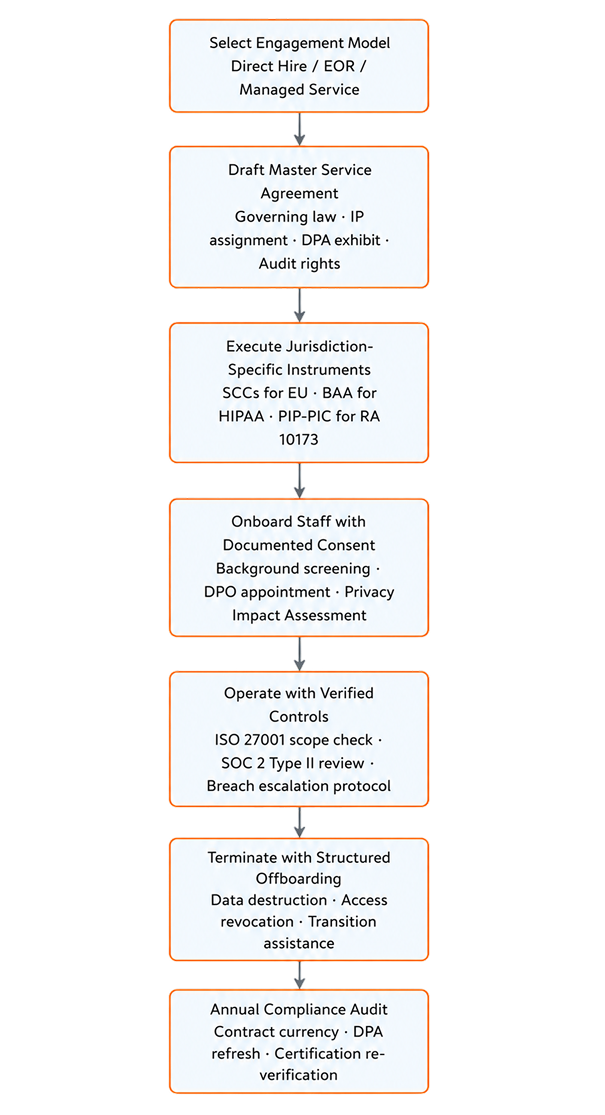
Three primary structures exist, each with materially different legal consequences. The selection must precede contract drafting, not follow it.
A compliant offshore staffing MSA is not a standard vendor services agreement with a Philippine addendum. The following clause categories are non-negotiable:
| Client Jurisdiction | Applicable Law | Required Contract Instrument | Key Obligation |
|---|---|---|---|
| European Union | GDPR (Regulation 2016/679) | Standard Contractual Clauses (SCCs) | Legitimize data transfer from EU controller to Philippine processor |
| United States — Healthcare | HIPAA | Business Associate Agreement (BAA) | Required before any PHI is shared with offshore vendor |
| United States — Financial | GLBA Safeguards Rule (16 CFR Part 314) | Service provider contractual safeguards | Ensure offshore processor maintains appropriate safeguards |
| United States — California | CCPA/CPRA | Service Provider Contract | Restrict offshore processor from selling or retaining consumer data |
| Philippines (domestic) | RA 10173 | DPA + PIP-PIC Agreement | Governs all processing by a Philippine entity |
ISO/IEC 27001 certification is widely adopted by Philippine offshore staffing and BPO providers. SOC 2 Type II reports are increasingly requested by US-based clients, particularly for accounting, finance, and healthcare-adjacent processes.
Two verification disciplines that are frequently skipped:
Background screening of offshore staff is governed by NPC guidelines on lawful processing of sensitive personal information. Checks must be proportionate to the role’s data access and risk profile, disclosed to the candidate prior to processing, and limited to information relevant to the role. The MSA should require the provider to document and retain candidate consent records for the duration of employment plus a defined retention period. Undocumented consent for background screening is a common NPC audit finding.
Treating the legal and compliance architecture as a first-order design decision — not a downstream formality — produces five durable operational advantages.
Clean IP Chain of Title from Day One
Present-tense IP assignment language, work-for-hire designation, and moral rights waivers executed at contract inception mean the foreign principal holds unambiguous title to all work-product. This matters most during M&A transactions, patent filings, and software licensing audits — precisely the moments when a chain-of-title gap is most damaging and most expensive to remediate retroactively.
Allocated Data Liability Before a Breach Occurs
A properly executed DPA, PIP-PIC agreement, and jurisdiction-specific instruments (SCCs, BAA, GLBA safeguard clauses) allocate data liability contractually before an incident occurs. When a breach happens, the question of who notifies which regulator within which timeline is already answered in the contract — not improvised under pressure. The 72-hour NPC and GDPR notification clocks do not pause for contractual ambiguity.
Labor Law Classification Certainty
Using a legitimate EOR or Philippine-registered entity as the employer-of-record cleanly resolves classification risk. The EOR is the legal employer; the foreign principal is the service recipient. This eliminates joint-and-several liability exposure for back-pay and statutory benefit deficiencies — obligations that are non-waivable under the Labor Code.
Audit-Ready Compliance Posture
Contractual audit rights, documented DPO appointments, Privacy Impact Assessments, and verified ISO/IEC 27001 scope create an audit-ready posture that satisfies both NPC inquiries and client-side due diligence. For offshore teams handling EU, healthcare, or financial data, this posture is increasingly a commercial prerequisite — not merely a regulatory one.
Structured Termination Without Data or IP Leakage
Survival clauses, data destruction certification requirements, and immediate access revocation provisions mean that contract termination does not create an uncontrolled IP or data exposure window. Transition assistance obligations — typically 30–90 days — preserve operational continuity while the offboarding is completed under documented controls.
The cost of offshore staffing legal compliance has two components: the statutory cost load embedded in the engagement structure, and the one-time and recurring costs of building the compliance framework itself.
Philippine statutory employment costs — SSS (Social Security System), PhilHealth, and Pag-IBIG (HDMF) contributions — add a mandatory load above base salary. This load is commonly estimated in the 12–15% range of gross compensation and must be factored into total cost-of-engagement modeling from the outset.
Principals who model offshore costs using base salary alone systematically underestimate the true cost of engagement. The statutory load is non-negotiable and non-waivable under Philippine law.
The 12–15% figure reflects the standard statutory contribution structure; actual percentages are subject to periodic regulatory adjustment and should be confirmed with Philippine legal counsel at the time of engagement.
| Dimension | Direct Hire (Philippine Subsidiary) | Employer-of-Record (EOR) | Managed Service / BPO |
|---|---|---|---|
| IP Ownership Default | Employer (your subsidiary) owns work-product | EOR is legal employer — explicit assignment clause required | Provider retains work-product unless MSA assigns it |
| Labor Law Exposure | Full Philippine Labor Code compliance required | EOR absorbs labor law obligations | Shared — depends on contract scope |
| Data Liability | Principal controls data processing directly | EOR acts as processor; DPA required | Provider is processor; DPA + PIP-PIC agreement required |
| Tax Treatment | Philippine corporate tax applies to subsidiary | Payroll tax obligations sit with EOR entity | Service fee structure; VAT treatment varies |
| Setup Complexity | High (SEC registration, PEZA/BOI optional) | Low-to-medium | Low |
| Control Over Staff | Maximum | Moderate | Lowest |
| Statutory Cost Load | 12–15% above base salary (SSS, PhilHealth, Pag-IBIG) | Embedded in EOR fee | Bundled into service rate |
The cost of building the legal framework — MSA drafting, DPA and PIP-PIC agreement preparation, SCC execution, BAA negotiation, DPO appointment, and Privacy Impact Assessment — is a one-time investment that scales with engagement complexity, not headcount. A single well-drafted MSA with complete exhibits serves an engagement of five or fifty offshore workers.
The recurring cost is the annual compliance audit: reviewing contract currency, refreshing DPA terms as data processing scope changes, re-verifying ISO/IEC 27001 certification scope, and confirming DPO registration status with the NPC. Operators who skip this annual review accumulate compliance drift — gaps between the contractual framework and the operational reality — that are more expensive to remediate than to prevent.
The cost of non-compliance is not theoretical. NPC penalties, GDPR supervisory authority fines, HIPAA civil monetary penalties, and IP chain-of-title litigation each carry independent financial exposure. The more operationally high cost is often the disruption to an M&A transaction or a client audit when compliance gaps surface under due diligence — at the moment when remediation is least feasible and most expensive.
A US-based financial services operator engaged a Philippine offshore staffing provider under a standard vendor services agreement. The MSA contained a confidentiality clause and a general data security provision but no DPA, no PIP-PIC agreement, and no GLBA Safeguards Rule contractual language. The offshore team processed customer financial records as part of a back-office reconciliation function.
When the operator’s primary client conducted a vendor due diligence review, the absence of a GLBA-compliant service provider contract was identified as a material gap. The operator was required to execute a retroactive DPA and GLBA safeguard addendum under time pressure — a process that took longer than anticipated because the Philippine provider’s legal counsel needed to review the instruments, and the operator’s own counsel needed to confirm the instruments satisfied the Safeguards Rule’s requirements.
The structural lesson: GLBA safeguard requirements apply to the offshore processor regardless of geographic location. The contractual instrument must be in place before data sharing begins, not retrofitted under client pressure.
A European technology company engaged a Philippine software development provider under a managed service model. The MSA assigned IP to the client but used future-tense assignment language (“Provider agrees to assign…”) rather than present-tense self-executing language. No Standard Contractual Clauses were executed for the transfer of EU resident data to the Philippine processor.
During a patent filing process, the client’s IP counsel identified that the future-tense assignment language had not been perfected by a subsequent deed of assignment. The SCC gap was identified separately during a GDPR compliance review triggered by a data subject access request.
The structural lesson: Future-tense IP assignment language requires a second act of transfer to be legally effective. Present-tense language is self-executing. SCCs must be executed before EU personal data flows to a Philippine processor — the NPC does not currently appear on the EU’s adequacy decision list.
A US-based operator in a healthcare-adjacent function engaged a Philippine offshore team to handle administrative processing that included incidental access to protected health information. No Business Associate Agreement was executed on the basis that the offshore team’s access to PHI was “incidental” and the vendor was “just a staffing provider.”
Under HIPAA, the geographic location of the business associate and the characterization of the access as “incidental” are not carve-outs. A BAA is required whenever a vendor has access to PHI in the course of providing services to a covered entity or business associate. The absence of a BAA constitutes a HIPAA violation regardless of whether a breach occurs.
Outcome: The company recovered transition costs within 8 months against annualized onshore TCE, with full run-rate savings realized from month nine onward. The asynchronous workflow design meant that AP/AR processing progressed overnight and reconciliations were ready at the start of the US business day — a throughput advantage that was not captured in the original cost model but was observed in operational performance.
Key lesson: Workflow architecture is a savings multiplier. Engagements designed for asynchronous execution extract a second-order productivity benefit that the wage differential alone does not capture.
A mid-market operator terminated an offshore staffing engagement without a structured offboarding protocol. System access credentials were not immediately revoked. No data destruction certification was obtained. The MSA’s confidentiality clause did not contain a survival provision.
Post-termination, the operator could not confirm whether proprietary process documentation retained by the offshore provider had been destroyed or returned. The absence of a survival clause meant the confidentiality obligation had technically lapsed at contract termination — the moment of highest exposure.
The structural lesson: Survival clauses, immediate access revocation, and data destruction certification are not administrative formalities. They are the controls that close the exposure window created by contract termination.
The Philippines is the primary offshore staffing destination for English-language business process functions, software development, finance and accounting, and legal support services. The legal and compliance framework governing these engagements is a layered stack of Philippine domestic law, international regulatory instruments, and client-jurisdiction requirements.
The National Privacy Commission (NPC) is the Philippine data privacy regulator. Key NPC instruments relevant to offshore staffing:
Offshore staffing providers operating under PEZA (Philippine Economic Zone Authority) registration are subject to PEZA’s own data security and operational compliance requirements in addition to NPC rules. PEZA-registered entities may offer fiscal incentives — income tax holidays and preferential tax rates — that affect the total cost structure of the engagement.
The Anti-Dummy Law (Commonwealth Act 108, as amended) restricts foreign ownership in certain business activities. Offshore staffing and BPO services are generally not restricted under the Foreign Investment Negative List, allowing 100% foreign ownership. However, activity classification matters — Philippine legal counsel should confirm that the specific service being delivered falls within the unrestricted category before structuring a wholly foreign-owned entity.
Philippine courts apply a proportionality test to post-employment restrictions. A 12-month non-compete that is narrowly scoped — specific industry segment, defined geographic market, roles directly competitive with the principal’s core business — has a better chance of surviving judicial scrutiny than a broad industry-wide restriction. Philippine courts have struck down non-competes that unreasonably restrict an individual’s right to earn a livelihood under the Labor Code and the Constitution.
The more defensible approach is to pair a narrowly drafted non-compete with robust NDAs, trade secret access controls, and non-solicitation clauses — which Philippine courts have generally upheld when reasonable in scope and duration.
For Philippine processors serving EU-based clients, a breach triggers a dual-notification obligation: notify the NPC within 72 hours and notify the EU supervisory authority within 72 hours. The MSA must specify which party bears primary notification responsibility and the internal escalation timeline — typically requiring the provider to notify the principal within 24 hours of discovery to allow the principal to meet its own regulatory deadlines.
GDPR applies to Philippine processors handling personal data of EU residents irrespective of where the processing occurs. The NPC does not currently appear on the EU’s list of jurisdictions with an adequacy decision. Standard Contractual Clauses remain the operative transfer mechanism.
The three offshore engagement models carry materially different legal, operational, and cost profiles. The table below maps each model across the dimensions most relevant to legal and compliance decision-making.
| Dimension | Direct Hire (Philippine Subsidiary) | Employer-of-Record (EOR) | Managed Service / BPO |
|---|---|---|---|
| IP Ownership Default | Employer (your subsidiary) owns work-product | EOR is legal employer — explicit assignment clause required | Provider retains work-product unless MSA assigns it |
| Labor Law Exposure | Full Philippine Labor Code compliance required | EOR absorbs labor law obligations | Shared — depends on contract scope |
| Data Liability | Principal controls data processing directly | EOR acts as processor; DPA required | Provider is processor; DPA + PIP-PIC agreement required |
| Tax Treatment | Philippine corporate tax applies to subsidiary | Payroll tax obligations sit with EOR entity | Service fee structure; VAT treatment varies |
| Setup Complexity | High (SEC registration, PEZA/BOI optional) | Low-to-medium | Low |
| Control Over Staff | Maximum | Moderate | Lowest |
| Statutory Cost Load | 12–15% above base salary (SSS, PhilHealth, Pag-IBIG) | Embedded in EOR fee | Bundled into service rate |
| DPA Required | Yes — principal is PIC; subsidiary is PIP | Yes — principal is PIC; EOR is PIP | Yes — principal is PIC; provider is PIP |
| IP Assignment Clause Required | Recommended (subsidiary-to-parent assignment) | Yes — EOR to principal | Yes — provider to principal |
| Recommended For | Long-term, high-control, high-headcount engagements | Fast-start, compliance-conscious, mid-scale engagements | Defined-output, lower-control, output-based engagements |
Philippine TCE figures include estimated statutory load (SSS, PhilHealth, Pag-IBIG, 13th-month pay) and a managed seat-rate infrastructure component. US TCE figures include estimated statutory and benefits load of 20–35% above base salary. Year-2 realized savings reflect amortized ramp costs and assume low attrition.
Non-Compete Enforceability by Jurisdiction
The offshore staffing context frequently involves staff in multiple jurisdictions. Non-compete enforceability varies materially by local law.
| Jurisdiction | Non-Compete Enforceability | Key Legal Provision | Practical Implication |
|---|---|---|---|
| Philippines | Enforced with proportionality test | Labor Code; Constitutional right to livelihood | Narrow scope, defined duration, specific industry — or risk voidance |
| Argentina | Generally unenforceable post-employment | Labor Contract Law (Ley 20.744) | Non-competes typically void; NDAs and trade secret protections are the operative instruments |
| Colombia | Limited enforceability; compensation may be required | Labor Code (Código Sustantivo del Trabajo) | Courts may require compensation for the restriction period; uncompensated clauses risk voidance |
| India | Generally unenforceable post-employment | Indian Contract Act, Section 27 | Post-employment non-competes are void as restraints of trade; in-employment restrictions are enforceable |
| United States | Varies by state; trend toward restriction | FTC rule (status subject to legal challenge); state statutes | California, Minnesota, North Dakota: effectively unenforceable; other states: enforceability depends on reasonableness |
This table reflects general legal positions and does not constitute legal advice. Engage local counsel in each relevant jurisdiction before relying on non-compete clauses as a primary protection mechanism.
The legal and compliance architecture of an offshore staffing engagement is not a one-time contract exercise. It is a living operational system that must be reviewed at three trigger points: at engagement inception, at any material change in data processing scope (new client data types, new jurisdictions, new systems access), and at contract renewal.
The most durable offshore staffing arrangements share a structural characteristic: the legal framework was designed before the commercial terms were finalized, not retrofitted afterward. IP assignment language, DPA exhibits, BAAs, and audit rights are not negotiating chips — they are the structural load-bearing elements of the engagement.
Companies that treat offshore legal compliance as a one-time contract exercise rather than a living governance framework will face compounding exposure as data privacy laws proliferate and IP disputes scale with headcount. Long-term solvency in offshore staffing depends on building jurisdiction-aware contract templates, annual compliance audits, and a dedicated data protection officer function before headcount exceeds 10 offshore workers.
For organizations currently operating offshore arrangements without a current DPA, PIP-PIC agreement, or verified ISO/IEC 27001 scope, the immediate priority is a compliance gap assessment — not a contract redraft. Identify what is missing, quantify the exposure, and sequence remediation by risk severity.
The three actions that produce the highest compliance return per unit of effort:
Execute a present-tense IP
Assignment clause in every offshore MSA — not an agreement to assign, but a self-executing transfer. This closes the chain-of-title gap that surfaces most visibly during M&A due diligence.
Appoint and register a DPO with the NPC
Before offshore headcount exceeds 10 workers processing personal data. The DPO function is both a statutory requirement for high-volume processors and the internal governance anchor for breach response.
Conduct an annual compliance audit
Covering contract currency, DPA scope alignment, ISO/IEC 27001 certification re-verification, and breach escalation protocol testing. Compliance drift — the gap between the contractual framework and the operational reality — accumulates silently and is more expensive to remediate than to prevent.
A U.S.-governed MSA does not automatically perfect IP ownership under Philippine law. Under the Intellectual Property Code of the Philippines (Republic Act 8293), work created by an employee in the course of employment is owned by the employer — which in an EOR or managed service arrangement is the Philippine entity, not the foreign principal. A U.S.-law IP assignment clause is enforceable between the contracting parties as a matter of contract, but it does not substitute for a Philippine-law Deed of Assignment where the chain of title must be recorded or enforced in the Philippines. Best practice is to execute both: a present-tense assignment clause in the MSA (self-executing as between the parties) and a separate Deed of Assignment under Philippine law for any registrable IP — patents, trademarks, and copyrights where formal recordation is required. Engage Philippine IP counsel to confirm the recordation requirements for the specific IP category at issue.
GDPR Article 28 requires that the DPA between the EU controller and the offshore processor specify the technical and organizational measures the processor implements to protect personal data. For an offshore team in India processing EU resident data, the TOMs documentation should address at minimum: (1) encryption at rest and in transit, specifying the encryption standard and key management protocol; (2) access controls, including role-based access, multi-factor authentication, and privileged access management; (3) pseudonymization or anonymization where applicable to the processing purpose; (4) physical security controls at the processing facility; (5) incident detection and response procedures, including the internal escalation timeline that enables the controller to meet the 72-hour GDPR Article 33 notification deadline; (6) data minimization and retention controls; (7) sub-processor management, including the controller’s right to approve sub-processors; and (8) audit rights enabling the controller to verify TOM implementation. India does not currently hold an EU adequacy decision; Standard Contractual Clauses must be executed alongside the DPA to legitimize the transfer. The TOMs must be documented with sufficient specificity to demonstrate compliance — a generic security policy reference is not sufficient under GDPR Article 28(3)(c).
In Argentina, post-employment non-compete clauses are generally unenforceable under the Labor Contract Law (Ley 20.744), which prohibits contractual terms that restrict a worker’s right to work after the employment relationship ends. The operative protective instruments in Argentina are NDAs and trade secret protections, which are enforceable. In Colombia, the Labor Code (Código Sustantivo del Trabajo) permits post-employment restrictions but courts have required that the employer provide compensation for the restriction period — uncompensated non-competes risk being declared void. The enforceability analysis in both jurisdictions is further complicated when the worker is classified as an independent contractor rather than an employee, as contractor agreements may be subject to different statutory frameworks. In both Argentina and Colombia, the practical approach is to treat the non-compete as a secondary instrument and build primary IP protection around robust NDAs, trade secret access controls, documented classification protocols, and non-solicitation clauses — which have a stronger enforcement track record in both jurisdictions. Engage local labor counsel in each country before relying on a non-compete clause as a primary protection mechanism.
Compliance Framework and MSA Structuring
Onboarding and Background Screening Protocols
Pricing and Engagement Modeling
Total cost-of-engagement modeling must include the statutory cost load — commonly estimated in the 12–15% range above base salary for SSS, PhilHealth, and Pag-IBIG contributions — in addition to the EOR or managed service fee. Principals who model on base salary alone systematically underestimate the true cost of engagement.
Offshore and Remote Staffing — The Broader Architecture
The legal and compliance framework documented in this guide operates within a broader offshore staffing architecture that covers talent sourcing, team structure, performance management, and distributed team operations. For a comprehensive view of how compliant offshore engagements are built from the ground up, see Offshore and Remote Staffing Solutions: How to Build a High-Performing Distributed Team.
Start the Conversation
Free EBook download
Discover how to build a high-performing remote team, reduce costs, and scale your business effortlessly. Get your free copy of The Complete Guide to Remote Staffing now!