
Offshore staffing cost savings refer to the reduction in total cost-of-employment (TCE) achieved by replacing or supplementing onshore headcount with qualified staff based in lower-wage labor markets — most commonly the Philippines for English-language, finance, and back-office roles. The gross wage differential and the net realized savings are two different numbers. Practitioners consistently cite a 40–70% reduction in fully-loaded onshore equivalent TCE as the achievable range, with realized outcomes determined almost entirely by implementation quality, not by the headline wage gap alone.

The structural gap between US and Philippine labor costs is not a loophole or an arbitrage trick that will close next quarter. It is anchored in purchasing power parity, cost-of-living indices, and a labor market that has spent two decades building English-proficient, technically trained talent pipelines specifically for export-oriented services. That structural reality is durable. What erodes savings is poor implementation — unmodeled statutory costs, attrition, ramp time, and compliance overhead that practitioners routinely undercount.
The gross wage differential is real. It is also the least useful number in your financial model. Philippine skilled accounting and finance professionals — bookkeepers, junior accountants, accounts payable/receivable specialists — typically earn base salaries that are 60–76% lower than their US counterparts on a direct currency-converted basis. This is an illustrative range derived from publicly observable wage data across Metro Manila, Cebu, and secondary cities; actual figures vary by role seniority, industry, and provider.
US onshore baselines (base salary only, before employer load) illustrate the gap:
Beyond base salary, US employers carry a statutory and benefits load estimated at 20–35% above base salary:
| Cost Component | Estimated Range (% of Base) |
|---|---|
| FICA (Social Security + Medicare) | ~7.65% (statutory) |
| FUTA / SUTA (unemployment insurance) | 1–4% (varies by state) |
| Employer-sponsored health insurance | 8–15% (varies by plan) |
| Paid leave (PTO, sick, holidays) | 4–8% |
| Retirement contributions (401k match) | 2–5% |
| Total statutory + benefits load | ~20–35% |
A US-based bookkeeper earning $48,000 in base salary costs the employer $57,600–$64,800 in fully-loaded TCE before adding equipment, office space, software licenses, or HR administration overhead.
Philippine statutory employer contributions — covering the Social Security System (SSS), Philippine Health Insurance Corporation (PhilHealth), and the Home Development Mutual Fund (Pag-IBIG) — are generally estimated at 12–15% above base salary. The Labor Code of the Philippines and Presidential Decree No. 851 additionally mandate:
The Philippine statutory load is materially lower than the US equivalent, but it is not zero. Models that treat offshore labor as “salary only” are wrong by 12–15% before the engagement starts.
Accurate offshore TCE modeling requires five distinct cost layers. Collapsing any of them produces a savings projection that will not survive contact with year-one actuals.
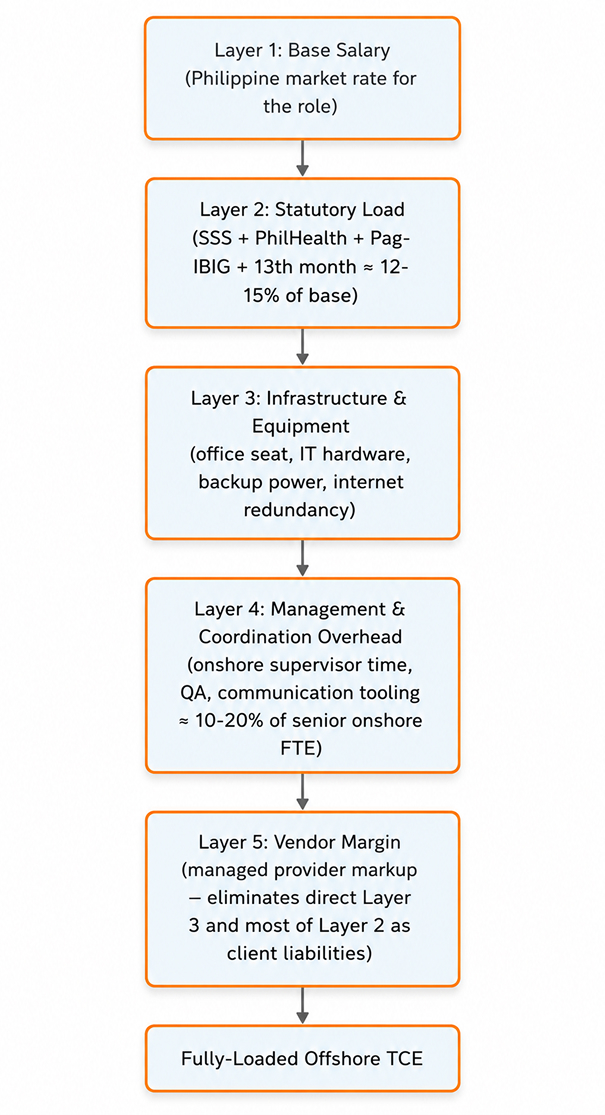
Practitioner experience across finance and accounting back-office roles consistently produces savings estimates in the 40–70% range of fully-loaded onshore equivalent TCE. That is a wide band, and the following variables determine where you land.
Conditions that produce ceiling-level savings (60–70%):
Conditions that compress savings toward the floor (38–45%):
The break-even formula for offshore staffing is straightforward:
Break-even point = One-time transition costs ÷ Monthly gross savings (onshore TCE − offshore seat rate)
Transition costs include process documentation and workflow mapping, systems access provisioning and IT setup, training hours (onshore staff time + offshore staff ramp time), and a productivity ramp period typically lasting 60–120 days for skilled finance and accounting roles.
For most modeled scenarios involving finance and accounting back-office roles, break-even occurs within 6–18 months of go-live. Engagements that break even in under six months typically involve roles with minimal ramp complexity and providers that absorb transition support costs. Engagements that take 18+ months to break even usually involve underestimated documentation debt or first-year attrition.
The Philippine peso-to-US dollar exchange rate introduces a foreign exchange risk variable that belongs in every cost model.
A 5–10% peso appreciation over a two-year engagement can meaningfully compress realized savings in a direct-hire structure. If you are running a direct offshore entity, model at least two FX scenarios: base case and a 10% peso appreciation scenario. If the savings case collapses under the stress scenario, the managed seat-rate model is the more defensible structure.
Every offshore savings projection should be stress-tested against this checklist before it becomes a board-level commitment:
A savings projection that cannot survive this checklist is a marketing number, not a financial model.
Before any offshore comparison is meaningful, calculate the fully-loaded cost of each role you are evaluating for transition. Add the US statutory and benefits load (estimated at 20–35% above base salary) to base compensation, then layer in equipment, software licenses, and a proportional share of HR administration overhead. This is your onshore TCE baseline — the number against which offshore savings will be measured.
Identify the Philippine market rate for the equivalent role in Metro Manila, Cebu, or your target secondary city. Add the Philippine statutory load (estimated at 12–15% above base salary, inclusive of SSS, PhilHealth, Pag-IBIG, and 13th-month pay). If using a managed offshore staffing provider, the quoted seat rate should already bundle these statutory obligations plus infrastructure and vendor margin — confirm this in writing before signing.
Quantify the productivity ramp as a one-time cost: offshore staff typically operate at 50–65% of full productivity in the first 30 days, rising to 75–85% by day 60, and reaching full productivity by day 90–120 depending on role complexity and process documentation quality. Calculate the output gap and add it to the transition cost line. Divide total transition costs by monthly gross savings to determine break-even month.
Run the savings projection through the hidden cost checklist: attrition probability, management overhead hours, cybersecurity tooling cost, compliance setup cost, rework rate, FX scenario (base and 10% peso appreciation), and shift premium if US-hours coverage is required. A projection that survives this stress test is a financial model. One that does not is a marketing number.
Three delivery structures are available, each with a different cost-predictability profile:
| Cost Component | Estimated Range (% of Base) |
|---|---|
| FICA (Social Security + Medicare) | ~7.65% (statutory) |
| FUTA / SUTA (unemployment insurance) | 1–4% (varies by state) |
| Employer-sponsored health insurance | 8–15% (varies by plan) |
| Paid leave (PTO, sick, holidays) | 4–8% |
| Retirement contributions (401k match) | 2–5% |
| Total statutory + benefits load | ~20–35% |
For most US accounting practices and back-office operations in the $5–30M revenue band, the managed seat-rate model produces the highest cost predictability and the lowest compliance overhead, even though its per-head rate exceeds the direct-hire equivalent.
Time-zone architecture is a workflow design requirement, not a constraint to be ignored. Philippine Standard Time (UTC+8) creates a significant overlap gap with US time zones:
| US Time Zone | Business Hours (Local) | Philippine Equivalent |
|---|---|---|
| Eastern (ET) | 9am–5pm | 9pm–5am (next day) |
| Central (CT) | 9am–5pm | 8pm–4am (next day) |
| Mountain (MT) | 9am–5pm | 7pm–3am (next day) |
| Pacific (PT) | 9am–5pm | 6pm–2am (next day) |
Engagements designed for asynchronous execution — end-of-day handoffs, morning deliverables, structured communication protocols — extract the time-zone gap as a productivity advantage. Engagements that require real-time US-hours availability impose shift premiums and burnout risk that directly increase attrition and compress savings.
For a comprehensive framework on building distributed teams that integrate these workflow principles, see Offshore and Remote Staffing Solutions: How to Build a High-Performing Distributed Team.
Structural Labor Cost Reduction
The primary benefit is a durable reduction in fully-loaded TCE for back-office and finance roles. At steady state (year two onward, low attrition), practitioners consistently observe 55–65% reduction in fully-loaded cost per role compared to onshore equivalents. This is not a one-year arbitrage — it is a structural labor cost advantage anchored in purchasing power parity and a mature talent pipeline.
Scalability Without Proportional Overhead Growth
Offshore staffing enables headcount scaling — including seasonal or project-based scaling — without the fixed cost of permanent US hires. A mid-market CPA firm that added four tax preparation support associates for the January–April peak period avoided the fixed cost of carrying permanent headcount through eight months of sub-peak utilization. (Anonymized composite case study.) The financial benefit is not just the wage differential — it is the avoided cost of permanent headcount at sub-peak utilization.
Faster Time-to-Fill Than the US Market
In a tight US labor market for accounting talent, the time-to-fill for an experienced bookkeeper or staff accountant can run 60–90 days. Offshore staffing providers operating in the Philippine IT-BPM sector can typically provision qualified candidates in two to four weeks for standard back-office roles. This reduces the opportunity cost of unfilled roles during peak seasons.
Asynchronous Productivity Advantage
The primary benefit is a durable reduction in fully-loaded TCE for back-office and finance roles. At steady state (year two onward, low attrition), practitioners consistently observe 55–65% reduction in fully-loaded cost per role compared to onshore equivalents. This is not a one-year arbitrage — it is a structural labor cost advantage anchored in purchasing power parity and a mature talent pipeline.
Cost Predictability Through Managed Seat Rates
Dollar-denominated managed seat-rate contracts eliminate FX risk, bundle statutory compliance obligations, and convert variable HR and infrastructure costs into a fixed monthly line item. For businesses without treasury infrastructure to manage currency exposure, this predictability has standalone financial value beyond the wage differential.
Compliance Infrastructure as a Byproduct
A properly structured offshore engagement — with Data Processing Agreements, cybersecurity controls, and documented supervision protocols — builds compliance infrastructure that benefits the broader business. For US CPA firms, the AICPA Code of Professional Conduct compliance framework required for offshore tax preparation support also strengthens the firm's overall data security posture.
The monthly seat rate quoted by a managed offshore staffing provider is not the total cost of the engagement. The fully-loaded offshore TCE includes the seat rate plus onshore management overhead, cybersecurity tooling, compliance setup (amortized), and any shift premium for US-hours coverage. Model all of these before approving the engagement.
| Role | US Fully-Loaded TCE (Est.) | Philippine Fully-Loaded TCE (Est.) | Gross Savings (Est.) |
|---|---|---|---|
| Bookkeeping Clerk | $58,000–$68,000/yr | $14,000–$20,000/yr | 65–75% |
| Staff Accountant | $72,000–$92,000/yr | $18,000–$28,000/yr | 65–75% |
| Accounts Payable Specialist | $55,000–$70,000/yr | $13,000–$19,000/yr | 65–75% |
| Financial Analyst (Junior–Mid) | $88,000–$115,000/yr | $22,000–$35,000/yr | 65–75% |
| Tax Preparation Support | $60,000–$80,000/yr | $16,000–$24,000/yr | 65–75% |
Transition costs are front-loaded and include:
These costs are one-time-heavy and recurring-light for most engagements. They belong in the break-even model, not as a footnote.
| Delivery Structure | Pricing Model | FX Risk | Compliance Burden |
|---|---|---|---|
| Direct offshore entity | Variable (peso-denominated payroll + CapEx) | Client-borne | High |
| Managed seat-rate provider | Fixed monthly (dollar-denominated) | Provider-borne | Low (bundled) |
| Hybrid onshore-offshore team | Mixed | Mixed | Mixed |
For offshore team pricing and engagement models details on how managed seat rates are structured, confirm that the quoted rate explicitly includes all Philippine statutory obligations, infrastructure, and vendor margin.
13th-month pay is a mandatory statutory obligation under Presidential Decree No. 851. A compliant managed offshore staffing provider will have already factored it into the monthly seat rate. If a provider’s seat rate does not include 13th-month pay, that is a compliance red flag and a future liability that will surface as a year-end invoice adjustment. Always confirm in writing that the quoted seat rate is fully inclusive of all Philippine statutory obligations.
Anonymized composite case studies referenced in this section are based on practitioner engagements and illustrative modeling. They do not represent the financial results of any specific named organization.
A US-based accounting practice in the $5–15M revenue band transitioned two full-time bookkeeping roles offshore. The practice modeled all five TCE layers before go-live: base salary, SSS/PhilHealth/Pag-IBIG statutory load, 13th-month pay, managed seat-rate infrastructure, and a 90-day productivity ramp.
Outcome: The practice realized approximately 50–55% reduction in fully-loaded cost per role in year one, improving to approximately 60% in year two as ramp costs amortized. The engagement reached break-even within the projected 8–12 month window. The primary variable that protected the savings trajectory was low attrition — both offshore staff members were retained through year two.
Key lesson: Proper upfront modeling of statutory load and ramp costs produced a year-one result that matched the projection. The savings improvement from year one to year two was entirely attributable to ramp cost amortization, not to any change in the underlying wage differential.
A composite professional services firm projected 60% savings on an offshore back-office engagement but failed to model attrition-related replacement costs. When one offshore staff member departed in month seven, the replacement and retraining cycle consumed approximately three to five months of the gross savings differential.
Outcome: Realized year-one savings eroded to approximately 38% — well below the projected 60%. The firm implemented a structured retention program in year two — performance bonuses, career pathing, team culture investment — and restored the savings trajectory.
Key lesson: Attrition is the single largest hidden cost variable in offshore staffing. Retention programs are not a soft HR concern; they are a financial instrument that protects the savings trajectory.
A composite US e-commerce company offshored accounts payable and receivable processing to a managed offshore staffing provider. The engagement was structured with dollar-denominated contracts (eliminating FX risk), asynchronous workflow design (end-of-day handoffs, morning deliverables), and pre-modeled cybersecurity tooling costs.
Outcome: The company recovered transition costs within 8 months against annualized onshore TCE, with full run-rate savings realized from month nine onward. The asynchronous workflow design meant that AP/AR processing progressed overnight and reconciliations were ready at the start of the US business day — a throughput advantage that was not captured in the original cost model but was observed in operational performance.
Key lesson: Workflow architecture is a savings multiplier. Engagements designed for asynchronous execution extract a second-order productivity benefit that the wage differential alone does not capture.
A mid-market CPA firm with high-volume tax season workload used offshore staffing to add four tax preparation support associates for the January–April peak period. The flexible engagement model avoided the fixed cost of four permanent US hires while covering seasonal demand.
Outcome: The financial benefit was not just the wage differential — it was the avoided cost of carrying permanent headcount through eight months of sub-peak utilization. The firm also avoided the 60–90-day US time-to-fill timeline by provisioning offshore candidates in two to four weeks.
Key lesson: Scalability is the undervalued second-order benefit of offshore staffing. The savings model should include avoided fixed headcount costs, not just the wage differential on active roles.
The Philippines is not simply a low-cost labor market. It is a labor market that has spent two decades building English-proficient, technically trained talent pipelines specifically for export-oriented services. The IT-BPM sector — which encompasses finance and accounting process outsourcing, among other functions — is a mature, regulated industry with established talent supply chains in Metro Manila, Cebu, Clark, Davao, and secondary cities.
For US accounting practices and back-office operations, the Philippines offers a combination of factors that no other offshore market replicates at scale: English proficiency at the professional level, familiarity with US GAAP and tax frameworks, a large pool of CPA-qualified and accounting-trained professionals, and a regulatory environment that supports structured data privacy compliance under the Philippine Data Privacy Act of 2012 (Republic Act 10173).
Philippine employer statutory contributions are non-negotiable and apply to all rank-and-file employees regardless of whether the employer is a local entity or a foreign-owned offshore staffing operation:
The combined employer statutory load is generally estimated at 12–15% above base salary. This is not optional, and it is not negotiable. Any offshore staffing model that excludes these obligations from the cost model is structurally incorrect.
Offshore engagements that involve the personal data of US clients or customers must be governed by properly structured Data Processing Agreements (DPAs) under the Philippine Data Privacy Act of 2012 (Republic Act 10173). Where applicable, NPC-mandated Personal Information Processor (PIP) and Personal Information Controller (PIC) agreements are required.
For US CPA firms, AICPA client confidentiality rules and applicable state board regulations layer additional compliance requirements on top of Philippine data privacy obligations. Compliance setup costs — legal review and execution of DPA/PIP-PIC agreements, cybersecurity tooling, staff training on data handling protocols, and ongoing audit and monitoring overhead — are one-time-heavy and recurring-light. They belong in the break-even model, not as a footnote.
Philippine offshore delivery centers operating in the IT-BPM sector routinely accommodate US-hours shifts, but this requires explicit shift differential compensation and should be reflected in the seat rate or direct salary model. For standard back-office roles, managed providers can typically provision qualified candidates in two to four weeks — compared to a 60–90-day US time-to-fill for equivalent roles.
The talent pipeline is deepest in Metro Manila and Cebu, with growing capacity in Clark, Davao, and Iloilo. Secondary cities offer lower base salary benchmarks than Metro Manila, which can further compress the Philippine TCE — but talent depth for specialized roles (senior accountants, financial analysts, tax specialists) is more concentrated in Metro Manila and Cebu.
Philippine Standard Time (UTC+8) is fixed — the Philippines does not observe daylight saving time. This means the overlap gap with US time zones is consistent year-round, unlike engagements with European or Latin American offshore locations where seasonal time changes affect the overlap window.
For US accounting practices, the absence of daylight saving time in the Philippines simplifies workflow scheduling and eliminates the twice-yearly disruption that affects other offshore locations. Asynchronous workflow design — end-of-day handoffs, morning deliverables, structured communication protocols — is the standard operating model for Philippine IT-BPM engagements and is well-supported by the local delivery infrastructure.
For a broader view of how distributed team architecture integrates Philippine offshore staffing with onshore operations, see Offshore and Remote Staffing Solutions: How to Build a High-Performing Distributed Team.
| Role | US Fully-Loaded TCE (Est.) | Philippine Fully-Loaded TCE (Est.) | Gross Savings (Est.) | Typical Realized Savings (Year 2) |
|---|---|---|---|---|
| Bookkeeping Clerk | $58,000–$68,000/yr | $14,000–$20,000/yr | 65–75% | 55–65% |
| Staff Accountant | $72,000–$92,000/yr | $18,000–$28,000/yr | 65–75% | 55–65% |
| Accounts Payable Specialist | $55,000–$70,000/yr | $13,000–$19,000/yr | 65–75% | 55–65% |
| Financial Analyst (Junior–Mid) | $88,000–$115,000/yr | $22,000–$35,000/yr | 65–75% | 55–65% |
| Tax Preparation Support | $60,000–$80,000/yr | $16,000–$24,000/yr | 65–75% | 55–65% |
Philippine TCE figures include estimated statutory load (SSS, PhilHealth, Pag-IBIG, 13th-month pay) and a managed seat-rate infrastructure component. US TCE figures include estimated statutory and benefits load of 20–35% above base salary. Year-2 realized savings reflect amortized ramp costs and assume low attrition.
Delivery Structure Comparison
| Delivery Structure | Cost Predictability | FX Risk | Compliance Burden | Best Fit |
|---|---|---|---|---|
| Direct offshore entity | Lower (variable CapEx + HR) | Client-borne (peso-denominated) | High (direct statutory liability) | Large operations with in-house HR/legal |
| Managed seat-rate provider | High (fixed monthly rate) | Provider-borne (dollar-denominated) | Low (bundled in seat rate) | $5–30M revenue band; most US practices |
| Hybrid onshore-offshore team | Medium | Mixed | Mixed | Transitional or partially documented workflows |
Savings Trajectory: Year One vs. Year Two
| Scenario | Year-One Realized Savings | Year-Two Realized Savings | Primary Variable |
|---|---|---|---|
| Best case (low attrition, documented processes) | 50–55% | 60–65% | Ramp cost amortization |
| Base case (moderate attrition, partial documentation) | 42–50% | 55–60% | Attrition + ramp overlap |
| Stress case (high attrition, undocumented processes) | 35–42% | 45–55% | Replacement cost + rework |
| Engagement Type | Typical Break-Even | Key Driver |
|---|---|---|
| Simple back-office roles, managed provider | 6–9 months | Low ramp complexity, provider absorbs transition support |
| Finance/accounting roles, partial documentation | 9–14 months | Ramp period + documentation debt |
| Complex or regulated roles, direct-hire structure | 14–18 months | Compliance setup + CapEx + ramp |
The 40–70% savings range cited across practitioner experience is structurally achievable for finance and accounting back-office roles in the Philippines. The realized figure — what actually lands in your P&L — is determined almost entirely by implementation quality, not by the gross wage differential.
Three variables have the highest leverage on realized savings:
Attrition
The single largest hidden cost variable. Retention programs are not a soft HR concern; they are a financial instrument that protects your savings trajectory.
Process documentation quality
Engagements that begin with well-documented workflows reach full productivity in 60–90 days. Engagements that begin with undocumented processes take 120–180 days and generate rework costs throughout.
Cost model completeness
Statutory load, FX risk, compliance overhead, and management time must be in the model before the engagement is approved, not discovered in the year-one reconciliation.
For most US accounting practices and back-office operations in the $5–30M revenue band, a properly structured offshore engagement with a managed provider reaches break-even within 8–12 months and delivers 55–65% fully-loaded cost reduction at steady state. That is a durable structural advantage — not a one-year experiment.
Offshore staffing cost savings are not a one-time arbitrage play but a structural lever for long-term labor cost optimization — businesses that build repeatable offshore hiring frameworks, integrate EOR compliance infrastructure, and benchmark compensation annually against local market rates will sustain 50–65% cost advantages while scaling headcount without proportional overhead growth.
Transfer pricing rules and permanent establishment (PE) risk are material considerations for any US business making recurring payments to a related offshore entity — and they are frequently undermodeled. If the offshore staffing entity is a related party (e.g., a wholly owned Philippine subsidiary), payments between the US parent and the Philippine entity must be priced at arm’s length under both US transfer pricing regulations (IRC §482) and Philippine Bureau of Internal Revenue rules. Failure to document arm’s-length pricing exposes the US parent to transfer pricing adjustments and penalties. PE risk arises when the offshore entity’s activities — particularly if it exercises authority to conclude contracts on behalf of the US parent — could be characterized as creating a taxable presence in the Philippines for the US entity. Managed offshore staffing providers structured as independent contractors or employer-of-record entities generally mitigate PE risk by maintaining a clear separation between the staffing provider’s legal obligations and the client’s operational direction. Confirm the PE risk analysis with qualified tax counsel before selecting a delivery structure, and ensure the engagement agreement explicitly addresses the nature of the relationship.
EOR markup fees are the margin layer that a managed offshore staffing provider adds above the direct employment cost (base salary + statutory load + infrastructure). These markups are not inherently unreasonable — they compensate the provider for absorbing statutory compliance liability, FX risk, HR administration, and infrastructure CapEx — but they must be explicitly modeled in the TCE calculation rather than treated as a black-box seat rate. Hidden or underspecified EOR fees typically surface in three forms: (1) year-end statutory adjustment invoices for 13th-month pay or SSS/PhilHealth/Pag-IBIG true-ups that were not bundled into the quoted seat rate; (2) technology or platform fees charged separately from the seat rate; and (3) recruitment or replacement fees triggered by attrition that were not disclosed in the original contract. To model EOR costs correctly, require the provider to itemize: base salary, statutory load (by component), infrastructure cost, and vendor margin — separately. A seat rate that cannot be decomposed into these four layers is not a transparent pricing model. See offshore team pricing and engagement models for how a fully itemized seat rate should be structured.
Several global HRIS and payroll platforms are designed to support multi-currency, multi-jurisdiction payroll consolidation, but platform selection alone does not resolve co-employment liability — the legal structure of the engagement does. Co-employment liability arises when the client exercises sufficient control over offshore workers (hiring, firing, day-to-day direction, performance management) that a court or regulator could characterize the relationship as a direct employment relationship, bypassing the staffing provider. The platform must be configured to route payroll through the EOR entity — not the client — and the engagement agreement must clearly delineate which party holds employer-of-record status. When evaluating platforms for hybrid onshore-offshore teams, confirm: (1) the platform supports peso-denominated payroll with automatic statutory deduction calculations for SSS, PhilHealth, and Pag-IBIG; (2) it generates Philippine Bureau of Internal Revenue-compliant payroll records; (3) it does not create a data residency conflict by storing Philippine employee PII on servers outside the Philippines without appropriate cross-border data transfer agreements under the Philippine Data Privacy Act.
For roles that handle customer PII subject to GDPR or CCPA, data residency and cross-border transfer compliance adds a real cost layer to the offshore engagement — and it is non-negotiable overhead, not an optional add-on. Under GDPR, transferring personal data of EU residents to the Philippines requires either an adequacy decision (not currently in place for the Philippines) or appropriate safeguards — most commonly Standard Contractual Clauses (SCCs) incorporated into the Data Processing Agreement between the US/EU controller and the Philippine processor. Under CCPA, the primary contractual requirement is a service provider agreement that prohibits the offshore entity from selling or using California consumer personal information for any purpose other than performing the contracted services. The cost impact is threefold: (1) legal fees for drafting and executing SCCs, DPAs, and service provider agreements — a one-time cost that should be modeled in the transition cost line; (2) cybersecurity tooling to enforce data residency requirements (e.g., restricting data access to Philippine-based endpoints, implementing data loss prevention controls) — an ongoing per-seat cost estimated at $150–300 per seat per month for regulated-industry engagements; and (3) ongoing audit and monitoring overhead to demonstrate compliance. Required contractual clauses in offshore staffing agreements for PII-handling roles include: data processing purpose limitation, sub-processor disclosure and approval rights, breach notification timelines (72 hours for GDPR), data subject rights fulfillment obligations, and data deletion or return provisions on contract termination.
Build Your Role-Level TCE Model First
Review the KineticStaff Onboarding Framework
The transition timeline — process documentation, systems access provisioning, ramp period, and break-even projection — is predictable when it is structured correctly. Review the onboarding framework to understand what the first 90 days of an offshore engagement look like in practice, and what documentation and tooling are required before go-live.
Explore Fully-Loaded Seat Rate Structures
A seat rate that cannot be decomposed into base salary, statutory load, infrastructure, and vendor margin is not a transparent pricing model. Explore how KineticStaff structures fully-loaded seat rates and confirm that the quoted rate is inclusive of all Philippine statutory obligations — SSS, PhilHealth, Pag-IBIG, and 13th-month pay — before signing.
Understand the Compliance Framework
For US CPA firms, RIA firms, and financial services back-office operations, the compliance layer — Data Processing Agreements, cybersecurity controls, AICPA Code of Professional Conduct alignment, and Philippine Data Privacy Act obligations — is non-negotiable overhead. Review the compliance framework to understand what contractual and operational controls are required for a properly structured offshore engagement.
Explore the Broader Offshore Staffing Architecture
Start with a Pilot Engagement
For most US accounting practices and back-office operations in the $5–30M revenue band, the lowest-risk entry point is a two-role pilot engagement with a managed offshore staffing provider. A pilot engagement allows the business to validate the workflow architecture, ramp timeline, and cost model against actual results before scaling headcount. Break-even on a two-role pilot typically occurs within 8–12 months; the data from the pilot informs the scaling decision with real operational evidence rather than projected savings.
Contact KineticStaff to begin a role-level TCE assessment and pilot engagement scoping.
Free EBook download
Discover how to build a high-performing remote team, reduce costs, and scale your business effortlessly. Get your free copy of The Complete Guide to Remote Staffing now!